The fastest way to turn emails into tasks is to use your inbox’s built-in conversion feature (Outlook’s drag-to-Tasks or Gmail’s Tasks panel) for one-off items, and automation rules for anything that repeats. Manual capture works fine at low volume; once the same type...
A hobby project planner is a tool, template, or notebook system that helps you capture ideas and, more importantly, always know your single next physical action. Right now, pick one tool, however basic, and write down the very next step for your current project....
AI agents reclaim your schedule by auto-scheduling tasks, defending focus blocks, and resolving conflicts before you even notice them, but only when you keep human-in-the-loop controls turned on. The strongest results come from task-first tools that unify your to-do...
AI goal planning converts a single sentence of intent, like “I want to get fit” or “I want a promotion,” into a measurable SMART goal with milestones, weekly tasks, and deadlines already attached. Within minutes, you get a concrete plan for the next seven days plus...
A life management system is a compact loop: capture what hits you, prioritize it, schedule it, and review it on a set cadence. That’s the whole mechanism. Everything else, from Pomodoro timers to color-coded calendars, just fills in the loop. The single best first...
The best marketing planner for freelancers fits on one page, ties to a single measurable outcome, and runs on a weekly rhythm with a fixed monthly review. That’s it. No 40-tab spreadsheet, no funnel diagram with seventeen boxes. Just one page: who you serve, what...
Start with a simple template that has defined fields, a 4 to 6 week working window, and one owner per item. Assign a status to every entry (idea, draft, review, scheduled, published) so nobody has to ask “where is this?” in a Slack thread. Your next move: open a...
Run this every morning: scan your calendar for two minutes, pick three Most Important Tasks (MITs), assign each one a rough time block, add a 15% buffer, then lock the plan and walk away. That is a complete daily planning routine, and it takes 5 to 10 minutes if you...
A weekly planning routine that actually works comes down to three moves: reflect on last week, gather everything competing for your attention, then plan your top priorities into real time slots. Do it in that order and the whole thing takes 20 to 30 minutes for a...
Your net worth is total assets minus total liabilities — and tracking it over time turns a single number into a trend you can actually act on. Here’s how to get a working snapshot in the next hour, then keep it current in under 15 minutes a month. Quick-start steps:...
Calendar Finance Integration: How to Automate Money Events
Calendar finance integration works best when you match the method to the job: native iCal feeds or a calendar-first finance app for visibility, middleware like Zapier or IFTTT for quick pilots, and API plus webhooks for anything running in production. Most finance teams should start with a feed or a no-code automation to prove the workflow, then graduate to API/webhooks once volume or reliability demands it. Security, ownership, and maintenance are not optional add-ons. They decide whether the integration survives past month three.
TL;DR:
Starting with native iCal feeds is ideal for quick, read-only visibility, but they do not support triggering downstream actions.
Middleware platforms like Zapier or IFTTT enable low-code automation, yet they require ongoing maintenance and can become costly with many workflows.
API and webhook integrations offer real-time, high-volume automation control but demand dedicated engineering resources and continuous oversight.
Team governance should involve assigning clear ownership, staging calendars by purpose, and linking events to source records for accountability and clarity.
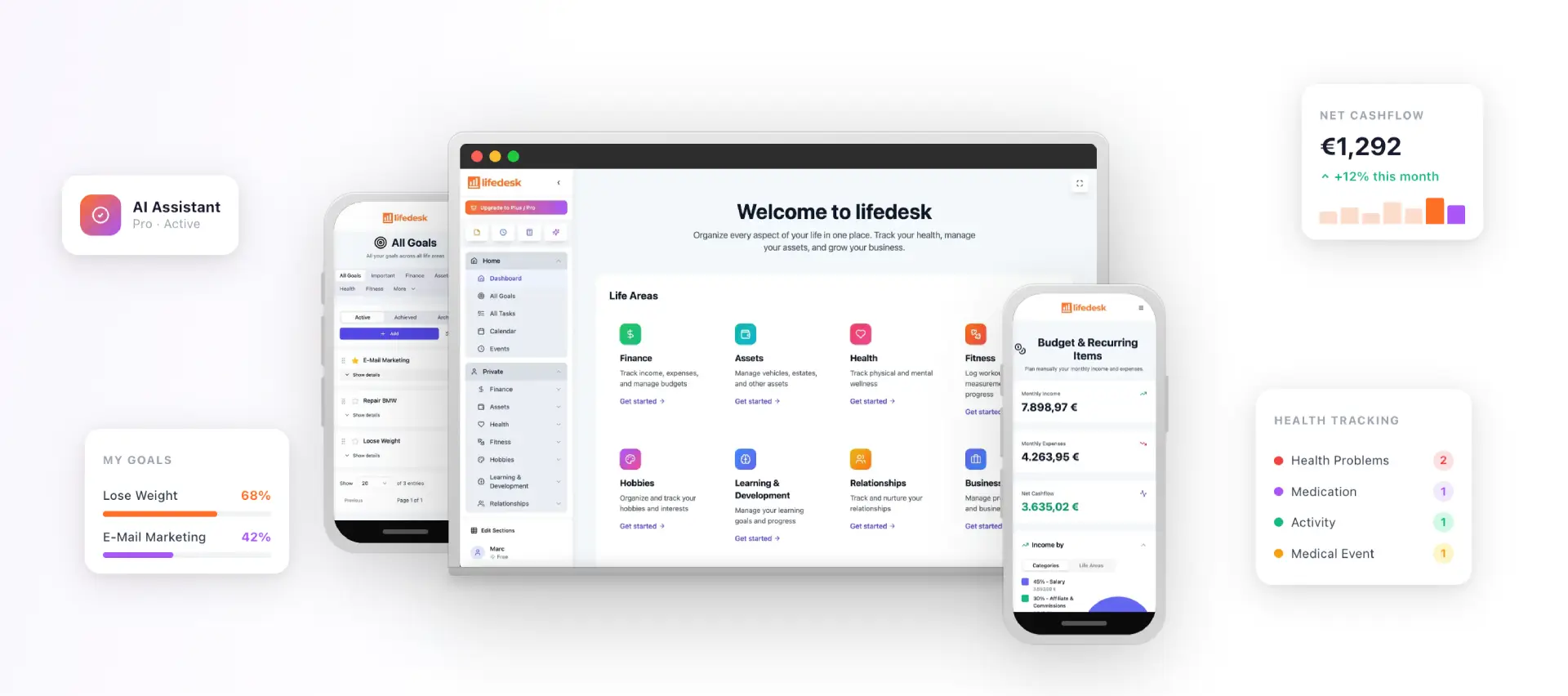
Simplifying setup and ongoing management is available through integrated platforms like LifeDesk, which combine finance tracking and calendar functions in one secure workspace.
What Are the Main Ways to Connect Your Calendar and Finances?
Four approaches cover almost every calendar finance integration use case, and each fits a different stage of maturity.
Native calendar feeds (iCal) are the simplest option. A finance tool publishes a read-only subscription link, and your calendar app (Google, Apple, Outlook) polls it for updates. Calendar for YNAB does exactly this, syncing transaction data into your existing calendar and refreshing roughly every 15 minutes. You get visibility with almost no setup risk, since there is no write access to worry about. The trade-off is flexibility. You can view events, but you can’t trigger downstream actions from them.
Calendar-first finance apps flip the model: instead of bolting a calendar onto your finance data, they build the calendar around it. Tools like Cash Flow Calendar plot income and bills directly on dates and project your daily balance forward, which is far more useful for spotting a tight week than a monthly summary buried in a spreadsheet. These apps suit freelancers and finance teams tracking irregular income streams particularly well.
Middleware platforms (Zapier, IFTTT) sit between your finance data and your calendar, triggering actions on events like a stock price crossing a threshold or an invoice becoming overdue. IFTTT alone lists 18 ready-made Finance-to-Google-Calendar applets, and building a custom one takes minutes, not days. The catch: every automation you add is another moving part someone has to maintain, and middleware can get expensive or brittle once you’re running dozens of workflows.
API and webhook integrations give you the most control. You build a direct connection between your finance system and the calendar’s API, triggered by webhooks the moment something changes. This is the only approach built for real-time, high-volume, production-grade automation, though it demands engineering time and ongoing upkeep.
Native feeds: setup in under an hour, read-only, best for visibility
Calendar-first apps: setup in a day, best for forecasting and irregular income
Middleware: setup in hours, best for pilots and low-volume triggers
API/webhooks: setup in days to weeks, best for scale and reliability
How Do You Build a Trigger-to-Calendar Automation?
Every calendar finance integration, regardless of platform, follows the same three-step pattern: trigger, transform, calendar event. Something happens in your finance system (an invoice is issued, a bill comes due, a price hits a threshold). That data gets reshaped into the fields a calendar event needs. Then it gets written to the calendar.
The mapping matters more than people expect. At minimum, map these fields:
Date and time — when the obligation or event actually occurs, not when it was created
Amount — the dollar figure, formatted consistently across every event type
Account — which account or ledger the transaction touches
Owner — who is responsible for acting on it
Link to proof — a URL back to the invoice, receipt, or source record
Skip the “link to proof” field and you’ll spend hours later hunting down which invoice a stray calendar event refers to.
Building a middleware flow (Zapier or IFTTT):
Authenticate both apps, granting the minimum access scope each requests
Pick your trigger (new invoice, bill due date, price alert)
Map the trigger’s data fields to your calendar event template
Test with a dummy transaction before going live
Enable the automation and monitor the first week closely
Building an API/webhook flow:
Create a dedicated service account rather than using a personal login
Subscribe to the relevant webhook (new transaction, invoice status change)
Transform the incoming payload into the calendar API’s event schema
POST the event to the calendar API and log the response
A concrete example: an invoice hits its due date in 14 days. The webhook fires, your transform step builds an event titled “Invoice #4471 due, Acme Corp, $3,200,” and the API call creates a calendar entry linking straight back to the invoice record. Anyone on the team can click through without opening the accounting system first.
Pro Tip:Build your first automation around one invoice type or one alert category, not your entire finance stack. Prove the trigger-to-calendar loop works cleanly on a narrow slice before you scale it to every workflow you own.
What Are the Best Use Cases for Calendar Finance Integration?
The most common calendar finance integration patterns cluster around a handful of recurring finance jobs.
Cash-flow and budget calendars. Displaying every incoming and outgoing transaction on the date it lands gives you a day-by-day balance projection instead of a monthly guess. This approach is especially valuable for freelancers and teams with irregular income, since it surfaces a tight cash day two weeks before it hits rather than after.
Close calendars. Month-end and quarter-end reconciliation tasks map naturally to calendar events, each with an assigned owner and a dependency chain. If the bank reconciliation task depends on the prior day’s transaction import finishing, that dependency belongs in the event description, not in someone’s memory.
Price and market alerts. Threshold-based automations, like the IFTTT applets that fire when a stock crosses a set price, convert market-watching from a manual habit into a calendar event that shows up when it matters.
Billing and client workflows. Scheduling invoice follow-ups as calendar events, each linked back to the original billing record, turns “chase overdue invoices” from a vague ongoing task into a specific list of dated actions.
Shared household or team finance calendars. A shared calendar view of upcoming bills and income cuts down on the recurring check-in meeting. Instead of asking “what’s coming up,” everyone looks at the same scrollable calendar and sees it directly.
How Do You Keep a Finance Calendar Integration Secure?
Calendar events built from financial data carry real risk if they’re mishandled, so security decisions here deserve the same scrutiny as any other financial system.
Grant the narrowest OAuth scope the integration needs. If a workflow only needs to display information, use a read-only iCal feed instead of a write-enabled API connection. There’s no reason to hand an automation write access to your entire calendar when it only needs to post one event type.
Rotate service account tokens on a fixed schedule, and never let credentials live in a shared inbox or a spreadsheet someone forwards around. Treat token storage the way you’d treat a banking password, not a shared Wi-Fi code.
Steer clear of browser-extension scraping tools or unofficial data-pulling hacks. They’re brittle, they break the moment a vendor changes their page layout, and they carry more security exposure than official APIs or feeds. Stick to sanctioned integrations even when the unofficial route looks faster.
Log every automated event creation and failed delivery
Set alerts for authentication token expirations before they lapse silently
Run a quarterly access review of every connected app and service account
Classify any calendar event containing payment details as sensitive data internally
Pro Tip:If you’re experimenting with AI-driven parsing that turns calendar text into financial actions, the kind of setup experimental projects are starting to demonstrate, keep a human approval step in the loop. Letting an automated system move money based on a misread calendar event is a fast way to create a very bad afternoon.
What Should You Decide Before Building the Integration?
A short planning pass saves you from rebuilding the integration three months in. Before writing any automation, settle these points:
Objective — what decision or action should this calendar event drive?
Audience — who views it: one person, a finance team, or a shared household calendar?
Approach — feed, calendar-first app, middleware, or API/webhook?
Required fields — date, amount, account, owner, and link to proof at minimum
Owner — who maintains the integration when it breaks?
Rollback plan — how do you disable it fast if it misfires?
A minimal event mapping template looks like: title, date_time, amount, currency, account_id, owner, source_link, status. Keep the field names consistent across every automation you build, or you’ll end up debugging inconsistent formats instead of the actual workflow.
For timelines, a proof-of-concept middleware flow typically runs a day or two of setup and testing. A production API/webhook build, with proper error handling and logging, usually takes one to three weeks depending on how many finance systems it touches.
How Do You Test and Troubleshoot a Finance Calendar Integration?
Test these cases before rollout, not after something breaks in front of a client:
Date boundaries (midnight rollovers, end-of-month dates that don’t exist in every month)
Daylight saving time transitions, which shift event times by an hour twice a year
Recurring events that need to update correctly when the source data changes
Missing or malformed fields, so a bad payload doesn’t silently create a broken event
Once live, monitor webhook delivery failure rates, watch for authentication tokens nearing expiration, and track event mismatch counts between your finance system and the calendar. A sudden spike in any of these usually means an API changed on the vendor’s end, not that your code broke.
When something fails, the fastest fix is usually disabling the automation, checking the last successful webhook payload, and re-testing against a known-good record before re-enabling. Set an escalation path: a failed delivery alert should reach the integration owner within minutes, not surface a week later when someone notices a missing invoice reminder.
How Should Teams Govern a Shared Finance Calendar?
Layer your calendars by purpose rather than dumping everything into one view. A per-account cash-flow calendar, a separate close calendar, and a billing-follow-up calendar each stay scannable on their own; merged together, they turn into noise fast.
Use a consistent event title pattern, something like [Type] Account — Amount — Owner, so anyone scanning the calendar can identify what an event is without opening it. Assign an explicit owner to every recurring event, especially close-calendar tasks with dependencies, and set a review cadence (monthly is typical) to confirm ownership hasn’t gone stale. Every event description should link back to its source record. That one habit turns a calendar entry from a vague reminder into an audit trail.
Skip the Stitching: LifeDesk Handles Calendar and Finance Together
If the integration steps above sound like a lot of infrastructure for what should be a simple reminder, that’s because piecing together feeds, middleware, and API connections often is more overhead than most finance teams actually want to own long term.
LifeDesk brings finance tracking and calendar scheduling into one workspace, so you’re not maintaining a webhook subscription just to see when an invoice is due. Financial events, bills, and cash-flow milestones show up directly on your calendar with built-in ownership and reminders, and business finance features extend that same view across multi-user teams without a separate governance layer to manage. For teams that would rather not run a quarterly access review on five different automations, an integrated platform removes that maintenance burden entirely.
You can also lean on LifeDesk’s broader feature set, from tasks and goals to time tracking, so the calendar isn’t just holding finance events in isolation. Check the pricing plans to see which tier fits your team, and start a trial to see whether an integrated calendar and finance workspace saves you the setup time a stitched-together automation would otherwise cost you.
Calendar integration connects a calendar app to another system, in this case finance software, so events like bills, invoices, or price alerts appear automatically as calendar entries instead of requiring manual entry.
How Do You Make a Finance Calendar?
Start with either a calendar-first finance app that plots income and bills by date, or an iCal feed from your existing finance tool, then map key fields (date, amount, account, owner) so every entry is actionable rather than just informational.
What Is the Best Calendar Integration App?
There’s no single best app across every situation: read-only iCal feeds like Calendar for YNAB suit simple visibility needs, middleware like IFTTT suits quick automations, and integrated platforms like LifeDesk suit teams who want finance and calendar data managed in one place without stitching tools together.
What Is a Finance Calendar?
A finance calendar is a calendar view built around financial events, income, bills, invoice due dates, or reconciliation tasks, so that money-related deadlines and cash-flow patterns are visible by date rather than buried in spreadsheets or separate apps.
Is It Safe to Put Financial Details on a Shared Calendar?
Only if you apply least-privilege access controls and treat any event containing payment details as sensitive data; use read-only feeds for visibility-only sharing and restrict write access to a small, defined set of service accounts.