The fastest way to turn emails into tasks is to use your inbox’s built-in conversion feature (Outlook’s drag-to-Tasks or Gmail’s Tasks panel) for one-off items, and automation rules for anything that repeats. Manual capture works fine at low volume; once the same type...
A hobby project planner is a tool, template, or notebook system that helps you capture ideas and, more importantly, always know your single next physical action. Right now, pick one tool, however basic, and write down the very next step for your current project....
AI agents reclaim your schedule by auto-scheduling tasks, defending focus blocks, and resolving conflicts before you even notice them, but only when you keep human-in-the-loop controls turned on. The strongest results come from task-first tools that unify your to-do...
AI goal planning converts a single sentence of intent, like “I want to get fit” or “I want a promotion,” into a measurable SMART goal with milestones, weekly tasks, and deadlines already attached. Within minutes, you get a concrete plan for the next seven days plus...
Calendar finance integration works best when you match the method to the job: native iCal feeds or a calendar-first finance app for visibility, middleware like Zapier or IFTTT for quick pilots, and API plus webhooks for anything running in production. Most finance...
A life management system is a compact loop: capture what hits you, prioritize it, schedule it, and review it on a set cadence. That’s the whole mechanism. Everything else, from Pomodoro timers to color-coded calendars, just fills in the loop. The single best first...
Start with a simple template that has defined fields, a 4 to 6 week working window, and one owner per item. Assign a status to every entry (idea, draft, review, scheduled, published) so nobody has to ask “where is this?” in a Slack thread. Your next move: open a...
Run this every morning: scan your calendar for two minutes, pick three Most Important Tasks (MITs), assign each one a rough time block, add a 15% buffer, then lock the plan and walk away. That is a complete daily planning routine, and it takes 5 to 10 minutes if you...
A weekly planning routine that actually works comes down to three moves: reflect on last week, gather everything competing for your attention, then plan your top priorities into real time slots. Do it in that order and the whole thing takes 20 to 30 minutes for a...
Your net worth is total assets minus total liabilities — and tracking it over time turns a single number into a trend you can actually act on. Here’s how to get a working snapshot in the next hour, then keep it current in under 15 minutes a month. Quick-start steps:...
The One-Page Marketing Planner Freelancers Actually Use
The best marketing planner for freelancers fits on one page, ties to a single measurable outcome, and runs on a weekly rhythm with a fixed monthly review. That’s it. No 40-tab spreadsheet, no funnel diagram with seventeen boxes. Just one page: who you serve, what you’re chasing, which channels get your time, and what you do every week to move the needle.
Here’s what to copy right now:
One business outcome for the next 90 days (example: “3 new retainer clients by June”)
1 to 3 channels, each with a single job (LinkedIn for credibility, referrals for closing, cold email for volume)
Weekly blocks for prospecting, follow-up, and content, scheduled before client work
A monthly review that ends in one decision: keep, pivot, or stop
A one-page marketing plan with a single measurable outcome, one to three assigned channels, and a fixed monthly review outperforms complex plans because freelancers actually run it.
Point
Details
Keep the plan to one page
One outcome, one KPI, and a short channel list beat a sprawling strategy document.
Protect weekly marketing blocks
Schedule prospecting, follow-up, and content time before client work fills the calendar.
Limit channels to their job
Pick one to three channels, give each a specific role, and add more only after two months of proven results.
Review monthly and decide
End every review with keep, pivot, or stop, and write the decision down.
Consolidate the plan in LifeDesk
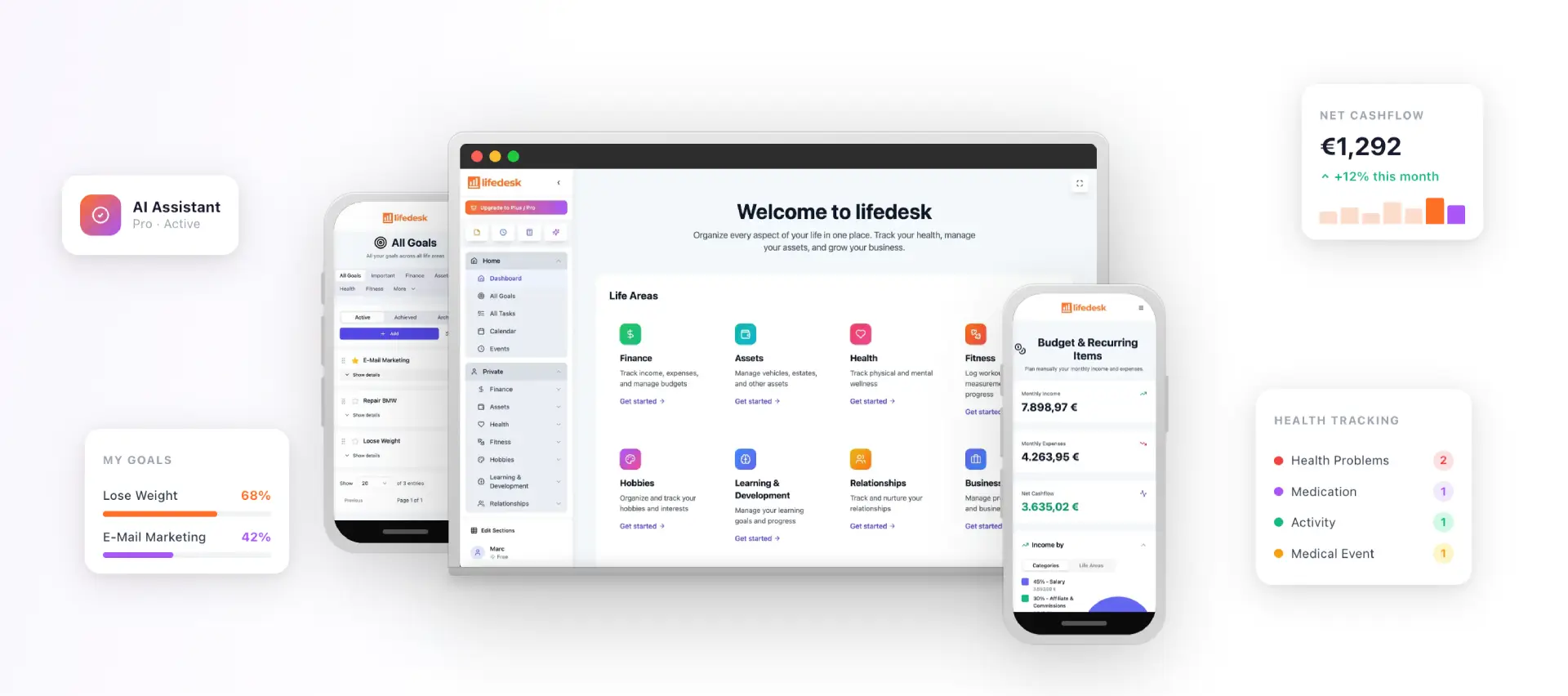
LifeDesk combines calendar blocks, recurring tasks, client records, and KPI tracking in one app instead of four separate tools.
A marketing planner for freelancers only works if it’s specific enough to act on Monday morning. Vague plans die in week two. Here’s the structure that survives.
Start with who you serve, written as one sentence: “I help early-stage SaaS founders write technical documentation” beats “I help businesses with content.” Add one disqualifier, too. “I don’t work with agencies reselling my time” saves you from wasting hours on the wrong discovery calls.
Next comes your one business outcome and its primary KPI. Pick something countable: qualified leads per month, proposals sent, or new-client revenue. A one-page plan tied to a single business result is easier to run and easier to judge at review time than a plan chasing five goals at once.
Then map your channels, each with a distinct job:
Outbound (cold email, LinkedIn outreach) generates new conversations
Inbound (a blog, a newsletter, case studies) builds credibility before the call
Referrals turn happy clients into your cheapest lead source
List weekly actions with a time estimate and an owner, even if the owner is always you. “Send 10 cold emails, Monday, 45 minutes” is a task. “Do more outreach” is a wish.
Finally, set handoff rules: what qualifies a lead for a proposal, and what disqualifies them immediately (no budget mentioned, wrong project size, unclear timeline).
Pro Tip:Write the disqualifier before the ideal client sentence. Knowing who to say no to saves more time than knowing who to say yes to.
Your Weekly and Monthly Marketing Rhythm
A freelance marketing plan only earns its keep once it becomes a routine, not a document you write once and forget. The weekly routine matters more than the plan itself because consistency, not brilliance, is what generates leads over time.
Here’s a weekly block schedule you can paste straight into your calendar:
Monday, 30 to 60 minutes: prospecting. Send outreach, comment on posts, ask for two referrals.
Wednesday, 30 minutes: follow-up. Reply to every open thread from the past two weeks. Leads go cold fast without this.
Thursday, 45 minutes: content distribution. Publish or share the one piece of content you committed to that week.
Friday, 20 minutes: pipeline cleanup. Update your KPI numbers and clear dead leads from your list.
Schedule these blocks before you schedule client work. If marketing time only happens when there’s nothing else to do, it never happens.
At month’s end, run a short review against three or four numbers: qualified leads, proposals sent, close rate, and new-client revenue. Then make one decision:
Keep if a channel is producing proposals, even slowly.
Pivot if a channel produces activity but zero proposals after 60 days. Change the message, not the channel, first.
Stop if a channel costs more time than it returns after two full review cycles.
Document the decision. That’s what separates a plan you run from a plan you wrote once and abandoned.
Which Marketing Channels Should You Actually Use?
Every channel needs a job description before it earns a spot on your planner. Outbound prospecting starts conversations. Inbound content builds trust before someone books a call. Referrals close deals faster than either because trust is already borrowed from an existing client.
Pick channels using three filters:
Audience presence: is your ideal client actually spending time there, or are you just comfortable posting there?
Measurable signal: can you track a lead or a reply from this channel within 30 days?
Time budget: do you have at least 2 to 4 hours a week to run it properly?
A strategy-first approach that starts with positioning before picking tactics tends to outperform freelancers who chase every platform at once. Realistic mixes look like this: cold outreach (3 hours/week) plus a monthly case study (2 hours/month) plus asking every finished client for one referral. That’s a full plan, not a starter kit.
Freelancers frequently spread themselves an inch deep across every channel instead of going deep on two. Only add a fourth channel once your first three are producing proposals consistently for at least two months straight.
Turning the Planner Into a Tool You Actually Open
A planner on paper works until you forget where you put it. The fields on your one-page plan map directly onto app features: calendar blocks become recurring events, weekly actions become recurring tasks, your ideal client sentence becomes a client record template, and your KPI becomes a dashboard widget you glance at once a week.
LifeDesk’s marketing planner consolidates all four into one interface: calendar, tasks, client records, and KPI tracking sit in the same app instead of scattered across a notebook, a spreadsheet, and a calendar app that don’t talk to each other. Marketing automation like scheduled reminders and follow-up nudges is part of what keeps service-based outreach consistent without you having to remember every touchpoint manually.
If you’d rather keep tools separate, a basic setup works too: a shared calendar for blocks, a lightweight CRM for client records, and a simple template in Notion or a Google Sheet for the KPI tracker. Connect them by copying weekly numbers into the sheet every Friday, and set calendar reminders to review the sheet monthly. For handoff and intake rules specifically, a dedicated system for managing contracts and client intake keeps new leads from slipping through the cracks between “interested” and “signed.”
Pro Tip:Whichever setup you pick, the KPI widget or tracker needs to be visible without opening five apps. If checking your numbers takes more than 10 seconds, you’ll stop checking them.
What Should You Measure Each Month?
Pick one primary KPI and one supporting KPI. That’s the whole measurement system, and it’s enough. A common pairing: qualified leads as the primary number, proposals sent as the supporting one.
Every weekly task should tie back to one of those two numbers. Monday’s prospecting block feeds qualified leads. Wednesday’s follow-up block feeds proposals sent. If a weekly task doesn’t move either number, question whether it belongs on the planner at all.
A simple report structure separates activity from outcome, which matters more than it sounds. Four columns cover it:
Activity: what you actually did (12 cold emails sent)
Outcome: what resulted (2 replies, 1 discovery call booked)
Owner: who did it, even solo freelancers benefit from writing this down
Notes: context for why a number moved (a slow week, a holiday, a new message tested)
Use decision rules to interpret the trend, not the noise: if qualified leads drop two months running, change your message before you change your channel. If proposals rise but close rate falls, your qualification criteria are too loose, not your pitch.
How to Conduct a Marketing Audit as a Freelancer
A marketing audit for freelancers doesn’t need a consultant or a 40-point checklist. It needs about an hour and an honest look at four things: where your last 10 clients actually came from, how much time each channel consumed, what your current message says, and where your pipeline stalls.
Start by tracing your last 10 paying clients back to their source. Most freelancers discover a large majority of their business came from one or two channels, usually referrals or a specific platform, while the rest of their marketing time went toward channels that produced nothing. That gap between where you spend time and where clients actually come from is the single biggest finding an audit surfaces.
Next, check your message against what you’re actually delivering. If your website says “full-service marketing” but you’ve closed every recent deal doing technical writing, your positioning is out of date and probably confusing prospects.
Then look at your pipeline stages. Where do leads go quiet? If proposals get sent but never signed, the problem sits in pricing or scope clarity, not lead generation. If discovery calls never get booked, the problem sits earlier, likely in your outreach message or your channel choice.
Finish the audit by comparing your findings against your current one-page plan. If the channels producing clients aren’t the channels getting your weekly time, that mismatch is your next move, not a future project.
Finding Your Freelance Niche and Ideal Client
A freelancer with a broad niche pays for it with longer sales cycles and lower rates. A freelancer with a tight niche charges more and closes faster because prospects can tell in one sentence whether you’re the right fit.
Define your ideal client with specifics: industry, company size, budget range, and the exact problem you solve for them. “I write email sequences for B2B SaaS companies with 10 to 50 employees” gives a prospect everything they need to self-select in or out within seconds.
The disqualifier matters just as much as the description. Name who you don’t serve, whether that’s a project size too small to be profitable or an industry outside your expertise. This isn’t about turning away business out of arrogance. It’s about spending your limited marketing hours on leads that convert instead of leads that waste a discovery call.
Test your niche definition by saying it out loud to someone outside your industry. If they immediately understand who you help and can picture that person, your positioning works. If they ask follow-up questions to understand what you do, the definition is still too broad.
Revisit your niche statement during every monthly review. As you land clients, patterns emerge that your original guess didn’t predict. Maybe your best clients aren’t the industry you targeted but a specific project type. Adjust the one-page plan to match reality rather than the assumption you started with six months ago.
Budgeting Time and Money for Freelance Marketing
Most freelancers overspend on marketing tools and underspend on marketing time, which is backward. Time is the scarcer resource, and it’s the one your one-page plan should protect first.
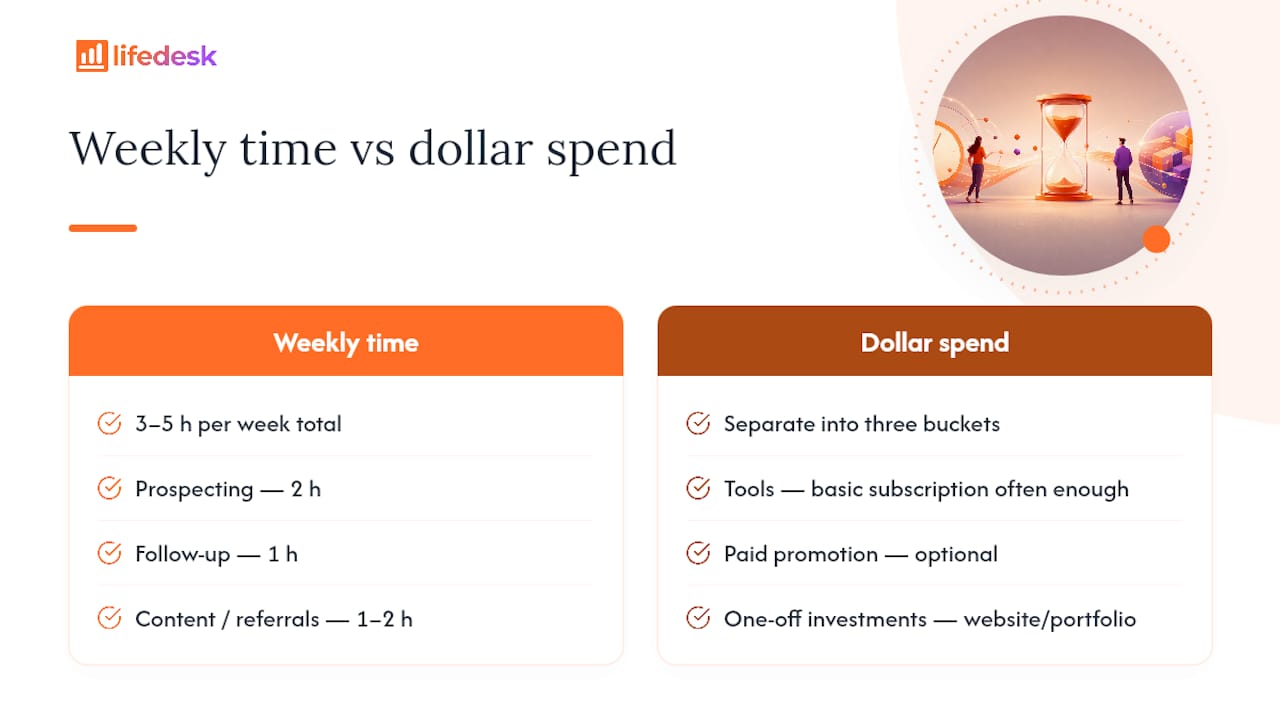
Set a weekly time budget before a dollar budget: 3 to 5 hours per week is realistic for a solo freelancer running one to three channels. That maps to the block schedule covered earlier, roughly 2 hours of prospecting, 1 hour of follow-up, and 1 to 2 hours of content or referral outreach.
For dollar budgeting, separate spending into three categories: tools (a planner app, an email service), paid promotion (if any), and one-off investments (a better website, a portfolio redesign). Freelancers just starting out often need close to zero dollars beyond a basic tool subscription, since referrals and organic outreach cost time, not money.
Resist the urge to buy a tool for every function. A CRM, a scheduling app, a separate content calendar, and a spreadsheet for KPIs adds up to four logins and four places information can get lost. Consolidating those functions, whether through an all-in-one platform or a disciplined manual system, protects both your budget and your attention.
Review your budget quarterly rather than monthly. Marketing spend rarely needs weekly adjustment, but a quarterly look tells you whether a paid channel is earning back what it costs, or whether that money would work harder redirected toward a referral incentive or a better portfolio.
Building a Personal Brand That Attracts Clients
A personal brand for a freelancer isn’t a logo or a tagline. It’s the answer to one question: what do people say about you when you’re not in the room? That reputation gets built through consistent, specific proof of your work, not through posting frequency.
Testimonials do more work than almost any other brand asset. A service business’s credibility depends heavily on visible proof of past results, and freelancers are service businesses. Ask every satisfied client for a specific testimonial within a week of finishing the project, while the results are still fresh in their mind. A vague “great to work with” quote helps less than “cut our onboarding time by half in six weeks.”
Case studies extend that same proof into a format prospects can actually use during their own decision-making. One detailed case study, published once a quarter, builds more trust over a year than fifty generic social posts.
Pick one platform where your ideal client already spends time, and show up there consistently rather than thinly across five platforms. Consistency compounds. Fifty people who see you post insight every week for six months trust you more than five thousand who saw you once.
Your bio and profile everywhere should say the same thing your one-page plan says about who you serve. Mismatched messaging between your website, your LinkedIn, and your proposal template makes prospects hesitate right when they’re closest to hiring you.
Networking and Collaborations That Actually Generate Work
Build a referral habit into your weekly plan rather than hoping it happens organically. After finishing a project, ask directly: “Do you know one or two people who might need this kind of help?” Most freelancers skip this step out of discomfort, and it’s the single easiest lead source they leave on the table.
Collaborations with adjacent freelancers multiply your reach without multiplying your workload. A copywriter and a web designer who refer clients to each other both win, since their services are complementary rather than competing. Look for freelancers who serve your same ideal client but solve a different problem, and propose a simple two-way referral arrangement.
Industry communities, whether a Slack group, a local meetup, or an online forum tied to your niche, work best when you show up consistently rather than only when you need work. Answering questions and sharing insight for months before you ever pitch anything builds the kind of trust that turns into inbound referrals later.
Track where referrals and collaborations originate the same way you track any other channel. If a specific community or partnership consistently sends qualified leads, give it a dedicated slot in your weekly plan instead of treating it as a happy accident.
Try LifeDesk’s Marketing Planner
LifeDesk turns the one-page plan from this article into something you actually run instead of something you wrote once and lost in a folder. Calendar blocks, recurring weekly tasks, client records, and a KPI widget live in one interface, so your prospecting hour, your follow-up reminders, and your monthly review numbers stop living in four different apps.
That consolidation matters more than it sounds. Freelancers who juggle a separate CRM, a separate calendar app, and a spreadsheet for KPIs lose track of exactly the follow-ups and review dates that make a marketing plan work. LifeDesk’s business tasks and goals features let you set your monthly outcome once and see your weekly actions tied directly to it, while automated reminders handle the follow-up nudges you’d otherwise forget by Thursday.
Set up your one-page plan inside LifeDesk today: block your weekly marketing hours on the calendar and task tools, add your KPI target, and let the monthly review remind itself.
Rates vary widely by niche and experience, typically ranging from project-based flat fees to hourly rates set by the freelancer’s specialty and market demand; there’s no single standard figure across the industry.
What is the 70/20/10 rule in marketing?
It’s a budget allocation guideline where most marketing effort goes to proven tactics, a smaller portion to improving what already works, and the remainder to testing new ideas or channels.
Is freelancing still worth it in 2026?
Freelancing remains viable for professionals who treat marketing as a weekly discipline rather than an afterthought; a one-page plan tied to weekly execution and monthly review is what separates freelancers with steady pipelines from those chasing feast-or-famine cycles.
How do I start freelance marketing?
Write your one-page plan first: define your ideal client, pick one measurable outcome, choose one to three channels, and block weekly time for prospecting and follow-up before you build anything more complex. Tools like LifeDesk’s marketing planner let you set that plan up and run it in a single app from day one.