The PARA method sorts every file, note, and task you own into four folders (Projects, Areas, Resources, Archives) based on how soon you need to act on it. The main payoff is speed: you stop hunting through nested folders and start finding what you need in seconds,...
The best prioritization frameworks for anyone juggling client work, personal goals, and everything in between are the Eisenhower Matrix, the Pareto principle (80/20), the 1-3-5 Rule, time blocking, and a weekly review. Pick one today: schedule a 90-minute protected...
The fastest way to turn emails into tasks is to use your inbox’s built-in conversion feature (Outlook’s drag-to-Tasks or Gmail’s Tasks panel) for one-off items, and automation rules for anything that repeats. Manual capture works fine at low volume; once the same type...
A hobby project planner is a tool, template, or notebook system that helps you capture ideas and, more importantly, always know your single next physical action. Right now, pick one tool, however basic, and write down the very next step for your current project....
AI agents reclaim your schedule by auto-scheduling tasks, defending focus blocks, and resolving conflicts before you even notice them, but only when you keep human-in-the-loop controls turned on. The strongest results come from task-first tools that unify your to-do...
AI goal planning converts a single sentence of intent, like “I want to get fit” or “I want a promotion,” into a measurable SMART goal with milestones, weekly tasks, and deadlines already attached. Within minutes, you get a concrete plan for the next seven days plus...
Calendar finance integration works best when you match the method to the job: native iCal feeds or a calendar-first finance app for visibility, middleware like Zapier or IFTTT for quick pilots, and API plus webhooks for anything running in production. Most finance...
A life management system is a compact loop: capture what hits you, prioritize it, schedule it, and review it on a set cadence. That’s the whole mechanism. Everything else, from Pomodoro timers to color-coded calendars, just fills in the loop. The single best first...
The best marketing planner for freelancers fits on one page, ties to a single measurable outcome, and runs on a weekly rhythm with a fixed monthly review. That’s it. No 40-tab spreadsheet, no funnel diagram with seventeen boxes. Just one page: who you serve, what...
Start with a simple template that has defined fields, a 4 to 6 week working window, and one owner per item. Assign a status to every entry (idea, draft, review, scheduled, published) so nobody has to ask “where is this?” in a Slack thread. Your next move: open a...
Stack 3 Goal Setting Frameworks for Strategy and Quarterly Execution
Most people don’t need one framework. They need three, stacked by time horizon: a long-range direction setter like a BHAG or OGSM, a quarterly execution engine like OKRs, and SMART criteria to keep the resulting key results honest and measurable. Skip the strategic layer and OKRs drift. Skip SMART discipline and key results turn into vague hopes. This guide compares the major goal setting frameworks, shows how they interlock, and gives you a template to start running them this week.
TL;DR:
Strategic frameworks like BHAG or OGSM provide long-term direction, which should precede quarterly execution tools like OKRs or 4DX for effective alignment.
SMART criteria serve as a quality filter for individual goals, ensuring they are specific, measurable, achievable, relevant, and time-bound, regardless of the overarching framework.
Regular weekly check-ins and quarterly scoring are essential for maintaining momentum and catching goal drift early across all frameworks.
Combining multiple goal-setting layers—long-term direction, measurement, and execution—works best when integrated into a single visible system, like LifeDesk, that tracks progress daily.
The primary mistake in using frameworks is running several simultaneously without clear ownership or review cadence, leading to neglect and unreviewed scoreboards.
LifeDesk
Keep Your Goals Visible
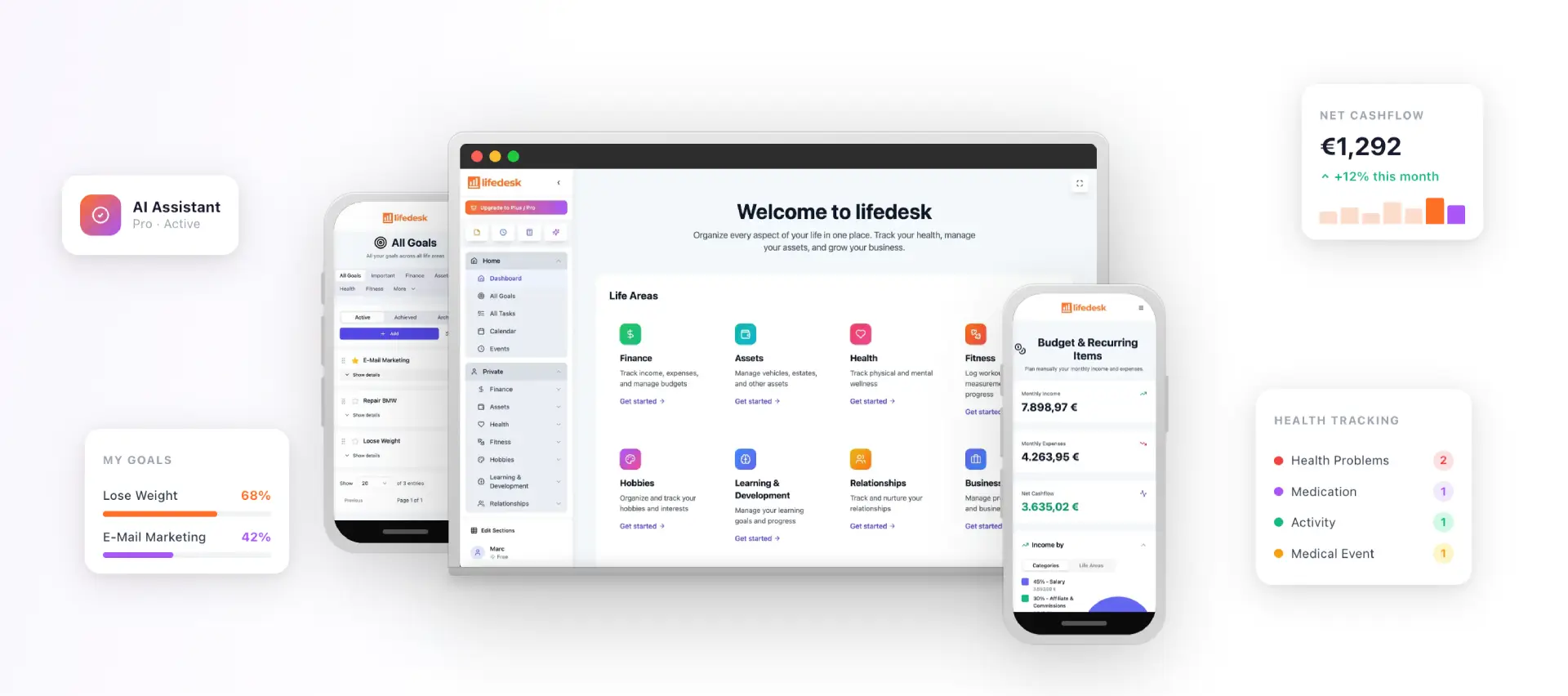
LifeDesk brings goals, tasks, calendars, and progress together, helping you organise strategy and execution in one central system.
What Is a Goal Setting Framework, and Why Bother With One?
A goal setting framework is a structured method for defining what you want to achieve, how you’ll measure it, and how often you’ll check progress. That’s the whole idea. Without one, goals tend to default to vague intentions like “grow the business” or “get healthier,” which sound fine but give you nothing to act on Monday morning.
The research case for structure is strong. Locke and Latham’s goal-setting theory found that specific, challenging goals consistently produce better performance than vague or easy ones, built around five principles: clarity, challenge, commitment, feedback, and task complexity. That’s not a soft suggestion. It’s the reason “write more” fails and “publish two articles a week for eight weeks” doesn’t.
Not every goal needs a formal framework. Deciding to read more books doesn’t require an OKR. But the moment a goal involves multiple people, spans more than a few weeks, or has real consequences if it slips, structure starts paying for itself.
That’s where the layer concept matters. Some frameworks answer “where are we going long term?” Others answer “what do we do this quarter?” A few just help you write any single goal correctly. Frameworks worth knowing include:
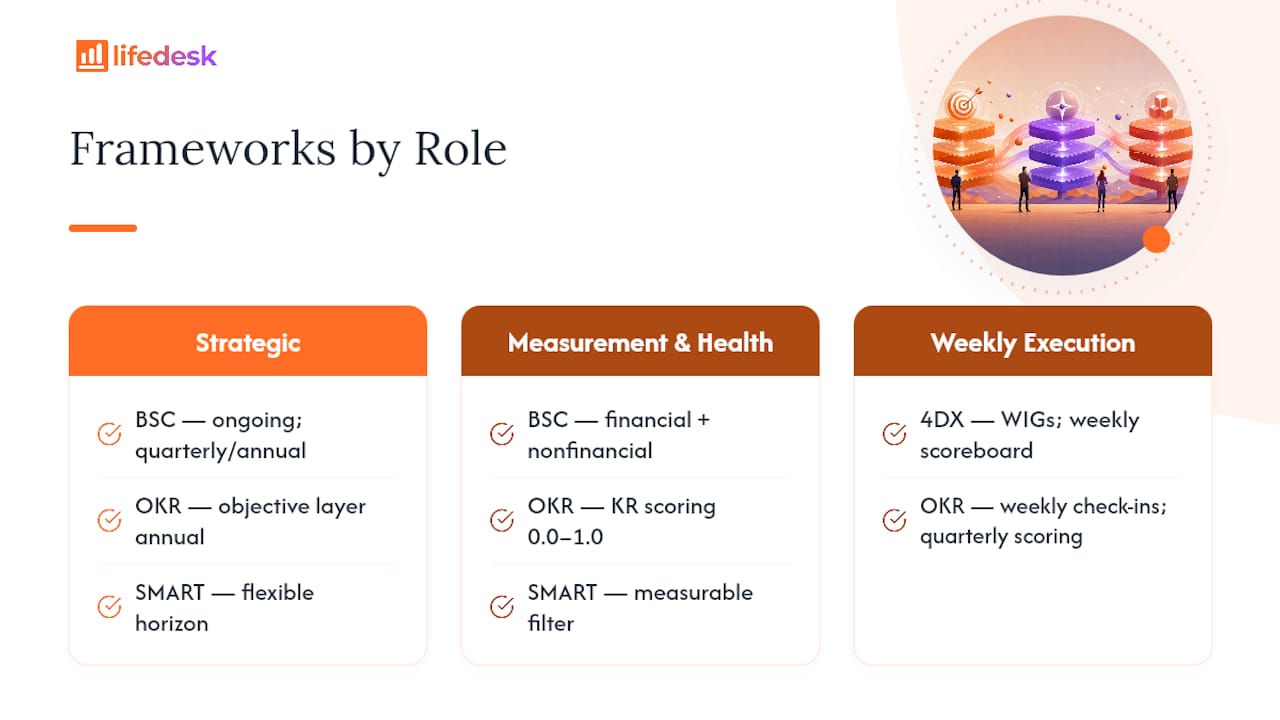
Strategic layer: BHAG, OGSM, Hoshin Kanri, EOS Vision/Traction Organizer
Measurement layer: Balanced Scorecard
Execution layer: OKRs, 4DX, EOS Rocks
Goal-writing discipline: SMART criteria, applied inside any of the above
Comparing the Major Goal Setting Frameworks
Here’s what each framework actually does, who should own it, and how they connect. Microsoft Learn’s framework catalog covers several of these directly, and it’s a useful reference if you want the vendor-neutral definitions.
SMART Goals
SMART stands for Specific, Measurable, Achievable, Relevant, and Time-bound. It’s not a standalone system so much as a quality filter you run any goal through. Time horizon: flexible, from a week to a year. Owner: whoever holds the goal, individually. Cadence: reviewed whenever the goal itself is checked.
Example: “Increase monthly recurring revenue from $8,000 to $11,000 by March 31 by closing 6 new retainer clients.” Compare that to “grow revenue” and you can see why SMART goals examples always look almost boring. Boring is the point. Vague goals feel inspiring and produce nothing measurable.
Pro: forces precision. Pro: works inside almost any other framework. Con: says nothing about strategic importance. A perfectly SMART goal can still be the wrong goal.
OKRs (Objectives and Key Results)
An OKR pairs a qualitative, ambitious Objective with 2 to 5 measurable Key Results. Time horizon: typically quarterly, sometimes annual for the objective layer. Owner: teams or individuals, cascaded loosely rather than rigidly. Cadence: weekly check-ins, quarterly scoring.
Individual OKR template: Objective: Build a sustainable freelance writing income. Key Result 1: Land 4 new retainer clients by June 30. Key Result 2: Raise average project rate from $0.15/word to $0.22/word. Key Result 3: Publish 2 portfolio pieces per month.
GoalsAndProgress recommends one objective with 2 to 5 key results, a 13-week quarterly cycle, and scoring each key result from 0.0 to 1.0 at the end. An average around 0.6 to 0.7 signals healthy stretch, not failure. Pro: creates a tight execution rhythm. Pro: transparent scoring makes progress visible to a whole team. Con: OKRs answer “what do we do now,” not “why does this matter in five years.”
Balanced Scorecard (BSC)
BSC is a strategic measurement system that tracks performance across four perspectives: Financial, Customer, Internal Process, and Learning and Growth, rather than financial metrics alone. Time horizon: ongoing, reviewed quarterly or annually. Owner: leadership team. Cadence: quarterly business reviews.
Pro: prevents a business from optimizing revenue while quietly wrecking retention or culture. Pro: gives leaders one dashboard instead of four disconnected reports. Downside: it measures health, it doesn’t drive weekly execution. Pair it with OKRs or 4DX for that.
4DX (Four Disciplines of Execution)
4DX narrows focus to one or two wildly important goals (WIGs), tracks lead measures rather than lagging results, and runs a public scoreboard with weekly accountability sessions. Time horizon: quarterly to annual. Owner: a team, with a designated WIG session leader. Cadence: weekly.
Example: a sales team’s WIG might be revenue, but the lead measure they actually track weekly is “qualified demos booked,” since that’s the input they can control. Pro: brutal focus. Pro: lead measures give people something actionable today. Con: works best with one or two goals at a time; it isn’t built for a dozen simultaneous priorities.
BHAG (Big Hairy Audacious Goal)
A BHAG is a 10 to 25 year directional goal, vivid enough to align decisions without specifying how to get there. Time horizon: a decade or more. Owner: founder or executive team. Cadence: revisited rarely, referenced constantly.
Pro: gives every quarterly decision a reason to exist. Con: on its own, a BHAG is just a poster on the wall. Without an execution layer underneath it, it stays symbolic rather than actionable.
Hoshin Kanri and OGSM
Both translate long-term strategy into annual initiatives with specific, measurable targets. Hoshin Kanri (Japanese for “policy deployment”) cascades goals down through an organization with structured review. OGSM (Objectives, Goals, Strategies, Measures) is a one-page strategy document. Time horizon: annual. Owner: leadership, cascaded to department heads. Cadence: annual planning, quarterly review.
EOS (Entrepreneurial Operating System)
EOS uses “Rocks,” 90-day priorities, inside a broader Vision/Traction framework. Time horizon: 90 days for Rocks, 1 to 3 years for the vision component. Owner: leadership team, assigned individually per Rock. Cadence: weekly Level 10 meetings.
How to Choose the Right Framework for Your Situation
Start by diagnosing the actual problem before picking a name off this list. Ask three questions: What’s your time horizon? Do you need a strategic narrative or a weekly execution habit? And how many people need to stay aligned?
If you lack long-term direction and every decision feels reactive, start with a BHAG, OGSM, or Hoshin Kanri process. You need a North Star before you need a scoreboard.
If direction exists but execution is weak (plans made, nothing shipped), adopt OKRs or 4DX. Pick OKRs if you want flexibility across multiple priorities; pick 4DX if you need brutal focus on one or two goals.
If you need to see whether the business is healthy beyond revenue, layer in a Balanced Scorecard alongside whichever execution framework you’re already running.
If individual goals keep failing regardless of framework, the fix is usually SMART discipline, not a new system. Rewrite the goal before you replace the framework.
Before rolling anything out, run this adoption checklist:
Does every goal have one named owner, not a committee?
Are the measures numeric, not descriptive?
Is there a tool or shared document everyone actually checks?
Is a review cadence scheduled, not “whenever we remember”?
Is there a defined feedback loop for adjusting goals mid-cycle?
Pro Tip:The most common failure isn’t picking the wrong framework. It’s running three frameworks at once with no owner for any of them. Cut to one strategic layer and one execution layer before adding anything else.
Watch for red flags: leadership announcing a new framework every quarter, key results with no owner attached, or scorecards nobody reviews after the kickoff meeting. Those signal a framework problem dressed up as a motivation problem.
Running the Framework: Cadence, Scoring, and Common Mistakes
Once you’ve picked a framework, the mechanics matter more than the label. Use this five-step playbook regardless of which system you chose:
Set the objective. One sentence, qualitative, ambitious enough to matter.
Define 2 to 5 measures. Numbers only. “Improve client communication” is not a key result; “respond to client emails within 4 business hours” is.
Assign a single owner per measure, even on a team goal. Shared ownership means no ownership.
Schedule the cadence up front. Weekly check-ins of 10 to 15 minutes, monthly reviews for course correction, quarterly scoring to close the cycle.
Score and learn. Rate each key result 0.0 to 1.0, then ask what to carry forward and what to drop.
Regular short cadences beat infrequent long ones. Weekly check-ins paired with quarterly scoring keep the feedback loop tight enough to catch a stalled goal before the quarter is wasted, rather than discovering the failure in a year-end review.
The most common mistake is confusing tasks with outcomes. “Launch the new website” is a task. Frameworks measure outcomes; task lists belong underneath them, not instead of them.
For individuals working alone, the biggest lever isn’t willpower. It’s changing your environment and making the goal visible to someone else. Doerr’s own OKR writing describes people restructuring their surroundings, not just trying harder, to hit personal key results. Share your OKR with a friend or partner and your follow-through improves simply because someone else can ask how it’s going.
How LifeDesk Helps You Run These Frameworks Day to Day
Frameworks fail more often from neglect than from bad design. Nobody opens a spreadsheet on a Tuesday to check quarterly progress. A workflow you actually see daily solves that problem, which is where a unified tool fits.
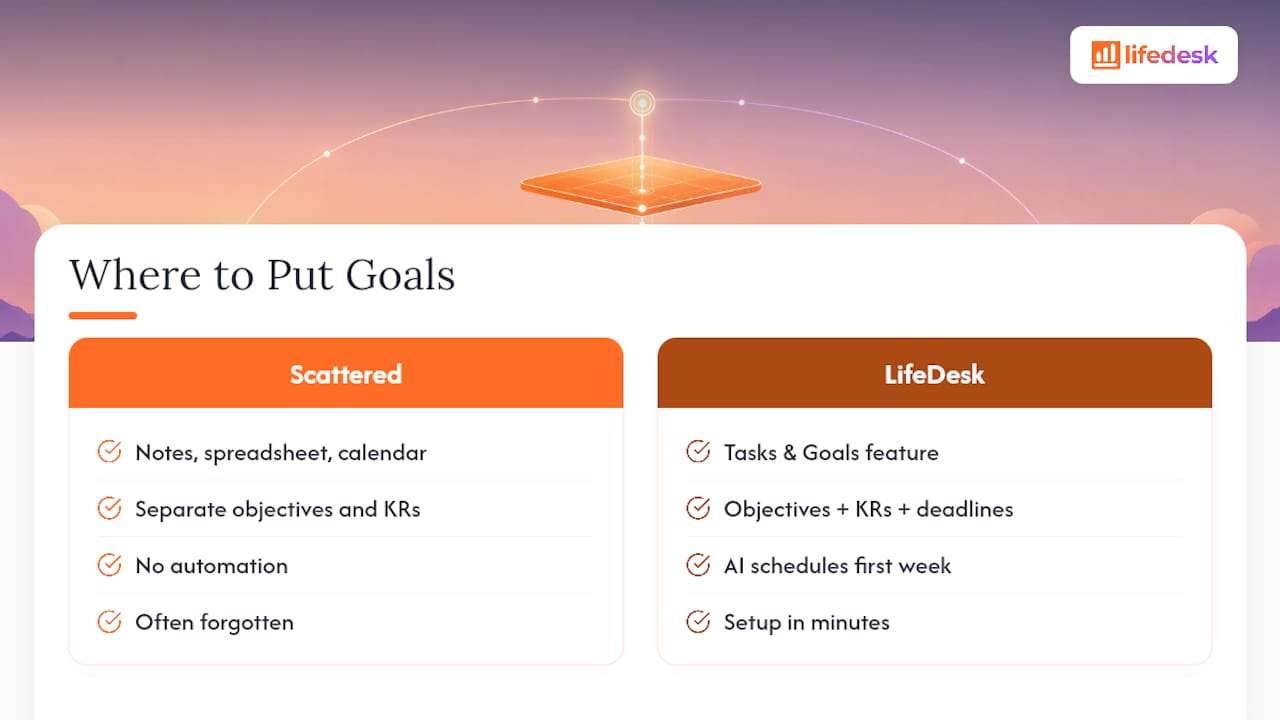
Inside LifeDesk, you can create an objective under Tasks & Goals, attach measurable key results, and link each one to the projects and time blocks that actually produce the work. The built-in AI planner turns a new goal into a first-week action plan automatically, so the gap between “I set an OKR” and “I did something about it Monday” disappears. Calendar integration schedules your weekly check-ins for you, and the time tracker feeds real data back into whichever key result depends on hours logged. For a small business owner running quarterly OKRs alongside client projects, that means one place to see the objective, the tasks under it, and the calendar slot for reviewing it. That closes the feedback loop the theory says matters most.
Put Your Framework Somewhere You’ll Actually See It
Choosing between SMART, OKRs, and a Balanced Scorecard only matters if the resulting goals live somewhere you check without being reminded. A useful platform centralizes strategic objectives, quarterly key results, and daily tasks together instead of scattering them across a notes app, a spreadsheet, and a calendar you forget to open.
This approach matters for individuals juggling client work, personal finances, and long-term goals at once, exactly the layer-jumping this guide describes. The Tasks and Goals feature lets you set an objective, attach key results, and track them against real deadlines rather than good intentions. Pair that with the AI-driven goal planning workflow, which turns a new goal into a scheduled first week automatically, and the gap between deciding on a framework and actually running it shrinks to a few minutes.
If you’re ready to stop managing goals in three disconnected tools, start with LifeDesk’s life management system and set up your first quarterly objective this week.
Sources
A few sources back most of the guidance above and reward a closer read:
A goal setting framework is a structured method for defining objectives, choosing measurable targets, and setting a review cadence, examples include SMART, OKRs, the Balanced Scorecard, and 4DX. Each one solves a different problem, from long-term direction to weekly execution.
What is the best framework for setting a company’s goals?
No single framework covers every layer, which is why most well-run companies combine a strategic framework like a BHAG or OGSM for direction with quarterly OKRs for execution and SMART criteria to sharpen individual key results. Combining frameworks across layers is standard practice among teams that hit their targets consistently.
What is the difference between OKRs and SMART goals?
SMART is a quality checklist you apply to any single goal, while OKRs are a full system pairing a qualitative Objective with multiple measurable Key Results on a quarterly cycle. In practice, well-written OKR key results are SMART goals by another name.
How often should I review my goals?
Weekly check-ins of 10 to 15 minutes keep momentum, monthly reviews catch drift early, and a quarterly scoring session closes the loop and resets priorities. This cadence applies whether you’re running OKRs individually or across a full team.
Can I use these frameworks for personal goals, not just business ones?
Yes. A personal OKR follows the same structure as a team OKR, one objective with 2 to 5 measurable key results, reviewed weekly and scored quarterly, and tools like LifeDesk’s Tasks and Goals feature apply the same logic to both a business objective and a personal one in the same place.