Use a list when your tasks are short, independent and mostly done in one sitting. Use a Kanban board when work passes through stages, when several things are in progress at once, or when you keep losing track of what is stuck. Most people need both: a list for...
Use a calendar for anything that happens at a specific time, and a to-do list for anything that only needs to happen eventually. Most people get stuck when they ask one tool to do the other’s job. A list can’t tell you whether Tuesday has room for a task, and a...
Mood and energy tracking means logging, a few times a day, how you feel and how much fuel you have, then reading the entries for patterns. Do it in 10 to 20 seconds per entry, 3 to 4 times a day, for two weeks. Add one line of context (what you were doing), and you...
A good personal dashboard is one screen that answers the few questions you ask yourself every day: What is next? Am I on track? What needs me right now? You set it up by choosing 4 to 6 widgets, arranging them in four zones, and deleting everything that does not earn...
Daily metrics tracking means watching a few current, high-frequency numbers that warn you early and let you correct course. Start by choosing a key performance question, then pick a small set of daily measures that answer it, such as time on priority tasks, completed...
Design daily boundaries, protect deep work, and run weekly reviews: that combination does more for sustainable balance than any single trick. Expect steadier energy and less burnout drift once boundaries are in place, and you can start today by picking one boundary (a...
Use time blocking for sustained deep work on a single project, and use task batching to group shallow, repeatable tasks into one focused session. Both methods solve the same underlying problem, which is constant context switching, but they solve it differently, and...
Open a dedicated business bank account and route every bit of business income there, right from the start. Pair it with a business credit card and standalone bookkeeping, and pay yourself through documented draws or payroll instead of pulling cash whenever you need...
Plan 2026 by picking 3 to 5 annual priorities, writing an if-then plan for each using mental contrasting, converting every priority into tracked projects and milestones, and running quarterly plus weekly reviews inside one integrated planner. This approach keeps...
Founders should track three things first: deep work hours, personal well-being basics like sleep and movement, and a weekly review. Start with one to three habits, log them in under 60 seconds each morning, and treat the data as a business input rather than a personal...
Test Five Prioritization Frameworks in 30 Days for Freelancers
The best prioritization frameworks for anyone juggling client work, personal goals, and everything in between are the Eisenhower Matrix, the Pareto principle (80/20), the 1-3-5 Rule, time blocking, and a weekly review. Pick one today: schedule a 90-minute protected power block this week and run your first daily task list using the 1-3-5 format. Everything below explains why these five work, when to use each one, and how to test the system for 30 days before you commit to it.
TL;DR:
The Eisenhower Matrix helps quick decisions on urgent and important tasks during interruptions, while Pareto analysis identifies key tasks or clients that generate most results over time.
The 1-3-5 Rule limits daily tasks to one big, three medium, and five small items, effectively preventing overload and increasing focus for freelancers.
Time blocking and weekly reviews are best suited for self-directed work and high-impact planning, with calendar-based scheduling reinforcing energy management.
Layering frameworks, such as using a 90-day target with daily Eisenhower triage, enhances overall prioritization and avoids overwhelm from multiple tools.
Testing frameworks over 30 days by tracking weekly completion rates and results ensures you find the most effective system without overcomplicating your workflow.
LifeDesk
lifedesk.me
Bring Your Priorities Together
LifeDesk brings tasks, goals, calendars, and business organization into one place for clearer planning across freelance work and life.
Each framework solves a different problem, which is why most people who try just one and quit are missing half the picture.
The Eisenhower Matrix sorts tasks into four boxes: urgent and important, important but not urgent, urgent but not important, and neither. It exists to fight what researchers call the “mere-urgency effect,” the pull to do whatever feels time-sensitive even when it barely matters. Harvard Business School’s guide to the Eisenhower Matrix lays out the four resulting actions clearly: do it now, schedule it, delegate it, or delete it. For a freelancer staring at a Monday inbox, it’s a five-minute daily triage.
The Pareto principle, or 80/20 rule, works differently. It’s a diagnostic, not a to-do list. You track your work for a short stretch, then look for the small cluster of tasks or clients producing most of your results, and protect that cluster with focused time. Psychology Today’s breakdown of the Pareto principle frames it as a five-step loop: identify, measure, rank, focus, review.
The 1-3-5 Rule caps your day at one big task, three medium ones, and five small ones, which stops the common freelancer habit of writing 20-item lists that guarantee failure.
Time blocking puts each task on the calendar instead of a list, pairing well with energy mapping (matching hard work to your sharpest hours).
The weekly review is a short reset, usually 20 to 30 minutes, to check what worked and reset the coming week’s targets.
When Should You Use Each Framework?
Match the tool to the planning horizon, not the other way around. Using a 90-day system to decide what to do in the next ten minutes is like using a road map to parallel park.
Right now, mid-interruption: Eisenhower Matrix. It’s fast enough to run in your head when a client email lands and you need to decide, on the spot, whether it’s a “do now” or a “schedule later.”
Today: the 1-3-5 Rule. It caps the day before it starts, which matters most for freelancers whose task list refills every time a client replies.
This week: Pareto scoring plus time blocking. Rank your tasks, then put the top few on the calendar during your best energy hours.
This quarter: a weekly review anchored to a single 90-day target, sometimes called a One-Page Operating System, which keeps the daily grind pointed at something bigger than the inbox.
A simple rule of thumb for freelancers: if a task won’t affect revenue in the next 30 days and isn’t tied to a health or family commitment, it’s a candidate for the “not doing” pile.
Pro Tip:Layer two frameworks instead of picking one. Use a 90-day target as your filter for what’s even allowed on your list, then run Eisenhower triage daily to handle whatever actually lands in your inbox. The combination catches both the big picture and the 3 p.m. fire drill.
How Do You Adopt a Prioritization System in 30 Days?
Most people fail at prioritization not because the framework is wrong but because they never test it long enough to know if it fits. Thirty days gives you enough data without demanding a life overhaul.
Week 0: audit before you plan. Spend three to five days logging what you actually do, in 30-minute increments if you can stand it. This baseline audit is what turns the 80/20 rule from a slogan into a real diagnostic, per FreeBrain’s productivity analysis.
Weeks 1 through 4, day by day:
Every morning, write your 1-3-5 list before opening email.
Block three 90-minute power blocks a week for your highest-leverage task, identified from the audit. LifeDesk’s guide to time blocking recommends scheduling these blocks first, before anything reactive gets a slot on the calendar.
Run a 20-minute weekly review every Friday or Sunday, and write one explicit “not doing this week” line.
Score any new recurring task using Impact × Frequency ÷ Effort, a rubric that turns vague gut feelings about what matters into a repeatable number.
At the end of week 4, compare your logged hours against your original audit.
Track two things as you go: a lead measure (did you complete your power blocks, yes or no) and a lag measure (did revenue or the metric you actually care about move). If your power blocks keep getting skipped, the framework isn’t broken. Your calendar is too crowded, and that’s worth knowing in week two, not month six.
If Eisenhower feels like busywork by week 2, you likely don’t have enough urgent chaos to justify it. Drop to just 1-3-5 and time blocking.
If the weekly review keeps getting skipped, shrink it to five bullet points instead of a full retrospective.
If nothing on your top-five Pareto list changed after two weeks, your audit window was probably too short. Extend it another week.
What Does This Look Like for a Real Freelancer?
Three setups cover most solo situations, and none of them require more than a notebook or one app to run.
The solo developer, buried in deep-focus coding work, does best with time blocking as the backbone. Three 90-minute blocks a week protect the hardest technical work, and a daily 1-3-5 list handles the smaller tickets and client replies that fill the gaps. Weekly review: 15 minutes, Friday afternoon.
The client-facing freelancer (designers, consultants, coaches) lives on interruptions, so Eisenhower triage runs constantly during the day, while Pareto scoring picks which clients or projects get protected time blocks each week. Delegate anything below a 3 on the impact score if you can afford to outsource it; delete anything below a 2.
The side-hustler with a day job and a family has the least spare time and the highest cost of getting it wrong. The 1-3-5 Rule caps evenings realistically (one big task, not five), and the weekly review doubles as a family check-in on Sunday to confirm the coming week’s commitments actually fit.
Pro Tip:If your calendar already has zero white space, don’t add a sixth framework. Cut a task from your 1-3-5 list instead. More structure on top of an overfull week just adds friction.
Which Prioritization Framework Fits Your Workflow?
The right framework depends less on personality and more on three concrete variables: how often your day gets interrupted, how many separate “roles” you juggle, and how far out you actually plan.
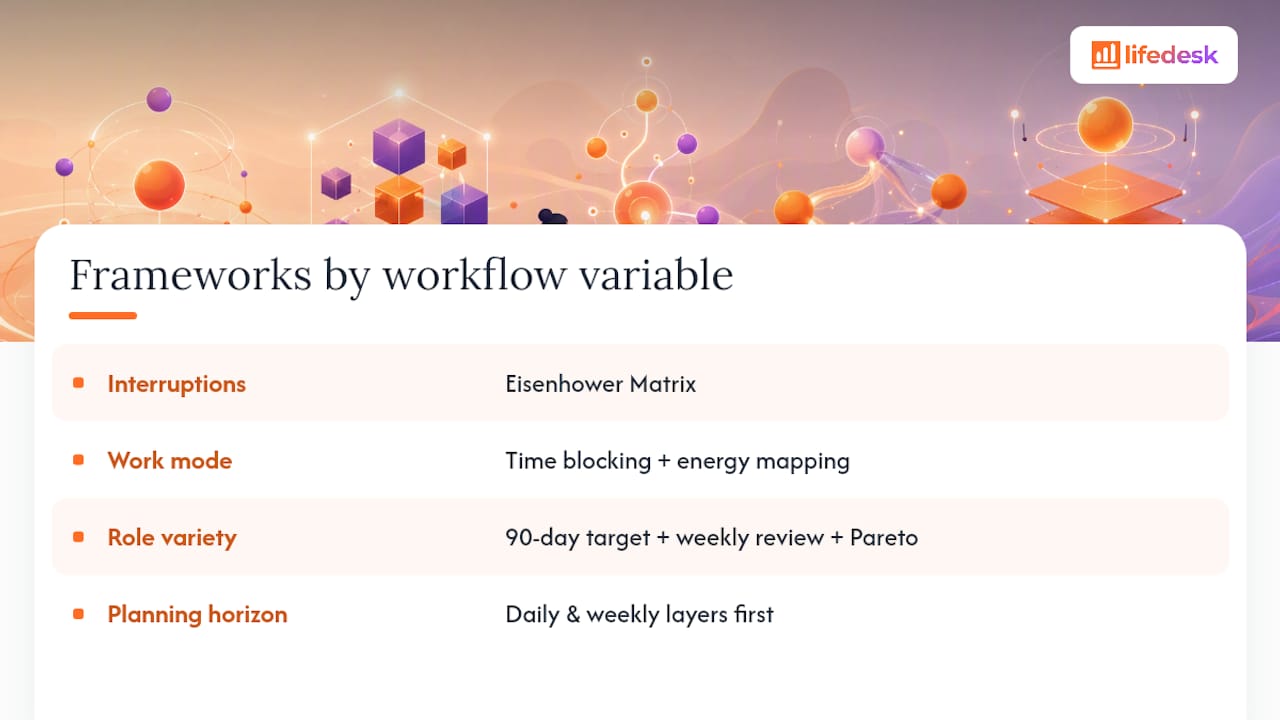
If interruptions dominate your day (client-facing work, support, sales calls), lean on Eisenhower Matrix because it’s built for split-second sorting. If your work is mostly heads-down and self-directed (writing, coding, design production), time blocking and energy mapping matter more since your biggest risk is a bad calendar, not a bad inbox.
Task variety matters too. Someone running one core service for a handful of clients can get by with a light 1-3-5 habit and a monthly Pareto check. Someone running a business with marketing, delivery, admin, and a side project needs the heavier structure: a 90-day target, a weekly review, and Pareto scoring to keep from spreading effort evenly across tasks that don’t deserve equal weight.
Planning horizon is the third filter. If you rarely think more than a week ahead, skip the 90-day target for now and master the daily/weekly layer first. Add the quarterly filter later, once the daily habit is automatic. Trying to install all five frameworks in week one is the single most common way people abandon the whole project by week three.
How Do These Frameworks Compare on Complexity and Payoff?
Complexity and payoff don’t move together in a straight line, which surprises people expecting the “best” method to also be the hardest to run.
The 1-3-5 Rule is the lowest-complexity option here, roughly a two-minute daily habit, and it delivers an outsized payoff for anyone whose main problem is overcommitment. The Eisenhower Matrix sits at similar complexity but demands more judgment calls per task, since every item needs an honest urgent/important assessment rather than a simple count.
Time blocking takes more setup, since it means fighting for calendar space and holding boundaries against meetings and messages, but the payoff compounds. Protected 90-minute blocks, according to James Clear’s analysis of the Eisenhower Box, are consistently what separates people who finish high-leverage work from people who stay busy without moving anything forward.
The Pareto audit is the most analytically demanding of the group; it requires tracking data honestly for a week and doing real math, not vibes. Its payoff is also the largest for anyone who suspects a fraction of their work is generating most of their income. The weekly review and 90-day target carry moderate complexity but the highest long-horizon payoff, since they’re the only tools here that stop short-term firefighting from quietly erasing your bigger goals.
What Mistakes Ruin Prioritization Systems?
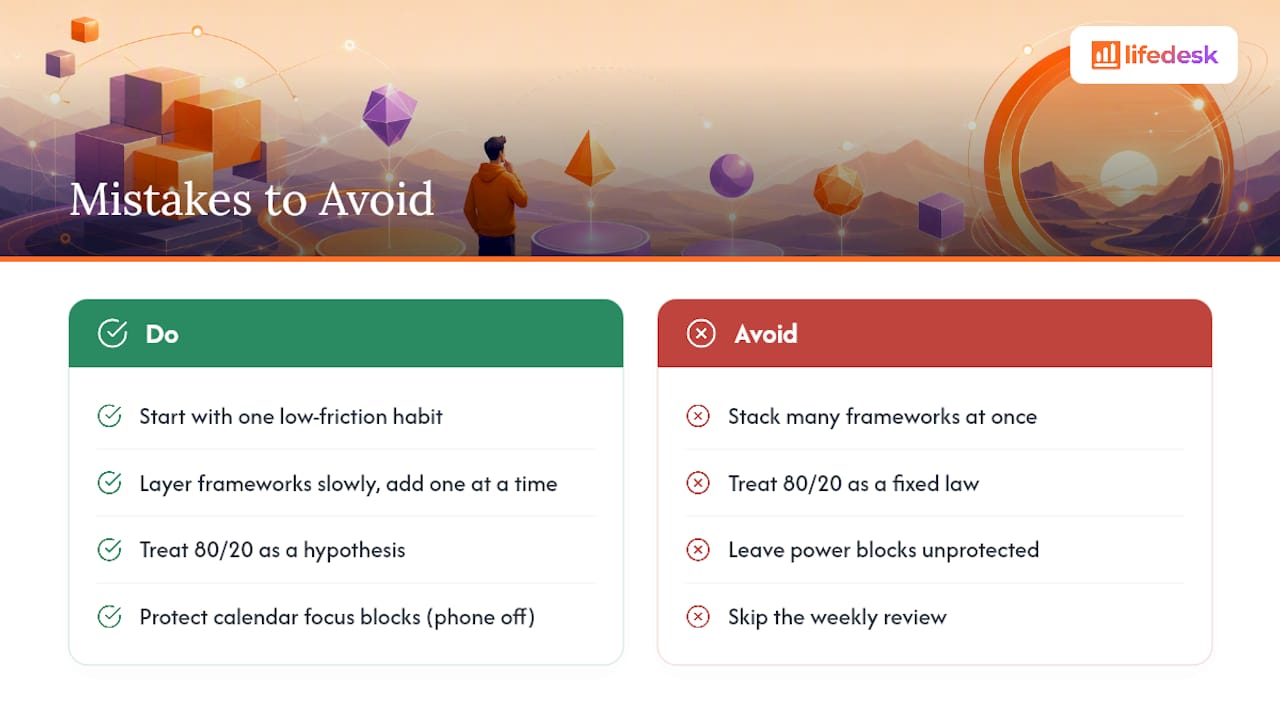
The most common failure isn’t picking the wrong framework. It’s stacking too many at once, right out of the gate.
Running Eisenhower, Pareto, time blocking, a weekly review, and a 90-day target simultaneously in week one is a guaranteed way to abandon all five by week three. Layering frameworks works, but layering them slowly is what actually sticks, according to insight from practitioners who advise starting with one low-friction habit before adding structure.
A second trap: treating the 80/20 split as a fixed law instead of a hypothesis. Your actual ratio might be 70/30 or 90/10, and that’s fine. Run the one-week audit expecting a rough pattern, not an exact number.
Third, people schedule power blocks and then let the first Slack message or client call cancel them. A block that isn’t protected isn’t a block, it’s a suggestion. If your calendar shows a 90-minute focus session but your phone stays on, expect it to get interrupted within 20 minutes.
Fourth mistake: skipping the weekly review because “nothing changed.” The review’s value isn’t reporting on a dramatic week. It’s catching small drift (a client eating more hours than they’re worth, a goal quietly abandoned) before it becomes a pattern you have to unwind three months later.
Finally, some freelancers build an elaborate not-doing list once and never revisit it. A One-Page Operating System approach works because the not-doing list gets checked weekly, not filed away.
Can You Adapt These Frameworks Outside Standard Office Work?
Yes, and the adaptation usually means simplifying, not complicating. Frameworks built for corporate teams assume a manager assigning work, a shared calendar, and standing meetings. Solo operators have none of that, so the versions that survive contact with freelance life tend to be stripped down.
A freelance designer running client work adapts Eisenhower by replacing “delegate” with “template it” since there’s often no one to hand a task to. A consultant billing hourly adapts time blocking around client call windows instead of arbitrary morning/afternoon splits, protecting the after-call hours for deliverables instead of guarding a fixed 9-to-11 slot.
Creative freelancers (writers, artists, musicians) often find the 1-3-5 Rule needs a fourth category: a single “maintenance” task like invoicing or outreach, since creative work and business admin compete for the same slot otherwise. Anyone running a small team, even one contractor, can layer a shared version of the weekly review, using it as a 15-minute sync instead of a solo journal entry.
The one constant across every adaptation, whether the industry is consulting, design, coaching, or trades work: the framework survives when it’s shrunk to fit the actual size of the workload, not when the workload gets forced to fit a framework built for someone else’s job.
Run Your 30-Day Test Inside One App Instead of Five
Most people who try this system lose it within a month, not because the frameworks fail, but because the 1-3-5 list lives in one app, the time blocks live in a calendar, the weekly review lives in a notebook, and none of them talk to each other. Some productivity platforms exist specifically to close that gap: tasks, goals, calendar, and time tracking sit in one connected workspace instead of five disconnected tabs.
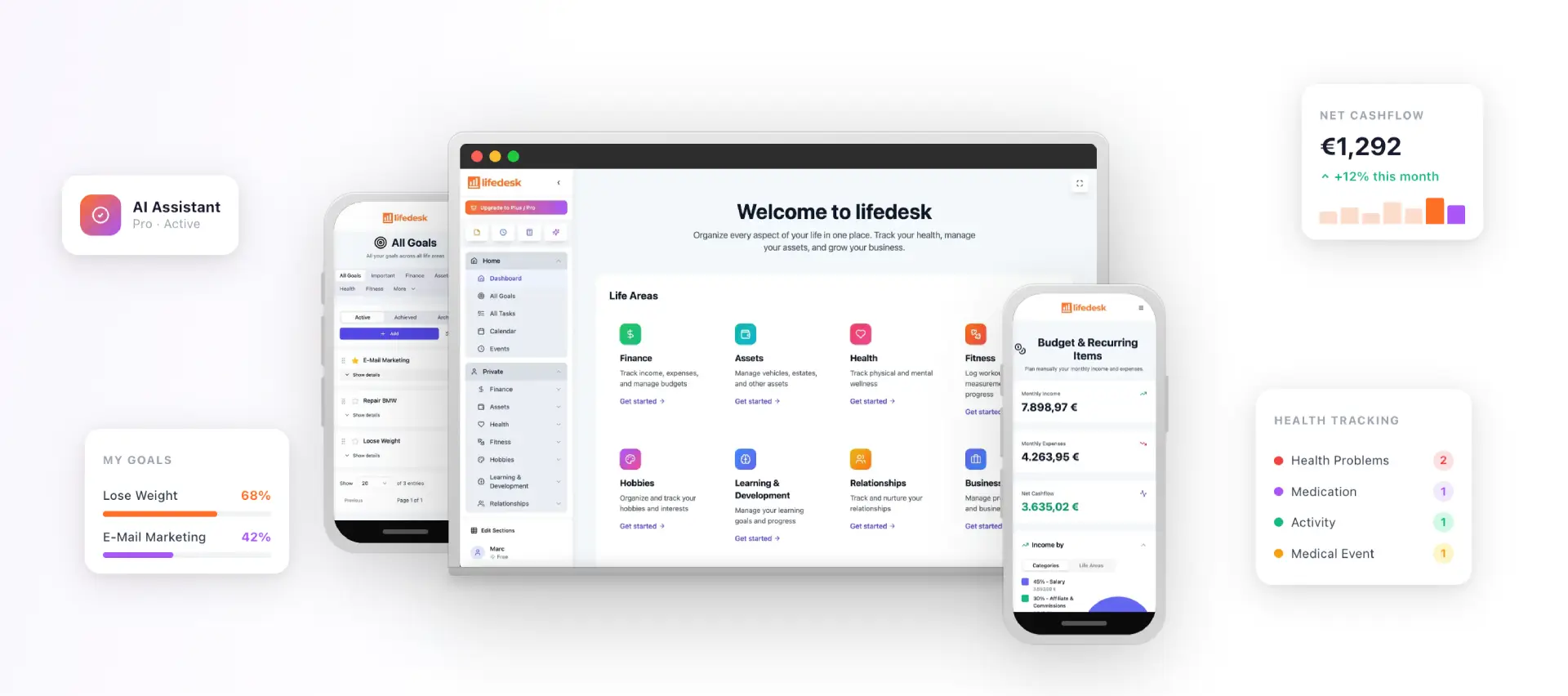
Map the guide directly onto the platform. Your daily 1-3-5 list runs in tasks and goals, your 90-minute power blocks go straight onto the built-in calendar the same way LifeDesk’s time blocking guide describes, and the time tracker gives you the exact audit data the Pareto method needs instead of a guess. Client projects get their own home in project management, separate from personal goals but visible in the same weekly view, and the built-in AI assistant can flag when a power block keeps sliding so the drift shows up before week four instead of after.
The honest next step: don’t wait for a perfect system. Open LifeDesk’s life management system this week, run your Week 0 audit inside it, and build your first 1-3-5 list before Friday.
What Is the Best Prioritization Framework for Beginners?
The 1-3-5 Rule is the easiest starting point because it takes under two minutes a day and immediately stops overloaded to-do lists.
How Long Should You Test a New Prioritization System?
Run any new framework for at least two to four weeks before judging it, since the first week is usually just building the habit, not measuring results.
Can You Combine Multiple Prioritization Frameworks?
Yes, layering works well: use a 90-day target or weekly review to filter what belongs on your list, then use the Eisenhower Matrix daily to triage whatever actually shows up.
What’s the Difference Between the Eisenhower Matrix and the Pareto Principle?
The Eisenhower Matrix sorts individual tasks by urgency and importance in the moment, while the Pareto principle is a broader audit that identifies which small cluster of tasks or clients drives most of your results over time.
How Do Freelancers Track Whether a Framework Is Working?
Compare a lead measure, like whether you completed your scheduled power blocks, against a lag measure, like revenue or project completion, using a simple tool like LifeDesk’s time tracker to log the baseline honestly.