Design daily boundaries, protect deep work, and run weekly reviews: that combination does more for sustainable balance than any single trick. Expect steadier energy and less burnout drift once boundaries are in place, and you can start today by picking one boundary (a...
Open a dedicated business bank account and route every bit of business income there, right from the start. Pair it with a business credit card and standalone bookkeeping, and pay yourself through documented draws or payroll instead of pulling cash whenever you need...
Plan 2026 by picking 3 to 5 annual priorities, writing an if-then plan for each using mental contrasting, converting every priority into tracked projects and milestones, and running quarterly plus weekly reviews inside one integrated planner. This approach keeps...
Founders should track three things first: deep work hours, personal well-being basics like sleep and movement, and a weekly review. Start with one to three habits, log them in under 60 seconds each morning, and treat the data as a business input rather than a personal...
Digital minimalism for work means using only the tools and notifications that earn a place in your day, so attention goes to the tasks that matter. The single fastest move is to protect a scheduled focus block on your calendar and mute every nonessential notification...
Use a one-page marketing planner built around a single quarterly goal, monthly campaign boxes, and weekly 30 to 60 minute execution blocks. This structure gives you clarity on what to work on today and protects you from the burnout that comes with juggling ten...
The best approach depends on frequency and sensitivity: use a client portal for recurring or sensitive exchanges, secure email or password-protected transfers for occasional low-risk files, e-signature services for anything requiring a signature, and managed file...
Make a room-by-room, photo-backed inventory of everything you own, then store a copy somewhere other than your house. Start today: pick your most valuable room and film a slow walkthrough narrating what you see, then upload whatever list you already have to a cloud...
A weekly review is a short, scheduled ritual where you clear your inboxes, check your calendar, and pick your priorities before the new week starts. The simplest version takes 15 to 20 minutes: dump loose tasks into one list, scan the next seven days, and write down...
Project and client management work best as two linked systems, not one blurred job. Delivery lives on scope, schedule, and resourcing; the relationship lives on trust, expectations, and retention. Agencies that connect them, with a shared client record and a fixed...
Time Blocking vs. Task Batching: Deep Work or Admin? Decide Today
Use time blocking for sustained deep work on a single project, and use task batching to group shallow, repeatable tasks into one focused session. Both methods solve the same underlying problem, which is constant context switching, but they solve it differently, and the two work best when scheduled together rather than chosen as a permanent either-or.
TL;DR:
Reserve time blocks for tasks requiring more than 60 uninterrupted minutes, and batch short, repeatable work into two or three daily windows.
Research links time blocking with more tasks attempted, but warns faster work can come at the cost of accuracy, especially when blocks lack clear goals.
Try two deep work blocks of 90 minutes each, two batches of 30 minutes each, and review the day for 15 minutes.
Before switching away from unfinished work, write one sentence naming the next step; a brief resumption note can reduce attention residue.
LifeDesk
lifedesk.me
Plan Focused Work in One Place
LifeDesk brings tasks, goals, and your calendar together so you can organize deep work and batched tasks alongside your other responsibilities.
Time blocking means assigning a specific window on your calendar to a single task or project, then protecting that window as if it were a meeting. You decide in advance what you will work on and for how long, which removes the moment-by-moment decision of “what should I do now.” According to Slack’s guide to time blocking, the method assigns calendar windows to single tasks or task categories, with variations like timeboxing, which sets a fixed end time regardless of completion, and day theming, which dedicates a whole day to one type of work, such as “Mondays for client calls.”
Typical blocks often run from longer spans for deep creative or analytical work down to shorter increments for Pomodoro-style sprints. Common examples include blocks of varying lengths reserved for focused work, planning sessions, or themed days dedicated to particular types of tasks.
The decision-fatigue benefit is real and practical: once a block is on the calendar, you stop negotiating with yourself about priorities every hour. For a deeper walkthrough of setup and templates, our guide to time blocking covers how to structure a week around these windows.
What Is Task Batching and When Should You Use It?
Task batching groups similar, usually short, tasks into one dedicated session instead of handling them one at a time throughout the day. Rather than answering each email as it arrives or approving each invoice the moment it lands, you let these items accumulate and process them together. Slack describes batching as grouping similar short tasks, like email, approvals, and admin work, into a single session to reduce context switching for those specific activities.
The mechanism is different from time blocking’s decision-fatigue reduction. Batching targets the switching cost itself, the mental reset required every time you move from one kind of task to another. Tasks that batch well tend to share a format or tool, even when the content varies.
Email and message replies, processed in two or three set windows rather than continuously.
Invoice approvals, expense reports, and other short administrative tasks.
Social media scheduling or content review done once per day or week.
A short end-of-day review batch to close loose threads before logging off.
A common cadence is two daily batches, one mid-morning and one late afternoon, plus a 15-minute end-of-day review to catch anything unresolved. This keeps shallow work from bleeding into the hours you want reserved for deep, uninterrupted focus.
Time Blocking vs. Task Batching: Key Differences
The two methods schedule fundamentally different kinds of work. Time blocking reserves a window for one project or one type of deep, often unpredictable task. Task batching groups many small, similar, predictable tasks so they get handled together instead of scattered across the day.
A quick checklist helps decide which to use for any given task:
Task complexity: Does it require sustained thought, or is it a quick, low-stakes action?
Predictability: Is the task the same shape every time (like clearing email), or does it demand fresh thinking?
Collaboration and interruptions: Does it need total isolation, or can it tolerate being handled in a shared, interruptible window?
As a working heuristic, tasks needing longer uninterrupted time periods are often best managed by blocking. If it is one of many quick, similar items, batch it. Research on task switching and depletion found that switching from a complex task to a routine one, and back, can actually reduce depletion and increase motivation in knowledge workers, which is a useful reminder that batching routine work between deep blocks is not a compromise. It can be a deliberate energy-management move rather than just a fallback when focus runs out.
Experimental work on time blocking and work performance adds a caution worth building into your setup: time blocking can increase the number of tasks attempted, but it can also create a speed-accuracy trade-off, and the benefit is largest for high-ability workers who pair blocking with clear goals. In practice, that means a block without a defined output invites rushed, lower-quality work, so pairing each block with a specific goal matters more than the block itself.
Who Should Use Which Method: Scenarios and Templates
The right mix depends on your role and the shape of your week, not on picking one method and abandoning the other.
Freelancers juggling client delivery and admin tend to protect two or three deep blocks per week for billable project work, then batch invoicing, client replies, and proposal follow-ups into a single afternoon session. Our guide on time management for freelancers breaks down how to protect billable hours from administrative creep.
Managers with frequent meetings often cannot claim long uninterrupted stretches, so they batch one-on-one prep, approvals, and status updates into a morning window, then use any open afternoon slot as a single deep block for planning or strategy work.
Individual contributors on focused technical or creative work usually benefit most from two 90-minute blocks a day, one in the morning and one after lunch, with a short batch window reserved for Slack, email, and code review comments.
Parents managing both household and work tasks often batch errands, school communications, and bill payments into one evening or weekend window, freeing weekday mornings for a single protected work block before the rest of the day fills in.
A simple hybrid daily template looks like this: a 90-minute deep block in the morning, a 30-minute batch window for email and quick replies, a second 90-minute deep block after lunch, a second 30-minute batch window in the late afternoon, and a 15-minute end-of-day review. On a weekly level, reserve your largest blocks, such as strategy sessions or creative deep work, on the days with the fewest scheduled meetings, and push batching windows to the days that are naturally more fragmented.
How to Set Up Time Blocking and Task Batching Today
Getting both methods running does not require a new system, just a deliberate first pass at your calendar and task list.
Audit your week for 30 minutes. List every recurring task and rough-estimate how long each one actually takes, separating “needs focus” from “needs processing.”
Sort tasks into two buckets. Anything that needs more than 60 uninterrupted minutes goes toward a time block; anything short, repeatable, or reactive goes toward a batch.
Place blocks first. Put your deep-work blocks on the calendar before anything else, during the hours you have the most energy and the fewest interruptions.
Set batching windows around the blocks. Fit two or three batch sessions into the gaps, typically mid-morning, after lunch, and late afternoon.
Name and color-code every entry. A block labeled “Deep: Q3 report” reads differently at a glance than a generic “Work” entry, and consistent colors make a week scannable in seconds.
Turn off notifications during blocks, leave them on during batches. This keeps deep work protected while still letting you stay responsive during the windows built for it.
Add buffer zones. A 10-minute gap between a block and a batch gives you room to close one task properly before opening the next.
Run a short end-of-day wrap. Note what got done, what carried over, and write one sentence describing exactly where to resume tomorrow.
That last step matters more than it looks. Research on interrupted tasks found that attention residue, the mental carryover from an unfinished task, lowers performance after a switch, but a brief “ready-to-resume” plan written before switching meaningfully reduces that effect. A single sentence like “Next: finish the second paragraph of the client proposal, cite the Q2 numbers” does more for tomorrow’s start than any amount of willpower.
Pro Tip:Write your “ready-to-resume” note at the end of a block, not the start of the next one. You have the context fresh in your head now; you will not have it tomorrow.
Implementation intentions help here too. Slack notes that if-then plans, such as “when my 9 AM block starts, I open the proposal document and nothing else,” make starting scheduled work more likely by creating a specific trigger instead of relying on motivation in the moment.
For a weekly review, track three simple numbers: how many blocks you actually completed as scheduled, what percentage of batch items got cleared in their window, and which blocks got interrupted or skipped. If a particular block type keeps getting skipped, it usually means the time slot is wrong, not that the method has failed. Adjust the placement before you abandon the approach. For teams tracking adherence across multiple people, a resource like Kloqk’s guide to remote time tracking covers practical scheduling and measurement practices worth borrowing even for a solo setup.
Running Blocks and Batches Inside LifeDesk
Putting this workflow into practice is mostly a matter of having tasks, calendar, and goals in the same place instead of juggling a separate app for each. A simple sequence works well:
Create a project for the work you want to protect with deep blocks, and break it into estimated tasks so each block has a defined, specific output.
Convert the largest tasks directly into calendar blocks, naming each one clearly so a glance at the week shows exactly what it is for.
Group the smaller, recurring tasks, like client emails, invoice follow-ups, or admin items, into a batch list attached to a recurring calendar window.
Use the weekly review to compare completed blocks against batch completion, adjusting next week’s placement based on what actually got protected versus what got interrupted.
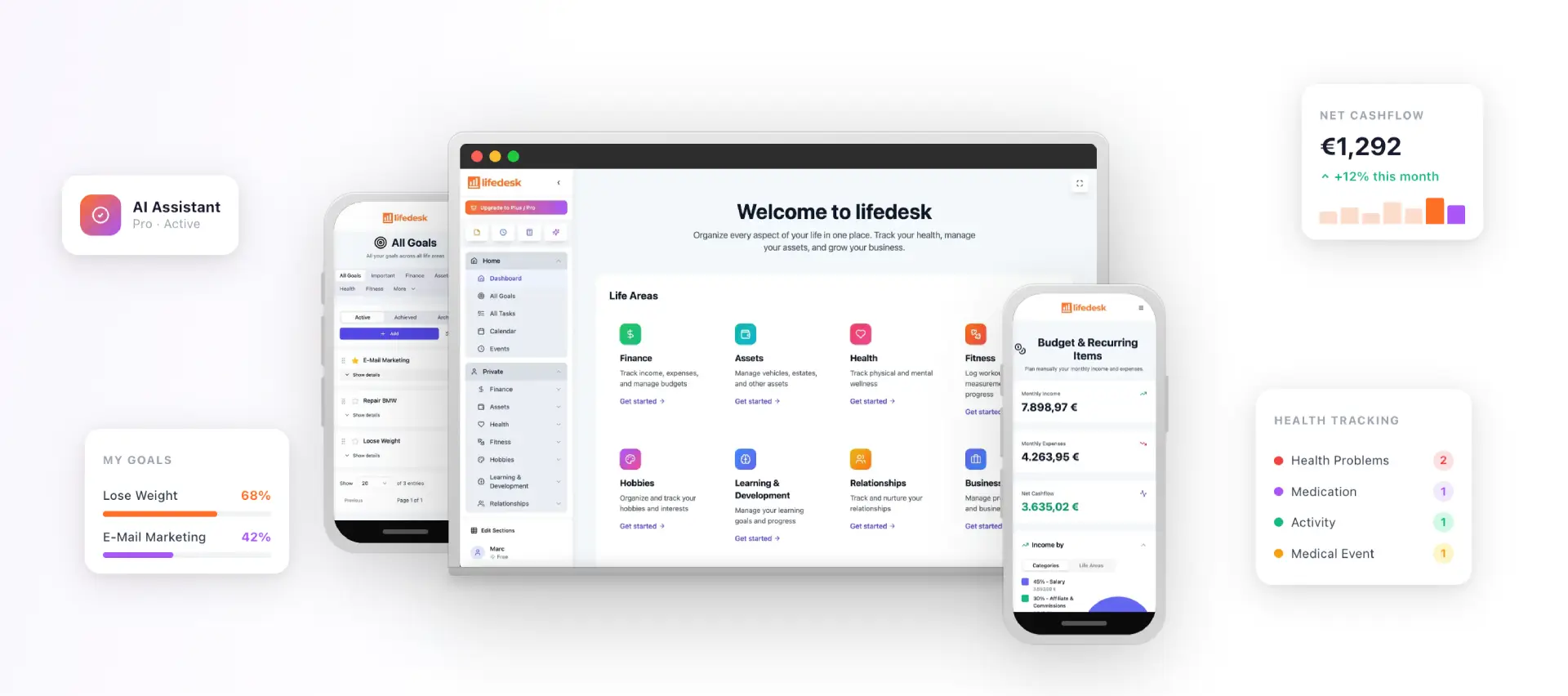
Because tasks, goals, and calendar live in one structure rather than three disconnected tools, a block created from a project task stays linked back to that project’s progress, and a batch list stays visible without needing a separate app open. Our calendar and task integration guide walks through the mechanics of linking tasks directly to calendar entries, which is the core move behind both methods described here.
Build Your Block-and-Batch Schedule in One Place
Running time blocking and task batching side by side gets harder the moment your calendar, your task list, and your project notes live in three different apps, which is exactly the fragmentation these two methods are meant to fix. We built LifeDesk to keep deep-work blocks, batch lists, goals, and even personal commitments in a single view, so a block you create for a client project and a batch list for weekly admin sit on the same calendar instead of competing across tools.
Our AI productivity assistant can suggest blocks based on your task estimates and surface recurring items worth batching, so setting up the workflow above takes minutes rather than a Sunday-afternoon planning session. The Free plan covers the basics of tasks and calendar, while Plus at $9 per month and Pro at $19 per month unlock the AI assistant and deeper integrations for anyone managing both business and personal responsibilities in the same week. If you want to see the full picture of how blocks, batches, and goals connect, our features overview shows the setup in detail. Try building one block-and-batch day inside LifeDesk this week and see how it holds up against your current calendar.
FAQ
Is multitasking good for time management?
No. Research summarized by the APA on multitasking shows that frequent multitasking harms sustained attention and often reduces performance on complex tasks. Time blocking and task batching both work specifically because they prevent multitasking, directing one kind of attention to one kind of task at a time.
What are the three types of tasks for scheduling purposes?
Most time management approaches, including time blocking and batching, sort tasks into deep, focus-intensive work, shallow repeatable work, and reactive or unpredictable work. Deep tasks fit time blocks, shallow and repeatable tasks fit batches, and reactive work is usually best handled in a dedicated response window rather than scattered across the day.
What are some effective time management techniques besides blocking and batching?
Beyond time blocking and task batching, common techniques include the Pomodoro method, which breaks work into short timed sprints, and day theming, which dedicates full days to one category of work. Setting implementation intentions, or specific if-then triggers for starting scheduled work, also meaningfully improves follow-through according to Slack’s breakdown of time blocking.
Does switching between apps and tasks actually cost time?
Yes. HBR’s analysis of app toggling found that switching between applications and tasks carries measurable time and cognitive costs, and grouping related work reduces those costs. This is the same logic behind task batching, applied specifically to digital tools and tabs rather than physical tasks.
How does LifeDesk help with time blocking and task batching?
LifeDesk keeps tasks, calendar, and goals in one view, so you can turn an estimated task directly into a calendar block or group several small tasks into a batch list without switching apps. The Plus and Pro plans add an AI assistant that can suggest blocks and batches based on your existing task list.