Design daily boundaries, protect deep work, and run weekly reviews: that combination does more for sustainable balance than any single trick. Expect steadier energy and less burnout drift once boundaries are in place, and you can start today by picking one boundary (a...
Use time blocking for sustained deep work on a single project, and use task batching to group shallow, repeatable tasks into one focused session. Both methods solve the same underlying problem, which is constant context switching, but they solve it differently, and...
Open a dedicated business bank account and route every bit of business income there, right from the start. Pair it with a business credit card and standalone bookkeeping, and pay yourself through documented draws or payroll instead of pulling cash whenever you need...
Founders should track three things first: deep work hours, personal well-being basics like sleep and movement, and a weekly review. Start with one to three habits, log them in under 60 seconds each morning, and treat the data as a business input rather than a personal...
Digital minimalism for work means using only the tools and notifications that earn a place in your day, so attention goes to the tasks that matter. The single fastest move is to protect a scheduled focus block on your calendar and mute every nonessential notification...
Use a one-page marketing planner built around a single quarterly goal, monthly campaign boxes, and weekly 30 to 60 minute execution blocks. This structure gives you clarity on what to work on today and protects you from the burnout that comes with juggling ten...
The best approach depends on frequency and sensitivity: use a client portal for recurring or sensitive exchanges, secure email or password-protected transfers for occasional low-risk files, e-signature services for anything requiring a signature, and managed file...
Make a room-by-room, photo-backed inventory of everything you own, then store a copy somewhere other than your house. Start today: pick your most valuable room and film a slow walkthrough narrating what you see, then upload whatever list you already have to a cloud...
A weekly review is a short, scheduled ritual where you clear your inboxes, check your calendar, and pick your priorities before the new week starts. The simplest version takes 15 to 20 minutes: dump loose tasks into one list, scan the next seven days, and write down...
Project and client management work best as two linked systems, not one blurred job. Delivery lives on scope, schedule, and resourcing; the relationship lives on trust, expectations, and retention. Agencies that connect them, with a shared client record and a fixed...
Yearly Planning 2026 with MCII: Map Goals to Calendar, Money & Health
Plan 2026 by picking 3 to 5 annual priorities, writing an if-then plan for each using mental contrasting, converting every priority into tracked projects and milestones, and running quarterly plus weekly reviews inside one integrated planner. This approach keeps goals, calendar, tasks, finances, and health visible in one place instead of six apps. A tool like LifeDesk can hold the whole structure, though the method matters more than the software.
TL;DR:
Setting 3 to 5 specific, outcome-based priorities and creating if-then plans for obstacles significantly improves follow-through, with effect sizes around 0.65.
Visualizing milestones, tracking finances and health metrics, and integrating all into one dashboard prevents scattered efforts and maintains focus throughout the year.
Conducting quarterly planning sessions and weekly reviews ensures continuous progress, with just 20 minutes weekly keeping goals aligned and on track.
Linking calendar milestones, tasks, finance events, and health metrics to each goal promotes seamless updates and prevents manual synchronization errors.
Using an app like LifeDesk that connects projects, calendars, finances, and health data supports this integrated workflow while requiring minimal setup time.
LifeDesk
lifedesk.me
Plan Your Whole Year in One Place
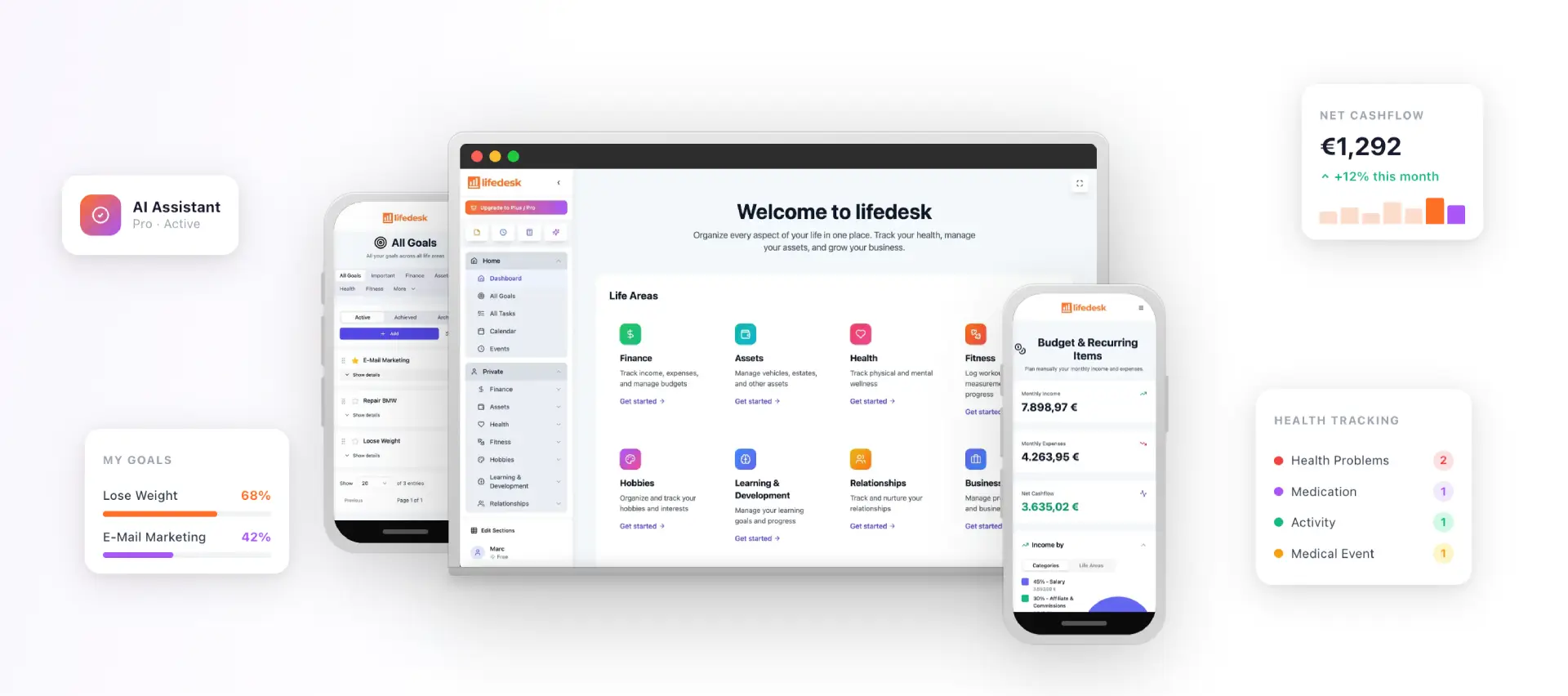
LifeDesk brings goals, calendars, finances, health, and work organisation together for a clearer view of your 2026 priorities.
A well-run annual plan does four things at once: it aligns your priorities so you stop juggling competing goals, makes milestones visible instead of vague, puts your finances and health in the same view as your work, and cuts the mental tax of switching between five different apps to check your life.
Structured goal writing is not just a productivity trend. Implementation intentions, the if-then plans at the core of this method, show medium-to-large effects on goal attainment across many studies, with a meta-analysis reporting Cohen’s d around 0.65. A staged written goal-setting intervention produced roughly a 22% jump in academic performance compared to people who set goals casually, and the depth of the written plan tracked closely with the size of the gain.
By the end of 2026, a plan run this way should leave you with a small number of completed milestones you can point to, a finance dashboard that reflects real transactions instead of guesses, and a health or fitness metric you actually moved, all visible on one dashboard rather than scattered across sticky notes and separate apps.
A compact, evidence-based yearly planning workflow
The workflow below borrows directly from mental contrasting with implementation intentions, or MCII, a technique with a solid research base. It takes a few hours once a year and about twenty minutes a week to maintain.
Choose 3 to 5 annual priorities. Write each as a specific outcome statement, not a vague wish: “Launch my consulting practice with 3 retained clients” beats “grow my business.”
Run mental contrasting, then write implementation intentions. For each goal, picture the positive outcome, then identify your biggest obstacle, then write 2 to 3 if-then plans (“If a client call runs long on a Tuesday, then I move my gym session to 6 AM”). MCII experiments found this combination increased course completion by 15% to 32% and that the exercise works even as a short online activity, sometimes under 8 minutes.
Break each goal into a project with milestones. Set 3 to 4 milestones across the year, then create the first 1 to 3 tasks that move you toward the nearest one.
Schedule milestone dates, block initial work time, and attach tracking. Put the milestone on your calendar, time-block the first work session, and connect any relevant finance or health metric.
A concrete example: a career goal of “get promoted to senior analyst” becomes a project with milestones at each quarter (skills review, visible project delivery, manager check-in, formal review), with the first task being a 30-minute skills gap conversation scheduled this week. A fitness goal of “run a half marathon in October” becomes a project with milestones at 5K, 10K, and 15K training benchmarks, with the first task being three scheduled runs this week logged in a tracker.
Pro Tip:Write the if-then plan on the same screen where you create the task, so the obstacle and the action live next to each other instead of in a separate notebook.
Map annual goals into calendar, tasks, projects, finance, and health tracking
A plan only stays integrated if every piece of a goal lands in the right place. Treat each annual priority as a source that feeds five different trackers, not five unrelated to-do lists.
Milestones go on the calendar as dated events, not just task deadlines, so you see them when you glance at a week or month view.
Next actions become tasks, each tagged to its parent project so a busy week never loses sight of which goal it serves.
Budgets and recurring costs go into the finance tracker, linked to the project they fund (a course fee, a marketing budget, a gear purchase).
Habits and metrics go into the health or fitness tracker, logged on a cadence that matches the goal (daily steps, weekly runs, monthly weight checks).
Money events get calendar entries too, like an invoice due date or a savings transfer, so the calendar doubles as an index of financial commitments.
For a career goal, that might mean a milestone event in March, three tasks tagged “promotion” this month, and no finance entry at all. For an income goal, it means a monthly revenue target logged in the finance dashboard alongside a tagged project for each client. For a fitness goal, it means a recurring task for each run and a weight or pace metric logged weekly.
Tags and linked records matter more than they sound. A project tagged once and referenced everywhere means a single update, say moving a deadline, automatically reflects on the calendar and in the weekly task list, instead of requiring you to edit three separate entries by hand.
Quarterly and weekly routines to execute 2026 without burnout
Annual goals fail most often not from bad intentions but from no cadence to check progress. Two routines carry most of the weight.
Quarterly planning (90 minutes, once per quarter). Write a one-page plan covering your 3 to 5 goals, their milestones for the next 90 days, and any budget tied to them. A one-page 90-day plan keeps this from sprawling into a document nobody rereads.
Weekly review (20 minutes, same day each week). Close the loop on last week’s tasks, check the calendar for the week ahead, glance at the finance dashboard, and log any health metrics you missed.
Daily micro-commitments. Pick one or two tasks tied to an active milestone and time-block them, rather than working from an open-ended list.
Re-plan a goal when a milestone slips twice in a row or when the obstacle in your if-then plan keeps recurring unresolved. That is a signal the plan, not your effort, needs adjusting.
Tools and setup checklist for an integrated digital planner
Before the quarterly cadence runs smoothly, the planner itself needs a few things configured once.
Create separate personal and work spaces so a client project and a family budget do not compete for the same view.
Connect calendars and finance accounts so milestones and money events show up automatically instead of requiring manual entry.
Enable health integrations or import baseline data for whichever metric matters most this year.
Set up the annual roadmap, quarterly plan, project board, weekly agenda, finance dashboard, and health dashboard as your core views, since these six cover almost every check-in you will need.
Build or import an MCII goal template, a project template with milestones and budgets, and a weekly review template, so you are filling in a form rather than starting from a blank page every time.
Platforms built for this kind of cross-domain tracking, such as the tasks and goals features in LifeDesk, handle the linking between projects and calendar automatically once the connections are set.
Track, review, and adapt: metrics, signals, and decision rules
Two kinds of metrics matter. Leading metrics, like weekly tasks completed or focus blocks scheduled, tell you whether you’re putting in the work. Lagging metrics, like milestones hit, net worth change, or a fitness benchmark, tell you whether the work is paying off.
During a weekly or quarterly review, use a simple 0-1-2 rule to decide what to do with a stalled goal: 0 means the metrics look fine, so you maintain the current plan; 1 means one leading or lagging metric is off track, so you adjust the if-then plan or the schedule; 2 means multiple metrics have been off for more than one cycle, so you replan the goal entirely or drop it.
A meta-analysis of implementation intentions found a Cohen’s d of approximately 0.65 for goal attainment, a medium-to-large effect that holds up across many different kinds of goals. That is the evidence behind writing if-then plans rather than only listing goals: the plan itself changes whether you follow through.
How LifeDesk supports this 2026 workflow
LifeDesk is built around a structure that supports this workflow: goals that connect to projects, projects that connect to calendar milestones, and calendar milestones that connect to finance and health tracking, integrated in a single app.
The platform includes MCII-ready goal templates, quarterly planning templates, and a weekly review template to facilitate setup efficiently. The platform connects bank accounts for personal and business finance, so a budget tied to a goal can reflect actual transactions. If you want to see the structure before committing, our Free plan gets you started, and our Plus and Pro plans unlock bank connections and the AI assistant once you’re ready to go further.
FAQ
What is the best way to start yearly planning for 2026?
Start by picking 3 to 5 priorities and writing each as a specific outcome, then use mental contrasting to identify the main obstacle before writing an if-then plan. This single step, backed by MCII research, does more for follow-through than a long list of resolutions.
How many goals should I set for the year?
Most structured planning approaches recommend 3 to 5 annual priorities rather than a longer list, since fewer goals written in depth tend to get more attention and follow-through than many goals listed casually. A goal-setting intervention study found that plan quality and participation depth correlated with better outcomes.
What is MCII and why does it matter for 2026 goals?
MCII stands for mental contrasting with implementation intentions: you picture the goal’s positive outcome, identify the obstacle in your way, then write an if-then plan for that specific obstacle. Experimental studies found this combination increased course completion by 15% to 32% in experiments compared to goal-setting without the if-then step.
How often should I review my 2026 plan?
A weekly review of about 20 minutes to close the loop on tasks and metrics, paired with a 90-minute quarterly planning session, covers most of what an annual plan needs. This cadence lines up with research on if-then planning, which finds that planning effects depend on being revisited rather than set once and forgotten.
Can one app really handle goals, finances, and health together?
Yes, provided the app links projects, calendar milestones, and trackers so an update in one place reflects everywhere else. We built LifeDesk specifically to connect those domains rather than keeping them in separate apps.
Sources
The research behind this workflow includes a meta-analysis on implementation intentions, the original MCII study in PNAS, a goal-setting intervention study on academic performance, and practical guidance on connecting notes to tasks for turning decisions into traceable work.