Use a one-page marketing planner built around a single quarterly goal, monthly campaign boxes, and weekly 30 to 60 minute execution blocks. This structure gives you clarity on what to work on today and protects you from the burnout that comes with juggling ten...
The best approach depends on frequency and sensitivity: use a client portal for recurring or sensitive exchanges, secure email or password-protected transfers for occasional low-risk files, e-signature services for anything requiring a signature, and managed file...
Make a room-by-room, photo-backed inventory of everything you own, then store a copy somewhere other than your house. Start today: pick your most valuable room and film a slow walkthrough narrating what you see, then upload whatever list you already have to a cloud...
A weekly review is a short, scheduled ritual where you clear your inboxes, check your calendar, and pick your priorities before the new week starts. The simplest version takes 15 to 20 minutes: dump loose tasks into one list, scan the next seven days, and write down...
Project and client management work best as two linked systems, not one blurred job. Delivery lives on scope, schedule, and resourcing; the relationship lives on trust, expectations, and retention. Agencies that connect them, with a shared client record and a fixed...
Calendar task integration turns your to-do list into scheduled, time-bound calendar blocks so work actually gets done instead of piling up unseen. The fastest path is either a native tasks layer inside your calendar app or an OAuth-based connector syncing a separate...
Quarterly planning means running your business goals on a 90-day cycle instead of a single annual push, reviewing progress and adjusting course every quarter. The practical version that works best: pick a few measurable priorities, assign a clear owner to each, set...
Most people don’t need one framework. They need three, stacked by time horizon: a long-range direction setter like a BHAG or OGSM, a quarterly execution engine like OKRs, and SMART criteria to keep the resulting key results honest and measurable. Skip the strategic...
The PARA method sorts every file, note, and task you own into four folders (Projects, Areas, Resources, Archives) based on how soon you need to act on it. The main payoff is speed: you stop hunting through nested folders and start finding what you need in seconds,...
The best prioritization frameworks for anyone juggling client work, personal goals, and everything in between are the Eisenhower Matrix, the Pareto principle (80/20), the 1-3-5 Rule, time blocking, and a weekly review. Pick one today: schedule a 90-minute protected...
Weekend Audit and 30 Day Plan for Digital Minimalism for Professionals
Digital minimalism for work means using only the tools and notifications that earn a place in your day, so attention goes to the tasks that matter. The single fastest move is to protect a scheduled focus block on your calendar and mute every nonessential notification before you start it. Everything else, from app audits to team norms, builds on that one habit.
TL;DR:
Using a single tool per job category and scheduling dedicated focus blocks minimizes app overload and enhances productivity during protected time.
Conducting a weekend app audit and establishing a 30-day follow-up routine helps eliminate unnecessary notifications and reduces digital clutter.
Setting fixed reply windows and batching notifications can decrease interruptions by over half, especially for those with low telepressure and fear of missing out.
Coordinating core work hours and limiting meeting lengths across teams fosters a focus-friendly environment and prevents workday fragmentation.
Consolidating tasks, calendar, notes, and finances into one system like LifeDesk simplifies digital environments and supports sustained minimalism efforts.
LifeDesk
lifedesk.me
Bring Your Work Into One Place
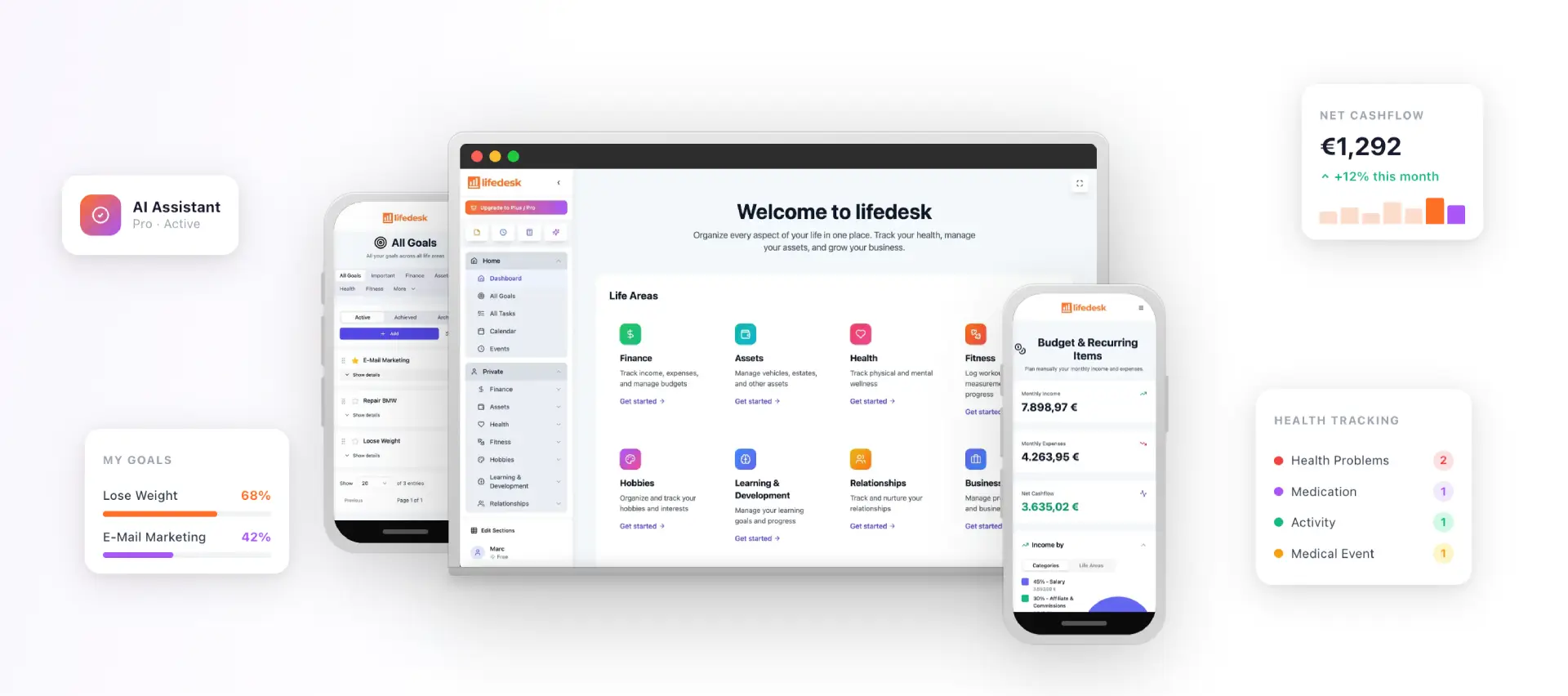
LifeDesk brings tasks, goals, calendars, finances, and business organization together, helping professionals structure work and personal responsibilities in one app.
Digital minimalism at work is not about using fewer devices for its own sake. It is about selective tool use: keeping the apps that remove friction and cutting the ones that just add another inbox to check. Time gets treated as a finite, protected resource rather than something to fill between interruptions, and availability becomes a choice you set on purpose instead of a default everyone assumes.
A few guardrails make this concrete:
Use one tool per job category instead of three overlapping ones.
Set explicit response-time expectations so colleagues stop expecting instant replies.
Schedule focus blocks before the week fills up with meetings.
Review app permissions and notifications monthly, not once and forget it.
The goal is more meaningful output, not less work. A three-layered approach that aligns physical space, digital tools, and time reduces the friction that eats hours, rather than asking people to simply try harder.
The three-layered framework: physical, digital, and time
Professionals who sustain digital minimalism usually organize it into three layers that reinforce each other.
Physical layer: One workstation, a clear desk surface, and a visual cue such as closed headphones or a closed door to signal focus time to others.
Digital layer: Consolidate overlapping apps into single-purpose tools, work in one window at a time, and simplify folder structures so files take seconds to find.
Time layer: Block two or three protected focus periods daily, treat them as fixed calendar appointments, and set specific reply windows for email and chat.
A sample day might look like this: a 90-minute focus block in the morning with notifications off, a midday reply window for email and messages, a second focus block after lunch, and a short end-of-day review to close open loops. Each layer supports the others: the physical cue keeps interruptions away during the digital and time blocks, while a simplified digital environment means the focus block does not get eaten up hunting for a file.
Pro Tip:Pair your focus block with a physical signal, like headphones on, so coworkers learn to read it without you having to explain it every time.
Step-by-step digital declutter: a weekend audit plus a 30-day follow-up
A working declutter routine has two phases: an intensive weekend pass and a lighter month of upkeep.
Weekend audit:
List every app, account, and subscription you use for work, including ones you forgot about.
Sort each into “essential,” “occasional,” or “remove,” and delete or archive anything in the last category.
Turn off push notifications for everything except messaging from direct collaborators.
Consolidate logins where possible so you are not juggling five separate passwords for tools that do similar things.
30-day follow-up:
Set a recurring weekly 15-minute check to remove any new app or notification that crept back in.
Track one measurable goal, such as fewer context switches per day or shorter time to inbox zero.
Note which focus blocks got interrupted and why, then adjust the physical or digital layer accordingly.
At day 30, compare your notification count and app list against the weekend audit baseline.
Expect some pushback in week one as colleagues adjust to your new response times. If a tool you cut turns out to be genuinely necessary, bring it back deliberately rather than letting the whole list creep back to where it started.
Notification and communication rules that protect focus
Reducing notification-caused interruptions improves performance and lowers strain, but the benefit is not uniform. People with low or moderate fear of missing out, and low telepressure, gain the most from cutting notifications outright. Employees high in either trait often need a compromise plan rather than a hard cutoff, since anxiety about missed messages can undercut the benefit.
Practical patterns that work across both groups:
Set fixed reply windows (for example, three times a day) instead of checking continuously.
Route urgent requests to one channel, like a phone call, and treat everything else as non-urgent by default.
Use a visible status signal, such as a calendar block or chat status, so colleagues see when you are heads-down.
Batch nonurgent notifications and review them at natural breakpoints rather than as they arrive.
One field study found that deferring notifications to opportune moments cut interruptions by about 54%, showing that timing, not just volume, drives the benefit. For high-FoMO professionals, a workable compromise is a short midday and end-of-day check paired with an away message explaining the reply window.
How to get teams and organizations to back digital minimalism
Individual habits only stick when the team around you supports them. A short set of shared rules prevents one person’s focus block from becoming another person’s bottleneck.
Define core hours when everyone is reachable, and treat the rest as async by default.
Set an email curfew, such as no expectation of replies after a fixed evening hour.
Cap meetings to a default length and require an agenda before anyone can book one.
Designate one channel for urgent matters and retire the rest for routine updates.
Leadership modeling matters more than a written policy. A manager who replies to messages at midnight signals that everyone should, regardless of what the policy says. Consolidating redundant tools, like three chat apps doing the same job, removes the temptation to check all of them “just in case.” A quick rollout checklist for managers: audit current tools, agree on core hours as a team, name one urgent channel, and revisit the rules after a month based on what actually got used.
Tools and minimal systems that support the approach
The right category of tool matters more than the specific brand. Favor a unified task manager over three overlapping to-do apps, a single calendar instead of separate personal and work calendars, and a focused email workflow that turns messages into tasks rather than leaving them as an ever-growing list.
Good selection criteria:
Low maintenance: the tool should not need daily tinkering to stay useful.
Few integrations required: fewer moving parts means fewer failure points.
Sensible defaults: a tool that works well out of the box beats one that needs heavy setup.
Distraction blockers or focus modes built in, rather than a separate app for that too.
A single-purpose app makes sense when you need deep functionality in one area, like dedicated time tracking. An all-in-one system makes more sense once you are juggling tasks, calendar, and notes across four or five separate apps and spend more time syncing them than using them.
Applying the guide with LifeDesk: a practical perspective
The three-layered framework holds up regardless of which tools you choose, but the digital layer gets easier to maintain when tasks, calendar, and notes live in one place instead of scattered across five logins. An all-in-one system like LifeDesk is one way to reduce that sprawl, since it keeps personal and business planning in the same view without requiring a separate app for each domain.
A safe way to adopt any integrated system: migrate one workflow at a time, such as moving your task list before your calendar, and check after two weeks whether it actually reduced app switching or just moved the clutter somewhere new. If it does not reduce friction, it is not the right fit for that layer yet.
Try LifeDesk to consolidate tools and protect your focus
If the weekend audit above left you with a shorter app list but still too many logins, LifeDesk consolidates tasks, calendar, notes, and even finances into one workspace, which maps directly onto the digital layer of the framework. The free plan covers basic task and calendar organization, while Plus and Pro add features like bank account connections and an AI assistant for those managing both a business and a personal life.
For a practical first step, the life management system starter guide walks through setting up your first workspace in one sitting, so you can test whether consolidation actually saves you the app switching you are trying to cut.
Digital minimalism continues to show up in workplace productivity advice, largely because notification overload and app sprawl have not gone away. The core practices, like batching notifications and protecting focus time, remain grounded in the interruption research cited above regardless of shifting trends.
Is Mark Zuckerberg a minimalist?
There is no publicly documented evidence tying Mark Zuckerberg to digital minimalism as a personal practice or philosophy. Digital minimalism is better understood as a set of workplace habits, such as selective tool use and protected focus time, than as a label attached to any single public figure.
What are the criticisms of digital minimalism?
A common criticism is that cutting notifications and apps does not help everyone equally. Research on task interruptions shows that people high in fear of missing out or telepressure often need social-norm interventions or compromise plans rather than a blanket notification cutoff, since anxiety about missed messages can offset the benefit.
Does Gen Z like minimalism?
There is no reliable data in the sources reviewed here on generational preferences for digital minimalism specifically. What the research does support is that reducing unnecessary interruptions improves focus and lowers strain across knowledge workers generally, independent of age group.