Digital minimalism for work means using only the tools and notifications that earn a place in your day, so attention goes to the tasks that matter. The single fastest move is to protect a scheduled focus block on your calendar and mute every nonessential notification...
Use a one-page marketing planner built around a single quarterly goal, monthly campaign boxes, and weekly 30 to 60 minute execution blocks. This structure gives you clarity on what to work on today and protects you from the burnout that comes with juggling ten...
Make a room-by-room, photo-backed inventory of everything you own, then store a copy somewhere other than your house. Start today: pick your most valuable room and film a slow walkthrough narrating what you see, then upload whatever list you already have to a cloud...
A weekly review is a short, scheduled ritual where you clear your inboxes, check your calendar, and pick your priorities before the new week starts. The simplest version takes 15 to 20 minutes: dump loose tasks into one list, scan the next seven days, and write down...
Project and client management work best as two linked systems, not one blurred job. Delivery lives on scope, schedule, and resourcing; the relationship lives on trust, expectations, and retention. Agencies that connect them, with a shared client record and a fixed...
Calendar task integration turns your to-do list into scheduled, time-bound calendar blocks so work actually gets done instead of piling up unseen. The fastest path is either a native tasks layer inside your calendar app or an OAuth-based connector syncing a separate...
Quarterly planning means running your business goals on a 90-day cycle instead of a single annual push, reviewing progress and adjusting course every quarter. The practical version that works best: pick a few measurable priorities, assign a clear owner to each, set...
Most people don’t need one framework. They need three, stacked by time horizon: a long-range direction setter like a BHAG or OGSM, a quarterly execution engine like OKRs, and SMART criteria to keep the resulting key results honest and measurable. Skip the strategic...
The PARA method sorts every file, note, and task you own into four folders (Projects, Areas, Resources, Archives) based on how soon you need to act on it. The main payoff is speed: you stop hunting through nested folders and start finding what you need in seconds,...
The best prioritization frameworks for anyone juggling client work, personal goals, and everything in between are the Eisenhower Matrix, the Pareto principle (80/20), the 1-3-5 Rule, time blocking, and a weekly review. Pick one today: schedule a 90-minute protected...
Busy Professionals: 5 Steps to Share Documents With Clients Securely
The best approach depends on frequency and sensitivity: use a client portal for recurring or sensitive exchanges, secure email or password-protected transfers for occasional low-risk files, e-signature services for anything requiring a signature, and managed file transfer (MFT) for regulated or high-volume transfers. Whichever method you pick, insist on encryption in transit and at rest, role-based access controls, audit logs, and link expiration. The details on setup and vendor selection follow below.
TL;DR:
Client portals are ideal for ongoing relationships with frequent file exchanges, providing role-based access, audit logs, and expiration links for security.
Secure email can be suitable for low-sensitivity, infrequent transfers by encrypting attachments and using third-party portals, but it has size and confidentiality limitations.
E-signature apps deliver tamper-proof signatures with detailed audit trails, ensuring verifiable custody and proper workflow for legal documents.
Managed file transfer offers guaranteed, compliant delivery for high-volume or regulated files, with robust logging and automated handling at higher costs.
Proper operational discipline, including MFA, access revocation, and regular review of permissions, is essential to maintain security over time.
LifeDesk
Keep Client Workflows Organized
LifeDesk brings tasks, goals, calendars, finances, and business organization together, helping busy professionals keep client work in view.
At a glance: quick shortlist of methods and when to use each
Choosing a method starts with two questions: how often do you send files to this client, and how sensitive is the content? A one-off invoice needs far less infrastructure than monthly financial statements or signed contracts.
Client portals work best for ongoing relationships where you exchange multiple documents over weeks or months, offering per-client folders and access history.
Secure email (encrypted attachments or password-protected files) suits infrequent, low-sensitivity exchanges where setting up a portal would be overkill.
E-signature apps are the right call anytime a document needs a legally recognized signature, such as contracts or engagement letters.
Business file-sharing services cover general document transfer for small teams that need shared folders without heavy compliance requirements.
Managed file transfer (MFT) fits regulated industries or large, scheduled transfers where guaranteed delivery and detailed audit trails are contractual requirements.
The tradeoff runs in one direction: convenience decreases and control increases as you move from email toward MFT. Matching the tool to the actual risk keeps both your workload and your client’s trust intact.
Secure email: when it fits and how to configure it safely
Email remains the default for many professionals, and it can be secure enough for low-sensitivity, one-off transfers when configured correctly. The NIST ITL Bulletin on file exchange security lists encrypted attachments, S/MIME, and third-party encryption portals as viable options, while warning that many commercial products do not use FIPS-validated cryptographic implementations. For anything beyond routine correspondence, that distinction matters: prefer tools that state their cryptographic standard rather than assuming “encrypted” means the same thing everywhere.
Encrypted zip files and S/MIME both scramble content so only the intended recipient can read it, but they come with friction. S/MIME requires certificate setup on both ends, which most clients will not tolerate. Encrypted zips are simpler but still require you to send a password through a separate channel, ideally a text message or phone call rather than a second email.
Third-party email encryption portals split the difference: the client clicks a link, verifies their identity, and reads the message in a browser rather than an inbox. This avoids certificate management while still limiting exposure if the email itself is intercepted.
Choose a strong, unique password for each encrypted file rather than reusing one across clients.
Send the password through a different channel than the file itself.
Set an expiration date on any hosted attachment link so it stops working after the engagement need has passed.
Confirm the recipient’s email address before sending, especially for auto-complete suggestions that resemble the real one.
Pro Tip:Never send the password in the same email thread as the file. If someone intercepts the message, they get both halves at once.
Email has real limits. Attachment size caps push large files into third-party links anyway, and email offers no per-client isolation: a misdirected message can expose one client’s data to another. For anything involving financial records, health information, or signed legal documents, treat email as a stopgap rather than a system.
E-signature apps: secure signing, auditability, and workflows
Emailing a PDF for a client to print, sign, scan, and return creates a document with no verifiable chain of custody. E-signature platforms solve this by producing a tamper-evident signature tied to a time-stamped audit log, so you can prove who signed what and when.
The minimum feature set worth requiring includes the following:
Tamper-evident signatures that break or flag if the document is altered after signing.
Time-stamped audit trails recording every view, field completion, and signature event.
Identity verification options, such as email confirmation or knowledge-based checks, for higher-stakes documents.
Secure storage of the final signed artifact in an access-controlled repository rather than a shared inbox.
Beyond the security basics, workflow design affects how smoothly clients actually sign. Prepopulating known fields (name, date, engagement details) reduces the chance of a client abandoning the form halfway through. Routing and delegation features let you send a document to the right signer even when the original contact isn’t the one authorized to sign, which matters for multi-person approvals inside a client organization.
Once signed, the document’s job isn’t done. Store the final version somewhere access-controlled and backed up, not just in the e-signature vendor’s own archive, since account access to that vendor could change or lapse. Treating the signed PDF as a permanent record, filed alongside related project documents, avoids a scramble later if a client disputes terms.
Client portals: per-client isolation, RBAC, and professional delivery
For any relationship that involves recurring document exchange, a dedicated client portal outperforms email on nearly every axis that matters: security, professionalism, and your own time. The core advantage is per-client isolation, meaning each client sees only their own folder and files, with no risk of one client’s invoice landing in another’s inbox by mistake. That single feature eliminates the most common way small businesses accidentally expose confidential information.
A portal worth using should include:
Role-based access controls (RBAC) so you can grant view-only, upload, or full-edit permissions per person rather than an all-or-nothing setting.
Audit logs that record every login, download, and upload for later review.
Time-limited magic links that expire after a set window instead of granting permanent access.
Watermarking on sensitive previews to discourage unauthorized redistribution.
Upload-back capability so clients can return signed documents or requested files into the same isolated space.
Encryption at rest and in transit, matching the baseline NIST SP 800-171 controls organizations use as a reference point for protecting sensitive nonfederal data.
Portals also cut down on operational noise you might not measure directly. Every file that moves out of email and into a portal is one less thread to search through, one less password to text separately, and one less chance of a misdirected send. Client portal vendors consistently market per-client isolation, RBAC, and audit logging as the baseline professional standard, which tells you these features are now expected rather than optional. Self-hosted options like ProjectSend give you full custody of the data if that matters for your compliance posture, at the cost of running your own server and updates. Cloud portals shift that maintenance burden to the vendor, in exchange for trusting their security practices.
Portals pay off fastest when volume is high, the relationship is ongoing, or a compliance framework requires documented access history. A single invoice doesn’t need a portal. Monthly financial statements, ongoing legal matters, or recurring health records almost always do.
File-sharing services vs. MFT: pick the right class for large or regulated transfers
Business file-sharing services and managed file transfer solve overlapping problems at different scales. A file-sharing service gives you shared folders, basic permissions, and enough structure for small-team collaboration at a manageable cost. MFT adds automation, detailed monitoring, and guaranteed delivery confirmations, built for organizations that need to prove a file arrived intact and on schedule.
Business file-sharing services suit teams exchanging documents casually, without contractual delivery guarantees.
MFT suits scheduled, large, or regulated transfers where a missed or corrupted delivery has real consequences.
Audit trail depth differs sharply: file-sharing tools log basic activity, while MFT systems are built around compliance-grade logging from the start.
Integration matters too, since MFT platforms typically connect directly into existing systems for automated, recurring transfers rather than manual uploads.
The practical tradeoff is cost and complexity against guarantees. MFT platforms require setup time and often a higher subscription tier, but they earn their keep when a contract specifies delivery confirmation or when file volume makes manual uploads impractical. NIST SP 800-171 treats exportable audit logs as a baseline expectation for organizations handling controlled or contractually regulated information, which is exactly the gap MFT closes that a basic file-sharing folder doesn’t.
If you’re migrating off ad-hoc shared folders, do it gradually: move your highest-volume or highest-risk client relationship first, confirm the new system holds up operationally for a month, then extend it to the rest of your client base. A rushed, all-at-once migration is where mistakes and missed permissions tend to happen.
How to choose: a decision framework and vendor checklist
Run every client relationship through the same set of questions before picking a tool, rather than defaulting to whatever you used last time.
How sensitive is the content? Financial, health, or legal data pushes you toward a portal or MFT regardless of volume.
How often do you exchange files with this client? Frequent exchanges justify the setup time of a portal; one-offs don’t.
How large are the files, and how many formats do you need to support? Large video or CAD files may rule out basic email entirely.
How tech-savvy is the client? A portal that requires account creation can frustrate a client who just wants to click a link.
What’s your budget and required auditability? Regulated engagements may require exportable logs as a contract term, not a nice-to-have.
Once you know what you need, put vendors through a short checklist: do they state which encryption standard they use, ideally FIPS-validated for high-security needs as NIST recommends? Can you revoke access to a specific file or client instantly? Do they offer true per-client isolation, or just shared folders with permission flags? Can you export audit logs in a standard format if a client or regulator asks for proof of access history?
Pro Tip:Ask a vendor directly how they handle access revocation when an engagement ends. A vague answer is a bigger red flag than a missing feature list.
Watch for a few specific red flags during evaluation: no activity logging at all, unclear statements about where data is physically stored, or no straightforward way to cut off a former client’s access. Any one of these should be enough to look elsewhere, since they tend to indicate deeper gaps in how the vendor thinks about data custody.
Implementation checklist: practical setup, operational rules, and monitoring
Picking the right tool solves half the problem. The other half is the operational discipline that keeps it secure over time, since the FTC’s guidance on protecting personal information points out that reasonable security measures and staff training matter as much as the technology itself.
Start with the technical baseline:
Enforce multi-factor authentication (MFA) on any account with access to client files.
Set link and share expirations by default rather than leaving them open indefinitely.
Configure role-based access so each team member sees only what their role requires.
Confirm encryption is active both in transit and at rest, not just one or the other.
Turn on audit logging from day one, even if you don’t expect to need it soon.
Layer operational rules on top of the technical setup:
Use consistent naming conventions for client folders and files so nothing gets misfiled.
Set a retention policy that specifies how long documents stay accessible after an engagement ends.
Build an onboarding template so each new client gets the same secure setup without manual reinvention.
Revoke access immediately when an engagement or contract ends, rather than leaving stale permissions active.
Monitoring closes the loop. A 2025 industry data-at-risk report recommends configuration monitoring and inline data-loss prevention to catch accidental oversharing before it becomes a real exposure, and that same logic applies at small-business scale: schedule periodic access reviews, check logs for unusual download patterns, and have a basic incident response plan (who to notify, what to shut down first) written down before you ever need it. Stale permissions from long-closed engagements are one of the simplest risks to eliminate and one of the easiest to overlook.
Integrating secure sharing into client experience and workflows
Security controls only work if clients actually use the system correctly, which means the setup experience matters as much as the technology behind it. A short onboarding email that explains exactly what to expect, “you’ll get a link, click it, verify your email, and your documents will be there,” prevents most of the confused follow-up messages that eat into your time.
Branded portals help here too: a client is far more likely to trust and use a portal that looks like it belongs to you rather than a generic third-party interface. Single-use links for one-off shares reduce the temptation to forward a link to someone else, and clear step-by-step instructions in the first email cut down on support requests later.
Automation removes friction on your side. Templated folder structures mean a new client’s portal is ready in seconds rather than built from scratch each time, as illustrated by Collaboration Option — Alhora. Intake forms can collect required documents upfront instead of chasing them over email, and automatic notifications tell a client the moment a new file is ready for them, closing the loop without a manual reminder.
LifeDesk perspective: how an all-in-one platform can centralize secure client document workflows
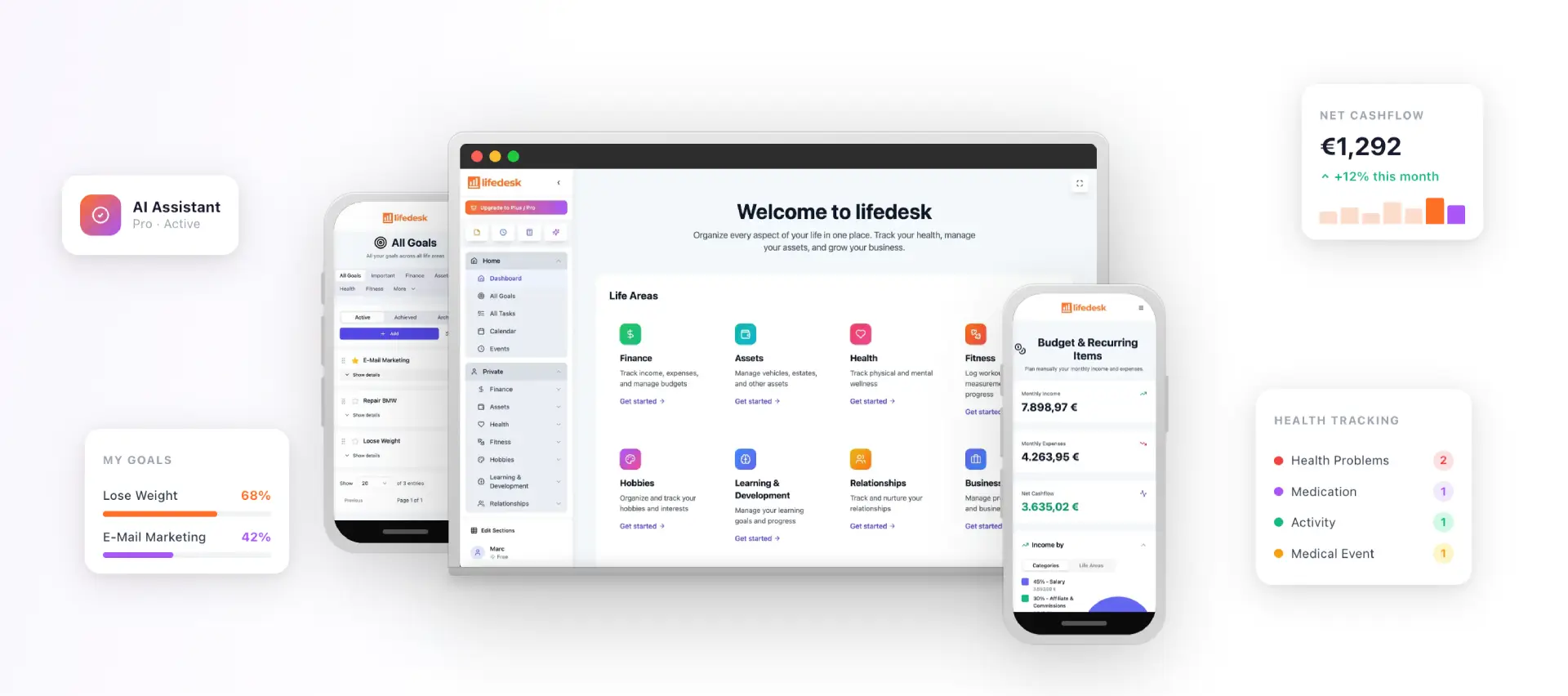
Most of the friction in secure document sharing comes from juggling separate tools: one app for the portal, another for tasks, a third for client notes, a fourth for invoicing. LifeDesk approaches this differently by combining client management, document storage, and task tracking in a single workspace, so a client’s files sit next to the project timeline and communication history that gave rise to them.
Picture a freelancer sending monthly deliverables to five clients. Instead of five separate email threads or a scattered set of shared-drive links, each client gets an organized space where documents, tasks, and deadlines live together, reducing the chance a file ends up in the wrong place. A consultant onboarding a new client can use the same structure to collect intake documents and track the engagement from the first meeting, without switching between a portal, a task app, and a separate note-taking tool.
The value here is in keeping client documents organized and connected to the work they support, for professionals who prefer fewer separate apps to manage client relationships.
Try LifeDesk to centralize client documents and workflows
Sharing documents securely is only part of running a client relationship well. LifeDesk gives freelancers, consultants, and small business owners a place to keep client documents, tasks, and project details together instead of scattered across a portal here and a task app there.
If you’re managing multiple clients alongside your own goals, finances, and schedule, an integrated workspace cuts down on the app-switching that eats into billable time. LifeDesk’s client management features keep each client’s documents and project history organized in one view, while the platform’s broader feature set covers tasks, finances, and calendar planning in the same place.
Start with the Free plan at $0 per month to see how client organization fits your workflow.
Compare the Plus plan at $9 per month and the Pro plan at $19 per month for expanded features like bank account connections and an AI assistant, both listed on the pricing page.
Visit LifeDesk to explore the full platform before committing to a paid tier.
Sources
For readers who want to verify the guidance above or dig deeper, the NIST ITL Bulletin on file exchange security and NIST SP 800-171 cover cryptographic recommendations and controls for protecting sensitive nonfederal data. The FTC’s guide for businesses outlines reasonable security practices for handling personal information, and the 2025 Zscaler data-at-risk report gives context on SaaS misconfiguration risks relevant to shared document platforms.
Match the method to the relationship: use a client portal for recurring exchanges, encrypted email or password-protected files for one-off low-risk transfers, and e-signature apps for anything requiring a signature. In every case, confirm encryption in transit and at rest and set an expiration on any shared link, following practices outlined in the NIST file exchange bulletin.
What is the best way to share confidential documents?
For confidential or regulated documents, a client portal with per-client isolation, role-based access controls, and audit logging is the strongest option, since it prevents accidental cross-client exposure and creates a verifiable access history. Regulated or high-volume transfers may warrant managed file transfer instead, which adds delivery guarantees and compliance-grade logging referenced in NIST SP 800-171.
What is the best platform for sharing documents with clients?
There’s no single best platform across every business: the right choice depends on how often you share files, how sensitive they are, and whether you need signature capability or regulatory-grade audit trails. Dedicated portal software, e-signature apps, and integrated workspaces like LifeDesk that keep documents alongside client management each fit different needs rather than one universal answer.
How do I send confidential documents to a client?
Send confidential documents through a channel that offers encryption, access controls, and an expiring link rather than a plain email attachment. If email is unavoidable, encrypt the file, send the password through a separate channel like a phone call, and confirm the recipient’s address before sending, following the cautious approach the FTC recommends for handling personal information.