A weekly review is a short, scheduled ritual where you clear your inboxes, check your calendar, and pick your priorities before the new week starts. The simplest version takes 15 to 20 minutes: dump loose tasks into one list, scan the next seven days, and write down...
Project and client management work best as two linked systems, not one blurred job. Delivery lives on scope, schedule, and resourcing; the relationship lives on trust, expectations, and retention. Agencies that connect them, with a shared client record and a fixed...
Calendar task integration turns your to-do list into scheduled, time-bound calendar blocks so work actually gets done instead of piling up unseen. The fastest path is either a native tasks layer inside your calendar app or an OAuth-based connector syncing a separate...
Quarterly planning means running your business goals on a 90-day cycle instead of a single annual push, reviewing progress and adjusting course every quarter. The practical version that works best: pick a few measurable priorities, assign a clear owner to each, set...
Most people don’t need one framework. They need three, stacked by time horizon: a long-range direction setter like a BHAG or OGSM, a quarterly execution engine like OKRs, and SMART criteria to keep the resulting key results honest and measurable. Skip the strategic...
The PARA method sorts every file, note, and task you own into four folders (Projects, Areas, Resources, Archives) based on how soon you need to act on it. The main payoff is speed: you stop hunting through nested folders and start finding what you need in seconds,...
The best prioritization frameworks for anyone juggling client work, personal goals, and everything in between are the Eisenhower Matrix, the Pareto principle (80/20), the 1-3-5 Rule, time blocking, and a weekly review. Pick one today: schedule a 90-minute protected...
The fastest way to turn emails into tasks is to use your inbox’s built-in conversion feature (Outlook’s drag-to-Tasks or Gmail’s Tasks panel) for one-off items, and automation rules for anything that repeats. Manual capture works fine at low volume; once the same type...
A hobby project planner is a tool, template, or notebook system that helps you capture ideas and, more importantly, always know your single next physical action. Right now, pick one tool, however basic, and write down the very next step for your current project....
AI agents reclaim your schedule by auto-scheduling tasks, defending focus blocks, and resolving conflicts before you even notice them, but only when you keep human-in-the-loop controls turned on. The strongest results come from task-first tools that unify your to-do...
Homeowners: Inventory Assets in 4–5 Sessions to Speed Claims
Make a room-by-room, photo-backed inventory of everything you own, then store a copy somewhere other than your house. Start today: pick your most valuable room and film a slow walkthrough narrating what you see, then upload whatever list you already have to a cloud folder. A documented inventory speeds up insurance claims and helps you set coverage that actually matches what you own, instead of guessing.
TL;DR:
A detailed home inventory helps ensure accurate insurance claims and reveals if you have enough coverage for your possessions.
Record each item with specific details like brand, serial number, purchase date, current condition, and supporting proof such as receipts or photos.
Create the inventory room by room through narrated video walkthroughs, then log items in a spreadsheet or app, focusing on high-value items first.
Store backups in separate locations, including cloud, external drives, and physical copies, and update regularly after purchases or major life events.
Use hybrid methods combining videos with detailed entries to balance speed and accuracy, and be mindful of privacy and security risks with digital data.
LifeDesk
Keep Your Asset Records Organized
LifeDesk brings personal and professional organization together, helping you structure information, priorities, and progress in one central app.
Why You Should Inventory Home Assets Before You Need To
Insurance adjusters work faster and pay more accurately when you hand them a documented list instead of a memory. A detailed home inventory with prices, purchase dates, and photos gives your claim a paper trail that’s hard to dispute, which matters most in the chaotic weeks after a fire or flood.
Beyond claims, the process forces you to confront a question most homeowners never ask: do you actually have enough personal property coverage? A lot of people are underinsured simply because they picked a policy limit without ever totaling what they own.
An inventory also pulls double duty in ways people forget about:
Documenting losses for tax deduction purposes after a casualty event
Giving police a real list of serial numbers if you’re burglarized
Settling disputes during estate planning or when dividing property after a divorce
Simply knowing what you have, which brings its own kind of relief
What To Record for Each Item on Your Property Inventory Checklist
A home contents inventory only works if each entry has enough detail to prove ownership and value. For every item, capture these fields:
Item name and room — “Sectional sofa, living room”
Quantity — especially for sets, tools, or collections
Brand and model number
Serial number, when the item has one (electronics, appliances, tools)
Purchase date and price, or your best estimate
Current condition
Proof of ownership — receipt, credit card statement, or appraisal
Photo or video timestamp linking the item to your visual walkthrough
For low-value, repetitive items (books, kitchen utensils, clothing), group them by category and estimate a lump replacement value rather than logging each one. Reserve individual entries for anything worth more than roughly $500, and get a professional appraisal for jewelry, art, musical instruments, or collectibles, since standard homeowners policies often cap payouts on these categories unless you add a rider or scheduled endorsement.
Here’s a sample entry:
Item: KitchenAid stand mixer, Professional 600 series. Room: Kitchen. Purchased: March 2023, a typical market price. Serial: KA600294. Proof: Amazon order confirmation, saved as PDF. Photo: kitchen_walkthrough_0847.jpg.
Pro Tip:Photograph the serial number plate directly, then photograph the whole item. Two images per high-value entry beats one blurry shot that misses the detail an adjuster actually needs.
How Do You Create a Home Inventory Room by Room?
Gather your tools before you start: a charged phone, a notebook or spreadsheet template, any receipts you can find in five minutes, and a tape measure for furniture dimensions if you’re filing anything custom-built. The Insurance Information Institute recommends working room by room rather than trying to catalog your whole house in one pass, because partial progress you can pick back up beats a project that stalls halfway through.
Follow this sequence in each room:
Film a slow walkthrough, narrating what you see out loud (“this is the oak dresser, purchased around 2019”).
Open drawers and closets on camera. Hidden items get forgotten first.
Log individual items into your spreadsheet or app once the video is done.
Group low-value items by category instead of itemizing each one.
Attach receipts, serial numbers, and appraisals to the matching entries before moving to the next room.
If time is tight, start with your most expensive rooms first: the kitchen, home office, and primary bedroom closet usually hold the highest concentration of value. Set a timer for 20 to 40 minutes per session rather than attempting the whole house at once. Most homeowners finish a full property inventory checklist across four or five short sessions spread over a couple of weekends, which beats burning out in a single exhausting afternoon.
Which Tools Work Best To Track Personal Assets?
The right method depends on how much time you have and how structured you want the output. A few categories cover almost everyone:
Mobile apps move fastest and produce clean, exportable files, which matters at claim time.
Spreadsheets give you full control over fields and cost nothing, but they demand more manual discipline to keep updated.
Photo and video walkthroughs are the quickest way to create proof, though they’re weaker on searchable detail unless paired with a written log.
Hybrid approaches (video walkthrough plus itemized entries for anything valuable) tend to balance speed against accuracy better than any single method alone.
The NAIC Home Inventory app is a free, official option worth knowing about. It groups items by room or category, supports barcode scanning and photos, and exports the finished inventory into a format you can hand straight to an insurer. If you’re not sure which method fits, ask yourself three questions: how much free time do you actually have this month, how comfortable are you with apps versus paper, and do you need a structured export or just visual proof.
How Do You Store and Back Up a Home Inventory Safely?
A personal asset tracker that lives only on your laptop is one house fire away from being useless; for guidance on emergency preparedness, see Does Your Family Have A Plan? Keep at least three copies in physically separate places:
A cloud backup you can access from any device after a disaster
An external hard drive stored somewhere other than the room it documents
A physical or digital copy in a safe deposit box, at a relative’s house, or in a service like FEMA’s Digital Backpack for secure document storage
Label and timestamp every photo and video so you can match it to a specific inventory entry months later, and keep receipts and appraisals filed alongside the item, not scattered across email threads.
Pro Tip:Password protect any cloud folder holding your inventory, and check that your export format (PDF, spreadsheet, or app file) actually opens on a different device before you need it in a crisis.
When Should You Update Your Inventory and How Does It Help at Claim Time?
Update your inventory after any major purchase, once a year as routine maintenance, and immediately after moving, renovating, or a big life event like a gift, sale, or inheritance. Waiting until claim time to discover your list is three years stale defeats the entire point.
When you actually file a claim, an adjuster typically wants:
Your exported inventory file, organized by room
Labeled, timestamped photos matched to specific items
Receipts, serial numbers, and appraisals for anything high value
Before you’re in a crisis, run a quick checklist: export your current file, email a copy to your insurance agent for their records, and confirm you can reach a physical backup copy even if your home is inaccessible.
How LifeDesk Keeps Your Asset Records in One Place
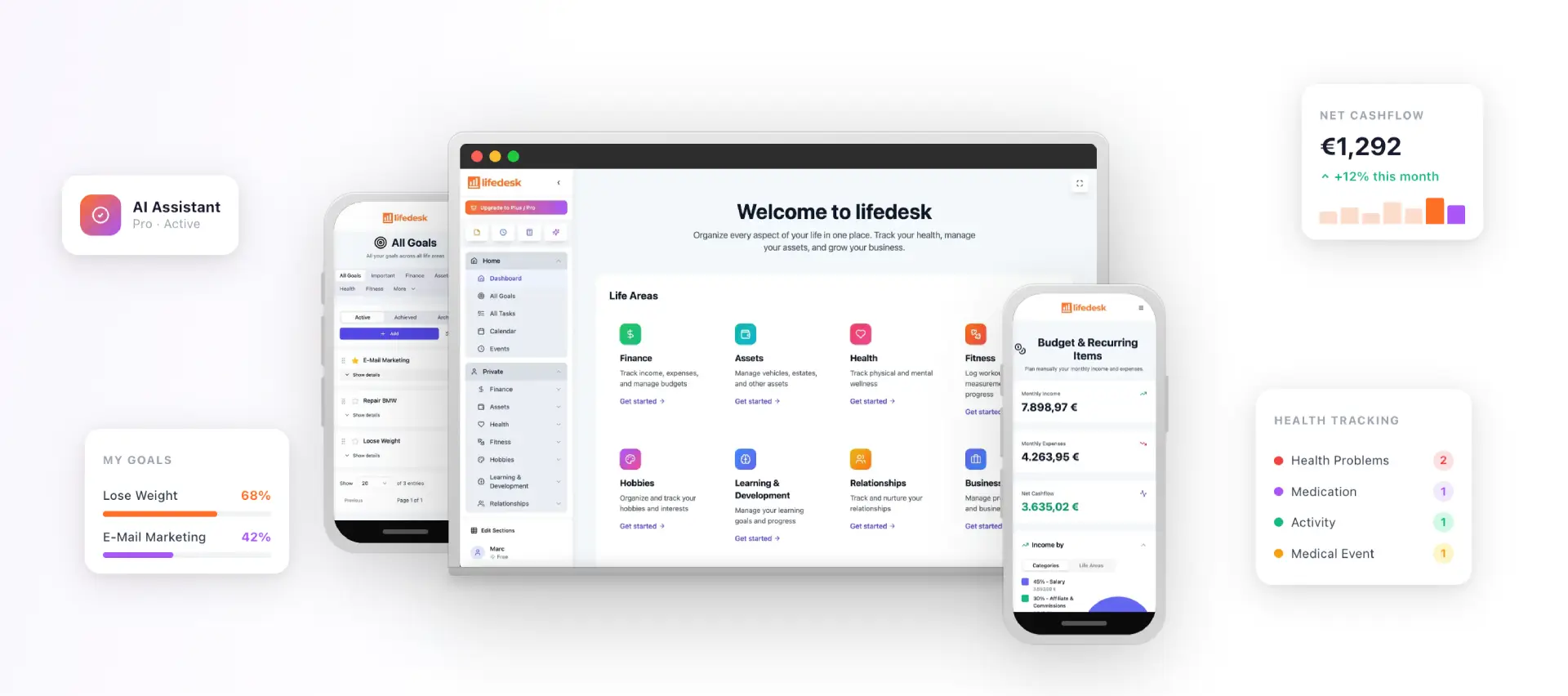
Instead of juggling a separate spreadsheet, a photo app, and a folder of scanned receipts, LifeDesk lets you log an item, attach its photo and receipt, and tag it by room in the same place you already track finances and documents. Add the mixer from your kitchen, snap the receipt, tag “Kitchen,” and it sits alongside your other household records instead of buried in camera roll from 2023.
That said, always confirm your export options and privacy settings on any platform before treating it as your only backup, LifeDesk included.
Common Mistakes to Avoid When Making a Home Inventory
The single biggest mistake is starting strong and never finishing. People film half the house, get interrupted, and never come back, leaving an inventory that’s worse than none at all because it creates false confidence.
The second is storing the only copy on the device sitting inside the house you’re documenting. A phone in a fire safe still burns with the fire. Keep backups physically separate, always.
Other recurring errors worth flagging:
Skipping receipts entirely and relying on memory for prices, which weakens a claim when an adjuster asks for proof
Ignoring closets, garages, and storage units because they feel tedious, when they often hold thousands in tools, seasonal gear, or sports equipment
Underestimating replacement cost by using what you paid years ago instead of what the same item costs today
Forgetting high-value categories like jewelry, art, or collectibles that need separate documentation or a policy rider
Never updating after a big purchase, so a new television or appliance simply doesn’t exist on paper
Using vague descriptions (“TV, living room”) instead of brand, model, and serial number, which slows verification
None of these mistakes are complicated to avoid. They just require finishing what you start and treating the inventory as a living document, not a one-time project.
What Legal and Privacy Issues Come With a Home Inventory?
A home inventory contains a fairly complete map of your valuables, which is exactly why it needs to be treated carefully. If you store it on a shared or unsecured device, anyone with access, a roommate, a repair technician, a hacked account, can see what’s worth taking and where it’s kept.
Password protect any digital file, use encrypted cloud storage where available, and think twice before printing a full copy and leaving it somewhere accessible to house guests or contractors. If you share your home with roommates or a co-owner, decide upfront who has access to the full list versus a redacted version.
There’s also an estate planning angle. A well-maintained inventory becomes useful documentation for executors or heirs sorting through a household after a death, and it can reduce disputes over who owns what if you’re going through a divorce or splitting a household during a move. Some homeowners choose to note ownership explicitly next to shared or disputed items for exactly this reason.
Finally, if you’re using a third-party app or cloud service, read what that provider does with your data before uploading photos of your most valuable possessions. Not every free tool treats your inventory data the same way, and a service that seems convenient today should still meet a reasonable privacy bar for information this sensitive.
Authoritative Downloads and Apps to Consult
Start with the NAIC’s consumer home inventory page for the official app, the III’s step-by-step inventory guide, and CFPB’s disaster preparedness checklists for document backups.
Keep Your Whole Household Organized in One App
Most homeowners end up spread across a notes app for the inventory, a separate app for receipts, and a mental note to “back it up eventually.” There are apps that consolidate asset logging, document attachment, and finance tracking alongside task, goal, and calendar management to organize your household records in one place.
If you own a home, a car, or anything worth insuring, an asset tracker that lives next to your financial records and document storage saves you from hunting through five apps when an adjuster calls. You can start free and explore the asset tracking features built for exactly this kind of record-keeping, or check the Free, Plus, and Pro plans to see which fits your household. The Free plan costs free of charge, and the Plus plan runs a low monthly fee if you want bank account tracking layered in alongside your inventory. Pick a room this weekend, log what’s in it, and let an all-in-one platform hold the rest.
Include the item name, room, quantity, brand and model, serial number, purchase date and price, condition, and proof of ownership like a receipt or appraisal. Pair every entry with a photo or timestamped video clip so you can match visual proof to the written record.
Can You Give Me an Example of an Inventory Asset Entry?
A complete entry looks like this: “KitchenAid stand mixer, Professional 600 series, kitchen, purchased March 2023 for a typical market price, serial number KA600294, Amazon receipt saved as PDF, photo filed as kitchen_walkthrough_0847.jpg.” That level of detail gives an adjuster everything needed to verify the claim without follow-up questions.
How Do I List Personal Belongings for a Home Inventory?
Work room by room rather than trying to catalog the whole house at once, filming a narrated walkthrough before logging individual items into a spreadsheet or app. Group low-value items like books or clothing by category, and itemize anything worth more than a few hundred dollars individually.
What Is a Good System for Tracking Personal Property at Home?
A hybrid approach, video walkthrough for speed plus itemized entries for high-value pieces, tends to balance thoroughness against the time it actually takes to finish. Apps like the free NAIC Home Inventory app work well if you want a structured export ready for insurance, while a platform like LifeDesk fits homeowners who want their asset list living next to their other financial and household records.