A task dependency is a link between two tasks: one cannot start or finish until the other has started or finished. For a freelancer or solo business owner, the useful version is simple. Know which task is waiting on which, put the blocking task first in your calendar,...
A client retention plan is a short set of repeatable habits for every stage of a client relationship, from the first welcome message to the follow-up after the project ends. For a freelancer, the plan that works is the one you can run in about 20 minutes a week: one...
A good color-coded calendar uses three to five colors, gives each color one meaning, and keeps those colors identical on every device. If you can look at your week for three seconds and see where work, personal time, deadlines and focus blocks sit, the system is...
Yes, AI can take your meeting notes. It records or listens to the call, turns speech into a transcript, and has a language model write a summary and a list of action items. The tools are the easy part. What decides whether AI meeting notes help you is what happens...
A CRM with a calendar puts your client records, meetings, tasks and follow-ups in one place, so every call you schedule is tied to the person and the deal behind it. For a freelancer or solo business owner, the best choice is the one that shows your client work next...
AI can turn your income, bills and goals into a working monthly budget in minutes. It can also categorize spending, explain budgeting methods and test “what if” scenarios. It works best when you give it real numbers, tell it which method to use, and check the output...
A recurring task is any piece of work that comes back on a pattern: the weekly invoice run, the Tuesday workout, the monthly tax set-aside, a client’s birthday. The best way to manage them is to decide two things for each one: what triggers the next copy (the calendar...
A life operating system (often shortened to Life OS) is one connected setup where your goals, projects, tasks, calendar, notes, money and habits live together and inform each other. A to-do list only stores actions. A life OS also tells you why those actions matter...
The most reliable way to plan work and personal life together is to stop splitting them. Write every commitment into one inventory, put it on one calendar, rank it by importance and urgency, give it a block of time, and review the plan weekly. The rest of this guide...
A calendar time audit is a review of what your calendar says you did over the past few weeks, set against what you say matters. You export or scroll back through four to eight weeks, sort every block into a handful of categories, add up the hours, and compare the...
How to Reverse Engineer Your Goals, Step by Step
TL;DR
Reverse goal setting means writing the end result first, then stepping back milestone by milestone until you reach a first action you can take today.
It pays off on complex, multi-step goals. For short tasks of a step or two, research on planning direction found no difference between forward and backward planning.
Use a state you can verify (“proposal sent”) rather than an activity (“working on proposal”) for every milestone.
Put the milestones on a calendar and review weekly, or the plan stays a document.
Most people plan forward. They ask, “What should I do first?” and then guess at the second and third steps. That works for a grocery run. It works badly for launching a service, landing a promotion or building a monthly income of a given size, because at every step several routes open up and it is hard to see which steps are essential.
Reverse engineering flips the direction. You describe the finished result in concrete terms, then ask what must be true immediately before it. Then you ask the same question about that step, and again, until the answer is something you can start now. The plan that comes out often looks like an ordinary forward plan. The difference is that every step exists because the next one needs it.
The approach is also called backward planning or reverse goal setting. If you searched for either name, this is the same method.
One experiment is worth knowing. In a study of 44 undergraduates reported by KQED, everyone planned for an exam with the same 15 activities. Forward planners started from the nearest task. Reverse planners started from the activity closest to the exam. The plans looked similar on paper, yet backward planning changed actual exam grades, but only for complex goals.
Two limits matter for how you use this. The studies involved university students, and the effect appears when a goal has many steps. So save the method for goals that need it: a new offer, a product launch, a career move, a revenue target. Don’t reverse engineer “reply to an email.”
A third, practical reason comes from the maze analogy in an ASBMB career-planning column: a maze is easier to solve from the exit. Knowing where you want to end up makes you less likely to wander. The same column notes the method can even reveal when you must start, if you have no deadline: pick a hypothetical date and count back.
The method in six steps
There are many versions of this method. They share the same core, and this is the version that works best for people who run their own time.
1. Write the goal as finished, dated and checkable
“Grow my business” cannot be reverse engineered because you cannot tell when you arrive. “I have four retainer clients paying a combined $8,000 a month by 30 June” can. Write it in the past tense, as if it has already happened, and attach a date.
Where it goes wrong: goals that depend on someone else’s decision. Phrase the end state so that you control it where you can (“proposals sent to 20 prospects”) and treat the other person’s reply as a result you track, not the goal itself.
2. List three to five finish criteria
Under the goal, write the conditions that must be true for you to call it done. For the retainer example: contracts signed, first invoices paid, a delivery routine that fits in 25 hours a week. Criteria prevent you from declaring victory too early, and they expose goals that are really two goals in one.
For freelancers, add one criterion that protects the rest of life: the hours, the income floor or the weekends you won’t give up. A reverse plan that ignores them tends to be abandoned.
3. Step back in time, one question at a time
Now work backward. Pick time points that fit the goal’s length. For a six-month goal, a useful ladder is: one month before, 90 days before, 60 days before, this month, this week, today. At each point, ask: “What had to be done before this?”
The ASBMB column shows the pattern with a conference poster due in October. The chain runs from abstract deadline in early August back through a key result by July, imaging by early June, antibody production by March, ordering materials by mid-February, to designing them by next week. Each link is something that must be finished so the next one can begin.
The same logic applies to a freelancer’s launch. If the goal is a productized service live by September, you need a tested sales page in August, three beta clients in July, a defined scope and price in June, and five customer conversations in May.
Where it goes wrong: steps that are activities instead of states. “Work on the website” never ends. “Sales page published with pricing” ends the moment it is true.
4. Check each milestone against reality
Backward chains have a weak spot: they feel precise while resting on guesses. For each milestone, ask how long a similar task actually took you before. Add a buffer to anything that depends on a client, an approval or another person’s reply. If the dates do not fit, you learn that on day one and can move the deadline or shrink the scope, which is far cheaper than finding out in month five.
Your own history is the best data. If your last three proposals each took two days rather than the half day you planned, plan two days.
5. Plan for the tightest link
Find the milestone with the least slack, the one where a delay pushes everything after it. Write a simple if-then rule for it: “If a prospect hasn’t replied after four days, then I send one follow-up and book the next call.” You decide in advance, when your head is clear, instead of improvising when you are busy.
6. Choose today’s action and schedule it
The last question of the backward chain gives you your first action. Make it small enough to do within an hour, then put it on a calendar at a specific time. A first step that stays on a list is a wish. A first step with a time slot gets done.
Three worked examples
A revenue goal: $100,000 a year
Revenue goals reverse engineer well because the arithmetic does most of the work. Divide $100,000 by 12 and you need roughly $8,333 a month. Now test price points:
Monthly price per client
Clients needed
$500
about 17
$800
about 11
$1,500
about 6
Then keep going backward. If a typical prospect conversation converts one time in four, 17 clients means roughly 68 conversations. If you hold 10 conversations a month, that takes seven months, which tells you the plan is either too slow or that the price is too low. The table forces a decision before you spend a quarter finding out. The point is not the exact numbers, which are yours to supply, but that an impossible combination is a signal to adjust price, scope or timeline now.
A career goal: promotion to a senior role
Suppose you work a job alongside freelance projects and want a senior title by the end of next year. Working back: the committee meets in November, so your nomination goes in during October, which needs a cross-team project finished by September, which needs you to take ownership of a service by June, which starts with a conversation about the promotion criteria in March. Now you know the first action: book that criteria meeting. If you are mapping a move into a new role or field, this career transition timeline shows how a long-term role goal breaks into dated stages.
A personal goal: a 10K and a steady sleep routine
Personal goals use the same chain. Done: you run 10 km without stopping on a date you choose. Four weeks earlier: you run 8 km comfortably. Eight weeks earlier: three runs a week at 5 km. This week: pick the three days and put them in the calendar around client calls. A sleep routine works the same way: a fixed bedtime by month three requires a wind-down ritual by month two and a work cutoff time by month one.
Work-life balance is where freelancers gain most here, because the personal chain sits next to the business chain. Seeing both on one timeline shows collisions early, such as a big delivery week landing on the week of your longest training run.
Keeping the plan alive: tracking, slippage and review
A reverse plan is not a contract. Expect some milestones to slip. When one does, resist throwing the plan out. Instead, find out why it ran long, correct that duration and move later dates. The estimate was wrong, not the goal.
Tracking works best when it is light. Two habits are enough for most solo professionals:
A one-line daily log of what you actually did. It is the evidence you will use to correct optimistic estimates.
A weekly review of what moved, what stalled and what the next week’s single most important action is. A 15-minute routine is plenty. We describe one in our guide to the weekly review.
If your goal has a number in it, track a small set of inputs rather than everything. Our piece on daily metrics covers how to decide what is worth measuring. For the 90-day layer of your backward ladder, a one-page quarterly plan with three to five goals keeps the middle of the chain from becoming a blur. KQED reports that the researchers saw reverse planning help sustain motivation in the middle of a goal, when inspiration tends to fade, so that middle layer deserves attention.
Where the plan lives matters
Most reverse-engineered plans die in the gap between a notebook page and the week ahead. The chain says “proposal drafts by the 14th,” but your calendar shows client calls all week and your task list shows 40 unrelated items. Three setups tend to fail:
A document with milestones and no dates on a calendar. You rarely reopen it.
A task list with no link to a goal. Tasks pile up and nobody remembers why they matter.
Separate tools for work, money and personal life. You cannot see that the week your retainer goal needs outreach is also the week of your move.
The fix is simple to state: each milestone becomes a goal with a date, each goal gets its tasks, and the tasks get time on the calendar. Our article on a calendar with goals explains how to turn plans into scheduled work. If you are stacking methods, this guide to combining goal-setting frameworks shows how reverse planning fits next to strategy and quarterly execution.
Doing it in LifeDesk
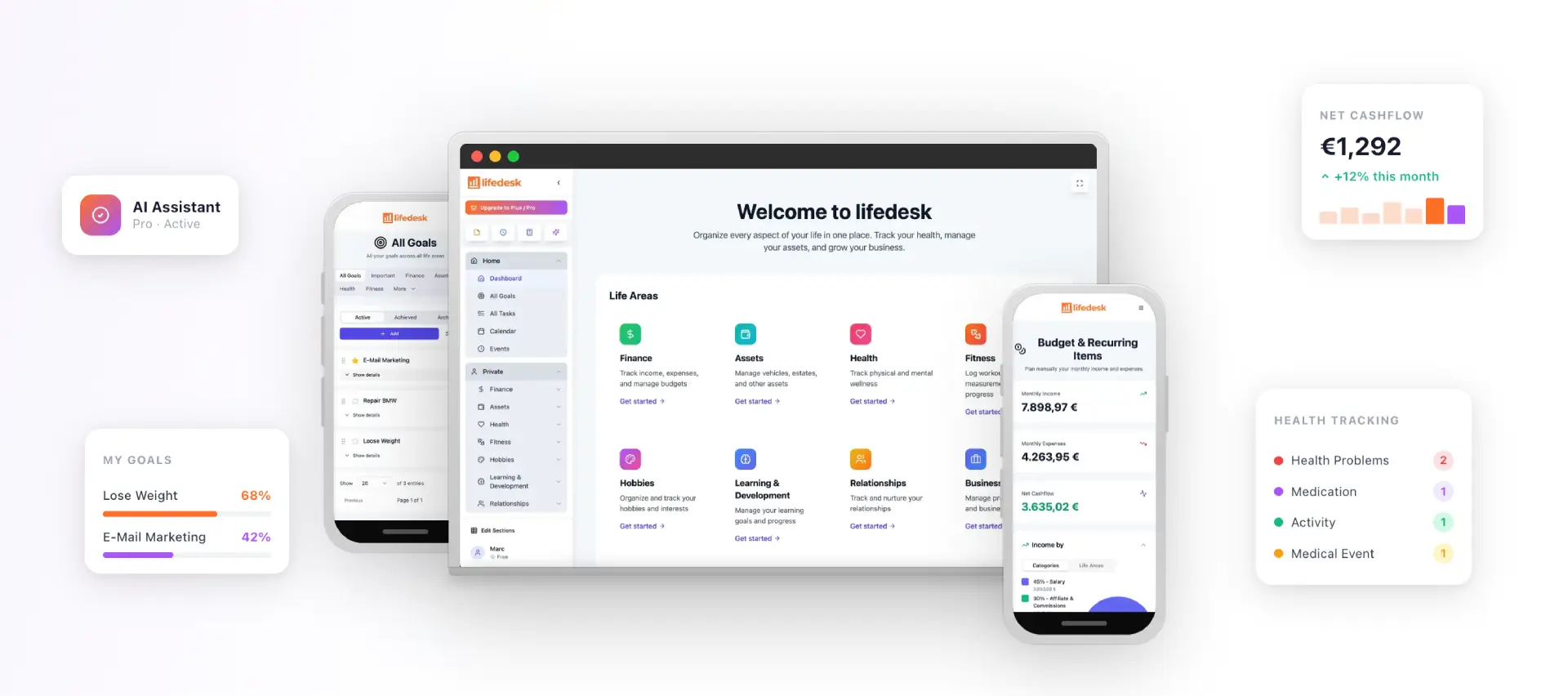
LifeDesk brings tasks, goals, calendar, finances, health, fitness and business organization into one app for web, iOS and Android, with separate but accessible views for private and business life. That suits a reverse plan, since a freelancer’s chain usually crosses both: the revenue milestone, the training block and the family week all sit in the same place. You can set the end goal, add the milestones you worked out above, and attach tasks to each one with tasks and goals.
The Free plan costs $0 per month. Plus is $9 per month and Pro is $19 per month, and the paid plans unlock bank account connections, higher limits and the AI assistant. Because bank connections cover both business and personal finance, a revenue goal can sit next to the money actually coming in. See the plans on the pricing page.
Common mistakes to avoid
Starting with a fuzzy end. If you cannot tell when you have arrived, every step back is guesswork.
Too many goals at once. Reverse engineering several big goals in parallel multiplies the milestones competing for the same hours. Choose one to three.
Milestones as activities. “Work on the draft” is a treadmill. “Chapters 1 to 4 drafted” is a finish line.
No buffer. Anything that depends on other people needs slack and a follow-up date.
Forgetting what you’d cut. One entrepreneur profiled by SUCCESS magazine compares the method to storyboarding a film: any scene that does not move the story toward its ending gets cut. For him that meant turning down a profitable side opportunity. Your plan should tell you what to say no to as clearly as what to do.
Using it on tiny tasks. For goals with only a step or two, forward planning does just as well.
FAQ
What is the difference between reverse goal setting and normal goal setting?
Normal goal setting starts from where you are and asks what to do next. Reverse goal setting starts from the finished result and asks what had to be true just before it, repeating until you reach a step you can take today. The result is a chain in which every step exists because a later step needs it.
Does reverse planning really work better?
For complex goals with many steps, a 2017 Psychological Science study found backward planners saw the necessary steps more clearly, followed their plans more closely and felt less time pressure. For simple goals of a step or two, it found no difference. Use it where the path is unclear.
How far back should I go?
Go back until you reach something you can do this week. For a goal six months away, checkpoints at 90 days, one month, one week and today usually suffice. For longer goals, such as a five-year career move, add yearly checkpoints first.
What if I have no deadline?
Pick a hypothetical date and work back from it. The ASBMB column suggests this reveals when you would actually need to start, whether that is two months or a year before the date.
What do I do when a milestone slips?
Correct the estimate and move the later dates, rather than abandoning the plan. Add a buffer to steps that rely on other people, and use your weekly review to see which estimates run consistently long.