Digital minimalism for work means using only the tools and notifications that earn a place in your day, so attention goes to the tasks that matter. The single fastest move is to protect a scheduled focus block on your calendar and mute every nonessential notification...
The best approach depends on frequency and sensitivity: use a client portal for recurring or sensitive exchanges, secure email or password-protected transfers for occasional low-risk files, e-signature services for anything requiring a signature, and managed file...
Make a room-by-room, photo-backed inventory of everything you own, then store a copy somewhere other than your house. Start today: pick your most valuable room and film a slow walkthrough narrating what you see, then upload whatever list you already have to a cloud...
A weekly review is a short, scheduled ritual where you clear your inboxes, check your calendar, and pick your priorities before the new week starts. The simplest version takes 15 to 20 minutes: dump loose tasks into one list, scan the next seven days, and write down...
Project and client management work best as two linked systems, not one blurred job. Delivery lives on scope, schedule, and resourcing; the relationship lives on trust, expectations, and retention. Agencies that connect them, with a shared client record and a fixed...
Calendar task integration turns your to-do list into scheduled, time-bound calendar blocks so work actually gets done instead of piling up unseen. The fastest path is either a native tasks layer inside your calendar app or an OAuth-based connector syncing a separate...
Quarterly planning means running your business goals on a 90-day cycle instead of a single annual push, reviewing progress and adjusting course every quarter. The practical version that works best: pick a few measurable priorities, assign a clear owner to each, set...
Most people don’t need one framework. They need three, stacked by time horizon: a long-range direction setter like a BHAG or OGSM, a quarterly execution engine like OKRs, and SMART criteria to keep the resulting key results honest and measurable. Skip the strategic...
The PARA method sorts every file, note, and task you own into four folders (Projects, Areas, Resources, Archives) based on how soon you need to act on it. The main payoff is speed: you stop hunting through nested folders and start finding what you need in seconds,...
The best prioritization frameworks for anyone juggling client work, personal goals, and everything in between are the Eisenhower Matrix, the Pareto principle (80/20), the 1-3-5 Rule, time blocking, and a weekly review. Pick one today: schedule a 90-minute protected...
30–60 Minute Weekly System: One Page Marketing Planner for Solopreneurs
Use a one-page marketing planner built around a single quarterly goal, monthly campaign boxes, and weekly 30 to 60 minute execution blocks. This structure gives you clarity on what to work on today and protects you from the burnout that comes with juggling ten marketing ideas at once. You can build it yourself on paper or in a spreadsheet, or set it up inside an app like LifeDesk that links your plan directly to your calendar and task list.
TL;DR:
Focusing on one or two marketing channels, such as email and LinkedIn, yields better results than spreading efforts across multiple platforms.
Tracking three core weekly numbers—visits, leads, and conversions—and reviewing them monthly helps determine channel effectiveness and optimize strategies.
Setting a quarterly goal, one KPI, and clear monthly campaigns ensures your marketing efforts stay focused and measurable, reducing waste and campaign fatigue.
Using an integrated planner that syncs with your calendar and task list makes it easier to implement, update, and review your marketing activities regularly.
Starting with simple metrics and plans allows solopreneurs to maintain momentum, avoid burnout, and make data-driven decisions without complex tools like GA4 until necessary.
LifeDesk
Bring Your Weekly Plan Together
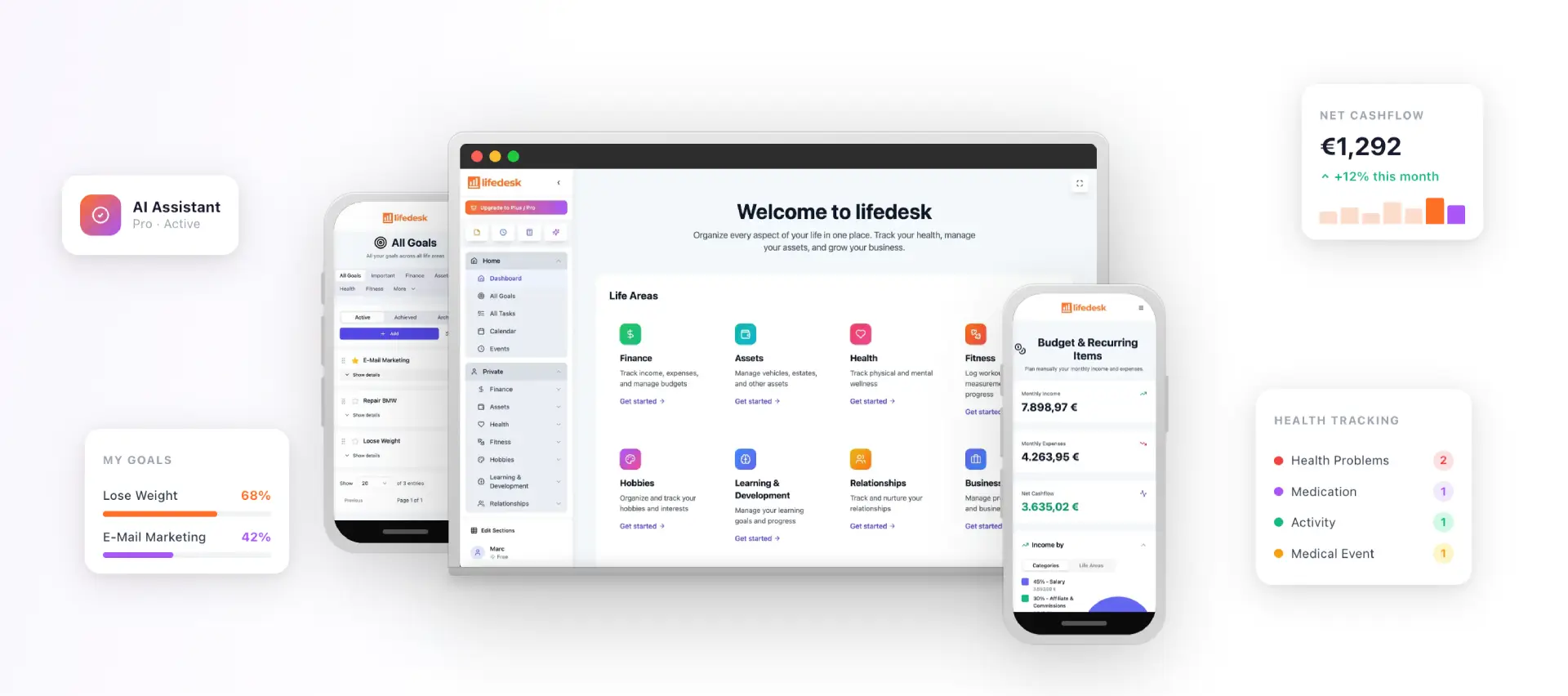
LifeDesk brings goals, tasks, calendars, and business organization into one place for a clearer weekly marketing routine.
A working one-page planner fits on a single sheet or screen and answers one question at a glance: what should I be doing this week to hit this quarter’s goal? The layout has five zones, each tied to a specific decision you need to make.
Top-line quarterly goal: one sentence, one number, one deadline, for example “grow email list to a specific number of subscribers by a set deadline.”
Monthly campaign boxes: three boxes, one per month, naming the single campaign or offer you are pushing.
Weekly action strip: a row of checkboxes or short phrases naming the two or three tasks that move the campaign forward.
KPI snapshot: three numbers you track weekly, like leads, conversion rate, or content published.
Budget line: dollars allocated per month split between paid promotion and tools.
Each field exists because vague plans fail. A goal without a number is a wish, a campaign without a deadline drifts, and a budget line forces you to decide, in advance, whether you are buying ads or spending your own time. This is the same logic behind the SMART goals framework the U.S. Small Business Administration recommends for small business marketing plans: specific, measurable targets beat open-ended intentions.
Planner components explained: goals, audience, channels, offers, calendar, budget, and KPIs
Filling in the boxes only helps if each one is built correctly. Here is how to approach the core components in order.
Write one SMART marketing goal with a single KPI attached. Instead of “get more clients,” write “book 6 discovery calls by the end of the month,” and track only that number weekly.
Draft a one-paragraph ideal customer snapshot. Name their job title or life stage, their biggest frustration, and the one sentence you say to them that makes them stop scrolling.
Choose one or two channels, not five. Solopreneurs get better returns from depth on fewer platforms than shallow presence everywhere; the State of Solopreneurship 2026 report points to email, LinkedIn, and partnerships as high-probability channels for solo operators.
Map one offer or lead magnet to each month. A free checklist in January, a webinar in February, a discount in March, each tied to the campaign box for that month.
Set a simple budget split. Decide what portion is cash for ads and what portion is your own time, since unpaid organic work still has a real cost in hours.
Pick KPIs that tie to revenue, such as conversion rate, qualified leads per month, or email revenue per subscriber, rather than vanity metrics like impressions.
Pro Tip:Pick one KPI per goal, not three. A single number you actually check every week beats a dashboard you ignore.
Weekly execution cadence: time-blocks and batching for one-person teams
Momentum comes from small, repeated blocks, not marathon sessions. A realistic weekly structure for a solopreneur looks like this:
Plan (30 minutes): review last week’s numbers and pick this week’s three actions.
Create (60 minutes): write the post, email, or content piece for the week in one sitting.
Reach out (30 to 60 minutes): send messages, comment, or pitch partnerships.
Review (30 minutes): log the week’s KPI numbers on your planner.
Batch similar tasks on the same day so you are not switching between writing, designing, and outreach every hour. A single recurring weekly check-in, even 15 minutes on a Friday, keeps the monthly campaign box honest because the numbers you log weekly are what roll up into your monthly KPI review.
Pro Tip:Block your “create” hour at the same time each week and treat it like a client meeting. Protecting one uninterrupted hour beats scattering marketing across ten short interruptions.
Tools and template formats: print, Notion, spreadsheet, or an integrated planner
The format matters less than whether you actually open it every week. A printable PDF is fast to set up and works well if you like writing by hand, but it does not update automatically and lives separately from your calendar. A Notion or document template is flexible and easy to share, though it takes setup time to link to tasks and dates. A spreadsheet is strong for tracking numbers over time but weak for a visual, at-a-glance view of the month.
An integrated app closes that gap by connecting the planner to the calendar and task list you already use, so a campaign box turns into actual scheduled work instead of a note you forget. LifeDesk’s one-page marketing planner is built this way, syncing campaign dates to your calendar and KPI checkpoints to your task list.
Whatever format you pick, confirm it includes:
A visible quarterly goal at the top.
Monthly campaign fields tied to dates.
A weekly action area.
A budget line.
A KPI tracking spot you can update in under two minutes.
Measure and optimize: which metrics to track and when to add GA4
Three numbers are enough for most solopreneurs: profile or website visits, qualified inbound leads, and the rate at which followers turn into actual conversations. Track these weekly, roll them into a monthly total, and step back every quarter to ask whether the channel mix still makes sense.
Weekly: log the three core numbers, five minutes, no analysis needed yet.
Monthly: compare the month’s total against the campaign box goal and note what worked.
Quarterly: decide whether to keep, adjust, or drop a channel based on three months of data.
Both the SBA and Shopify’s small business marketing plan guide frame measurement as a core section of any marketing plan, recommending regular comparison of marketing costs against revenue rather than a one-time setup.
GA4’s data-driven attribution model gives a fuller picture of which channels actually drive conversions, and is worth setting up once you run paid ads on more than one platform or sell directly online.Think with Google reports that small businesses adopting this model gain more visibility into the customer journey across channels. If you are running one or two organic channels without paid spend, your three weekly numbers are enough, and GA4’s attribution settings can wait until your channel mix grows.
60-minute quick start: make your planner now
Gather three things before you start: your last 90 days of basic metrics (visits, leads, or sales), a list of your current offers, and a one-paragraph description of your ideal customer.
Minutes 0 to 15: write your quarterly goal and pick the one KPI that proves it.
Minutes 15 to 30: fill in three monthly campaign boxes with one offer or theme each.
Minutes 30 to 45: write your weekly action strip, listing two or three repeatable tasks.
Minutes 45 to 55: set your budget line and choose your one or two channels.
Minutes 55 to 60: schedule your first weekly review on the calendar and create a simple tracking sheet for your KPI.
Put that first review 7 days out, not “sometime next week,” so the habit starts immediately.
How to run a simple market analysis before you plan
A market analysis for a solopreneur does not need a research team or a paid report. It needs three honest answers. First, who buys from you now, and what do they have in common: industry, budget, or the problem that pushed them to search for a solution. Second, where do they already spend time online, since this tells you which one or two channels deserve your limited hours. Third, what are two or three alternatives your ideal customer considers instead of you, and what do you offer that those alternatives do not.
You can answer all three by reviewing your last 10 to 20 customer conversations or sales, noting the channel that brought each one in, and writing one sentence on why they chose you over a competitor. This gives you a messaging line and a channel priority list without any formal research process. Feed both directly into your planner: the customer answer becomes your one-paragraph ideal customer snapshot, and the channel answer becomes your one or two chosen channels for the quarter. Revisit this short exercise every quarter, since the customers who convert often shift as your offers and content evolve.
Strategies to prioritize marketing activities with limited time
The biggest trap for solopreneurs is copying marketing processes built for teams with five people and a budget to match. With one person and a handful of hours a week, prioritization has to be ruthless.
Start by ranking every marketing activity you are considering against one question: does this directly lead to a lead, sale, or subscriber, or does it just feel productive. Posting on a fourth social platform because competitors do it rarely earns its place. Sending a weekly email to a list of real subscribers usually does.
Next, protect your “create” and “reach out” blocks from the earlier weekly cadence as non-negotiable, and treat anything outside your chosen one or two channels as optional. If a new platform or tactic appears, hold it against your quarterly goal before adding it to the planner. The State of Solopreneurship 2026 report points to founder-led benchmarks, tying activity to revenue and speed-to-monetize, as a more useful gauge for solo operators than following creator or agency-scale benchmarks built for bigger teams.
Finally, batch decisions, not just tasks. Choosing your month’s campaign once, at the start of the month, saves you from re-deciding priorities every single day.
Integrating content marketing and social media planning
Content and social media work best on the planner when they are treated as one system instead of two separate to-do lists. Your monthly campaign box should name one core piece of content, a blog post, a case study, or a short guide, and every social post that month should either point back to it or repurpose a piece of it.
This turns your weekly “create” block into one job: write the core piece once, then break it into three or four shorter posts for your chosen channel during your weekly planning session. A single customer story, for example, can become a LinkedIn post, an email, and a short video caption without writing three separate pieces from scratch. If you create visual work like photography or design, a workflow that moves finished pieces into a shareable portfolio, like the process described in this Lightroom-to-portfolio workflow guide, shows the same batching principle applied to creative output.
Keep the social calendar inside the same weekly action strip as your other tasks rather than in a separate app, so you are not managing two planning systems in parallel.
Common marketing challenges solopreneurs face and how the planner helps
Most solopreneurs run into the same handful of problems. Time scarcity means marketing gets pushed to “whenever I have a free hour,” which usually means never. The one-page planner fixes this by assigning marketing a fixed weekly block instead of leaving it to spare time.
Inconsistent messaging is another common issue: without a written customer snapshot, the pitch changes every time you talk about your business. Writing that one-paragraph ideal customer profile once and keeping it on the planner solves this by giving you a single message to return to.
Unclear ROI is the third recurring problem, where solopreneurs spend hours on social media with no idea whether it produces leads. The KPI snapshot and monthly review cadence answer this directly, showing in plain numbers whether a channel is worth the time it costs. Tracking where each lead actually came from, a practice covered in this guide to lead source tracking, makes this review even sharper once you have more than one channel running.
Finally, campaign fatigue, running the same promotion every month out of habit, shows up clearly once campaigns are written into monthly boxes, making it obvious when it is time to rotate to a new offer.
Bring your planner into LifeDesk
Building a one-page planner by hand works, but it lives apart from your actual calendar and task list, which means updates require copying information twice. An integrated marketing planner connects your quarterly goal, monthly campaigns, and weekly actions directly to the same task list and calendar you use for the rest of your business, so a campaign box becomes real scheduled work rather than a static note.
Tasks and goals: campaign items on your planner sync to your task list automatically.
Calendar: monthly campaign dates and your weekly review show up alongside your other appointments.
Mobile and web: update your KPI numbers from your phone during a client meeting or from your desktop at your planning desk.
You can start on the free plan, open the marketing planner template, and sync it to your calendar in a few minutes. If you want the AI assistant or bank-linked budget tracking for your marketing spend, those unlock on the Plus and Pro plans.
A one-page marketing plan needs a single quarterly goal, three monthly campaign boxes, a weekly action strip, a KPI snapshot, and a budget line. Each field should be fillable in one sentence or one number so the whole plan stays scannable at a glance.
How often should a solopreneur update their marketing plan?
Log KPI numbers weekly, review progress monthly, and reassess goals and channels quarterly. Shopify recommends quarterly reviews for small, agile operations even though formal plans are typically reviewed at least once a year.
How many marketing channels should a solopreneur focus on?
Most solopreneurs get better results from one or two channels used consistently than from a shallow presence across many. The State of Solopreneurship 2026 report highlights email, LinkedIn, and partnerships as reliable starting points for solo operators.
Do solopreneurs need GA4 or attribution tools?
Only once you run paid ads across more than one channel or sell directly online, since GA4’s data-driven attribution is built to show which channels contribute to a sale. If you run one or two organic channels, three simple weekly metrics are enough to start.
Can LifeDesk replace a separate marketing planning app?
LifeDesk includes a one-page marketing planner that connects directly to your existing task list, calendar, and goals inside the same platform. This means your campaign dates and weekly actions update in one place instead of across a separate planning document and a separate task app.