Use time blocking for sustained deep work on a single project, and use task batching to group shallow, repeatable tasks into one focused session. Both methods solve the same underlying problem, which is constant context switching, but they solve it differently, and...
Open a dedicated business bank account and route every bit of business income there, right from the start. Pair it with a business credit card and standalone bookkeeping, and pay yourself through documented draws or payroll instead of pulling cash whenever you need...
Plan 2026 by picking 3 to 5 annual priorities, writing an if-then plan for each using mental contrasting, converting every priority into tracked projects and milestones, and running quarterly plus weekly reviews inside one integrated planner. This approach keeps...
Founders should track three things first: deep work hours, personal well-being basics like sleep and movement, and a weekly review. Start with one to three habits, log them in under 60 seconds each morning, and treat the data as a business input rather than a personal...
Digital minimalism for work means using only the tools and notifications that earn a place in your day, so attention goes to the tasks that matter. The single fastest move is to protect a scheduled focus block on your calendar and mute every nonessential notification...
Use a one-page marketing planner built around a single quarterly goal, monthly campaign boxes, and weekly 30 to 60 minute execution blocks. This structure gives you clarity on what to work on today and protects you from the burnout that comes with juggling ten...
The best approach depends on frequency and sensitivity: use a client portal for recurring or sensitive exchanges, secure email or password-protected transfers for occasional low-risk files, e-signature services for anything requiring a signature, and managed file...
Make a room-by-room, photo-backed inventory of everything you own, then store a copy somewhere other than your house. Start today: pick your most valuable room and film a slow walkthrough narrating what you see, then upload whatever list you already have to a cloud...
A weekly review is a short, scheduled ritual where you clear your inboxes, check your calendar, and pick your priorities before the new week starts. The simplest version takes 15 to 20 minutes: dump loose tasks into one list, scan the next seven days, and write down...
Project and client management work best as two linked systems, not one blurred job. Delivery lives on scope, schedule, and resourcing; the relationship lives on trust, expectations, and retention. Agencies that connect them, with a shared client record and a fixed...
Work-Life Balance Strategies: Test Habits for 30–90 Days
Design daily boundaries, protect deep work, and run weekly reviews: that combination does more for sustainable balance than any single trick. Expect steadier energy and less burnout drift once boundaries are in place, and you can start today by picking one boundary (a hard stop time, a no-email window) and protecting it for a week before adding another.
TL;DR:
An APA survey found one in three workers lack enough flexibility, 45% work more hours than they want, and two in three report burnout symptoms.
Act when several warning signs last a month, including fatigue that sleep cannot fix, skipped breaks, constant message checking, or falling work quality.
Block focus work for 90 minutes to two hours, batch email into two or three daily windows, and reserve one meeting free block each week.
Test two or three tactics for three to four weeks, track one measure, then keep or change them based on a brief daily log.
Supervisor behavior and workplace culture shape whether flexible policies get used, so tie schedule requests to outcomes and raise safety concerns directly.
LifeDesk
Keep Work and Life in View
LifeDesk brings work and personal planning together, helping you organize priorities and track progress as you test new habits.
Work-Life Balance vs Work-Life Integration: What You’re Actually Aiming For
Balance is not a finish line. It is an ongoing set of choices about where your time and attention go, adjusted week to week as demands shift. Thinking of it as a one-time achievement sets you up to feel like you failed every time life gets messy.
Balance and integration are related but different strategies. Balance usually means separating domains: you shift your calendar so work ends at 6 PM and family time starts clean. Integration blends them on purpose: you take a midday walk with a parent and answer two work messages along the way, treating the boundary as porous rather than fixed.
Neither approach is universally right. A parent of young children, a caregiver, and an early-career professional building a reputation will all define “balanced” differently, and that definition will keep shifting as life stage, job demands, and personal values change. The useful question is not “am I balanced?” but “does this week’s split of time match what matters to me right now?”
Signs You’re Out of Balance: What to Watch For
Three categories of signals tend to show up before a full burnout hits, and catching them early makes correction much easier.
Personal signs include persistent fatigue that sleep does not fix, reduced presence with people you care about, and a creeping loss of interest in things you used to enjoy. Behavioral signs show up in habits: checking messages the moment you wake up, skipping lunch breaks, or answering work calls during time you had blocked off. Workplace signs are often the clearest: consistently long hours, a team culture where raising concerns feels risky, and a slow decline in the quality of your own work despite putting in more time.
Any one of these on its own might just be a rough week. Several showing up together, especially over a month or more, is a signal worth acting on rather than waiting out.
Why Work-Life Balance Matters: The Evidence-Based Case
The case for acting now is not abstract. An APA survey found that one in three workers say they lack enough flexibility to balance personal and professional demands, and 45% report working more hours per week than they want. Two in three workers reported at least one burnout-associated outcome, such as low energy or isolation, in the past month.
The employer case tracks the worker case closely. Wharton’s executive education research points to inclusive, whole-person policies, meaning clear goals paired with flexible means, as a lever for retention and sustained engagement rather than a short-term perk. Firms that experimented with flexible models reported gains in both.
Worker preferences have shifted alongside this evidence. Flexibility now sits near the top of what people weigh when deciding whether to stay in a role, and interest in compressed schedules and reduced-hour arrangements reflects a broader rethinking of how many hours in a seat actually translates to output. None of this requires a dramatic life overhaul to act on. It mostly requires honest tracking and a few structural changes, which is what the rest of this piece covers.
Actionable Strategies: What to Try This Week and This Month
Start with the tactics that touch the most hours in your day, then layer in the smaller habits.
Time design
Block your calendar in 90 minute to two hour chunks for your highest-value work, and treat those blocks as unmovable meetings with yourself.
Batch similar tasks (emails, calls, admin) into one or two windows a day instead of letting them interrupt focus work.
Defend deep-work blocks actively. Practitioner guidance notes that time blocking only works if you protect blocks from unscheduled creep, the ad-hoc requests that quietly eat into them.
Communication boundaries
Set two or three fixed windows a day for email and chat instead of checking continuously.
Turn off non-urgent notifications outside work hours and tell your team what “urgent” actually means to you.
Build an end-of-day ritual, even a two-minute one (closing tabs, writing tomorrow’s top task), that signals to your brain the workday is over.
Task hygiene and delegation
Pick your most important task (MIT) for the day before you open email. Single-task through it rather than toggling between windows, and delegate or automate anything that does not require your specific judgment. A weekend audit of which tasks actually needed you this week often reveals more delegation opportunity than expected.
Digital minimalism
A short weekly audit of app usage and notification volume helps you spot where attention leaks. Protect at least one no-meeting block per week for focus work, and consider a lighter phone setup on weekends to rebuild the habit of being unreachable on purpose.
Self-care that fits into a workday
Micro-breaks of 60 to 90 seconds between meetings, short walks, and consistent sleep timing do more for sustained energy than occasional long breaks squeezed in once a month. None of these require a wellness program. They require a calendar that has room for them.
Workplace actions
Ask directly for flexible hours tied to outcomes rather than hours logged, propose a meeting-free day for your team, and raise the topic of psychological safety explicitly if your workplace culture makes it hard to use the flexibility that technically exists on paper. Peer-reviewed research on policy effectiveness finds that supervisor behavior and workplace culture shape whether flexible policies actually get used, not just whether they exist.
Saying no without the guilt spiral
A short, specific script beats a vague apology: “I can’t take this on without dropping something else. Can we decide together what moves?” or “That doesn’t fit in this week, but I could look at it next Tuesday.” Both protect the relationship while protecting your time.
Planning time off
Schedule leave the same way you schedule a major project, months in advance if possible, and protect it the same way: tell your team early, hand off clearly, and resist checking in during the actual days off.
Example week template
A workable week often looks like two deep-work blocks each morning, batched communication windows after lunch, one no-meeting day, a protected evening cutoff most nights, and a single weekend audit session of 20 minutes to reset for the week ahead.
Pro Tip:Pick one tactic from each category rather than trying all of them at once. A boundary you actually keep beats five you abandon by Wednesday.
For a deeper dive into blocking your calendar effectively, see our guide on time blocking, and for a structured approach to cutting notification noise, our weekend audit for digital minimalism walks through the process step by step.
How to Run a 30 to 90 Day Experiment to Lock In New Habits
Treat new habits as a test, not a resolution. That framing makes it easier to adjust without feeling like you failed.
Choose two or three tactics to pilot, not ten. Protecting one deep-work block and setting one communication window is plenty to start.
Define a single success metric before you begin: energy level at the end of the day, hours worked per week, or number of uninterrupted focus streaks.
Set a weekly rhythm: a five-minute plan on Monday, a midweek check on Wednesday to see what is slipping, and a weekend review to log what worked.
Track results in a lightweight log rather than a detailed spreadsheet. A one-line daily note on energy and whether you held your time blocks is enough signal.
After three to four weeks, decide whether to keep, swap, or add a tactic based on what the log actually shows, not on how the week felt in the moment.
Running changes one at a time with a single metric produces faster, clearer learning than overhauling your whole routine and hoping something sticks.
Pro Tip:Celebrate the small win of a held boundary the same week it happens. Waiting until the full 90 days to acknowledge progress makes the habit much easier to abandon early.
The Research Behind These Strategies
The tactics above are not guesswork. Each maps to a specific risk the evidence identifies.
One in three workers report insufficient flexibility to balance work and personal life, and 45% work more hours than they want, according to the APA survey on workplace tensions: time design and communication boundaries directly target that hours problem.
The WHO Europe MeND survey collected over 122,000 responses from healthcare workers and found unsafe working conditions linked to worse mental health outcomes, while workplace supports were linked to better ones, reinforcing why workplace-level action matters alongside individual habits.
Wharton’s research on inclusive, whole-person policies supports the case for negotiating flexible means rather than just flexible hours.
Policy alone rarely fixes the problem. Peer-reviewed reviews find that access, culture, and supervisor attitudes determine whether any of this actually gets used.
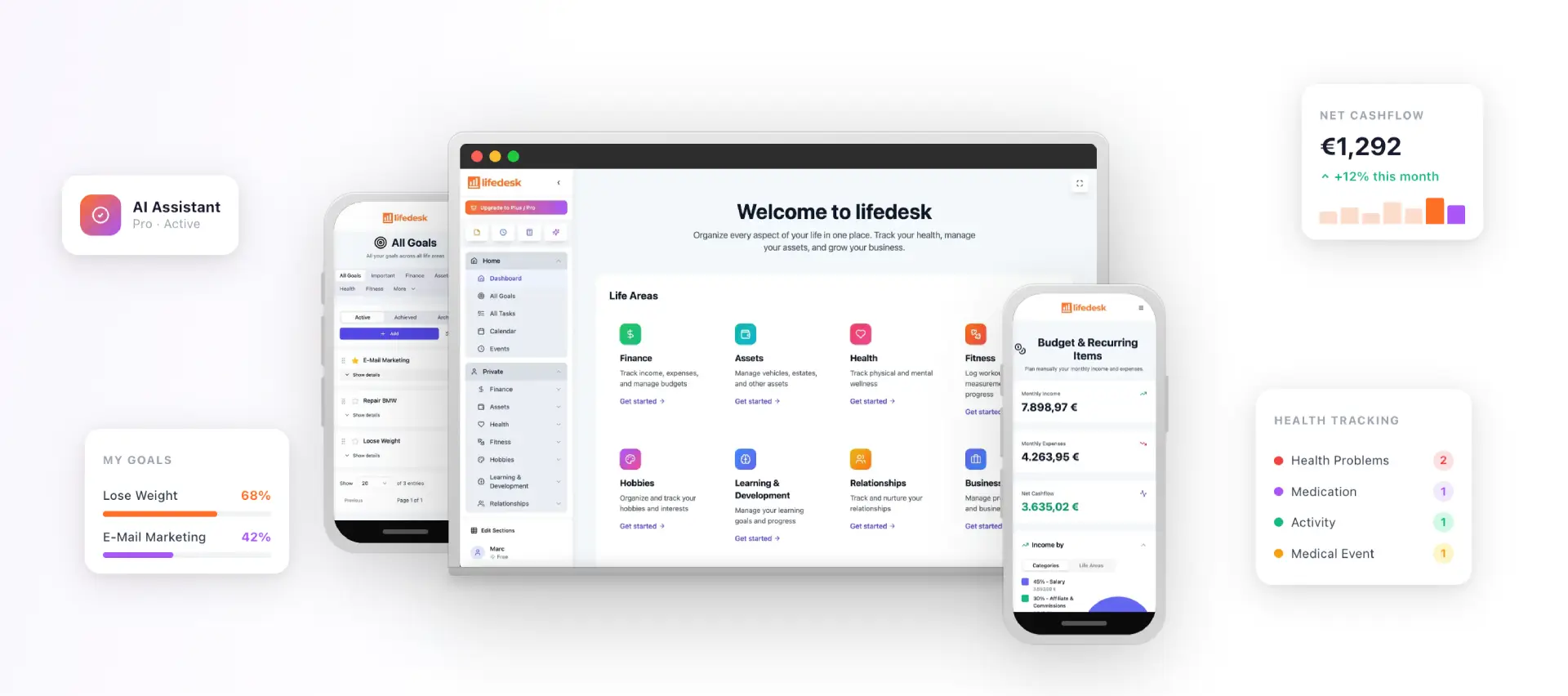
Putting These Strategies into One Place With LifeDesk
Running a 30 to 90 day experiment gets easier when your time blocks, weekly reviews, and habit tracking live in one spot instead of three different apps.
Build and defend time blocks directly on your LifeDesk calendar.
Run your weekly review using built-in task and goal views.
Track habits like a protected evening cutoff with simple daily check-ins.
Keep shared calendars and commitments synced so personal and work plans stop colliding.
Try running your next 30 day experiment inside LifeDesk’s pricing plans, starting with the free tier or stepping up to Plus at $9 per month for deeper tracking.
FAQ
What are effective strategies for balancing work and life?
The strategies with the most evidence behind them are protecting deep-work time blocks, setting fixed communication windows, and running a short weekly review to check what is working. Saying no with a clear script and scheduling time off in advance round out a practical starting set.
What is the 8/8/8 rule for work-life balance?
The 8/8/8 rule splits a day into equal parts for work, sleep, and personal time. It is a simple starting framework rather than a strict formula, and most people adjust the split based on their own job demands and life stage.
What are the five steps to achieve work-life balance?
A common five-step approach includes clarifying your values and priorities, setting specific boundaries around time and availability, designing your calendar around your most important work, reviewing progress weekly, and adjusting the plan as circumstances change. Treating it as a repeating cycle rather than a one-time fix makes it more sustainable.
How can we improve work-life balance at work?
Improving balance at work usually starts with negotiating flexible hours tied to outcomes rather than time logged, and pushing for at least one meeting-free block each week. Workplace culture and supervisor support strongly influence whether flexible policies actually get used, according to peer-reviewed research on policy effectiveness.