Design daily boundaries, protect deep work, and run weekly reviews: that combination does more for sustainable balance than any single trick. Expect steadier energy and less burnout drift once boundaries are in place, and you can start today by picking one boundary (a...
Use time blocking for sustained deep work on a single project, and use task batching to group shallow, repeatable tasks into one focused session. Both methods solve the same underlying problem, which is constant context switching, but they solve it differently, and...
Open a dedicated business bank account and route every bit of business income there, right from the start. Pair it with a business credit card and standalone bookkeeping, and pay yourself through documented draws or payroll instead of pulling cash whenever you need...
Plan 2026 by picking 3 to 5 annual priorities, writing an if-then plan for each using mental contrasting, converting every priority into tracked projects and milestones, and running quarterly plus weekly reviews inside one integrated planner. This approach keeps...
Digital minimalism for work means using only the tools and notifications that earn a place in your day, so attention goes to the tasks that matter. The single fastest move is to protect a scheduled focus block on your calendar and mute every nonessential notification...
Use a one-page marketing planner built around a single quarterly goal, monthly campaign boxes, and weekly 30 to 60 minute execution blocks. This structure gives you clarity on what to work on today and protects you from the burnout that comes with juggling ten...
The best approach depends on frequency and sensitivity: use a client portal for recurring or sensitive exchanges, secure email or password-protected transfers for occasional low-risk files, e-signature services for anything requiring a signature, and managed file...
Make a room-by-room, photo-backed inventory of everything you own, then store a copy somewhere other than your house. Start today: pick your most valuable room and film a slow walkthrough narrating what you see, then upload whatever list you already have to a cloud...
A weekly review is a short, scheduled ritual where you clear your inboxes, check your calendar, and pick your priorities before the new week starts. The simplest version takes 15 to 20 minutes: dump loose tasks into one list, scan the next seven days, and write down...
Project and client management work best as two linked systems, not one blurred job. Delivery lives on scope, schedule, and resourcing; the relationship lives on trust, expectations, and retention. Agencies that connect them, with a shared client record and a fixed...
Entrepreneur Habit Tracking: Protect 1–3 Founder Habits in 60 Seconds
Founders should track three things first: deep work hours, personal well-being basics like sleep and movement, and a weekly review. Start with one to three habits, log them in under 60 seconds each morning, and treat the data as a business input rather than a personal diary. Done this way, habit tracking stops being a wellness exercise and becomes a lever for more predictable output.
TL;DR:
Founders should focus on tracking deep work hours, sleep, movement, and weekly reviews using specific, low-ambiguity metrics for better business impact insights.
Limiting habit tracking to one to three habits is crucial to avoid burnout, with impact, feasibility, and context stability guiding selection.
A low-friction system combining quick daily logs, automation, and scheduled weekly audits enhances habit consistency, especially during disruptions like travel or crises.
Anchoring habits to stable triggers and defining crisis-minimum versions help ensure habits survive chaotic weeks or unexpected schedule changes.
Incorporating accountability via peer groups, public reporting, or financial consequences, along with regular review of habit data against business KPIs, drives meaningful action and strategic decisions.
LifeDesk
Keep Founder Habits In One Place
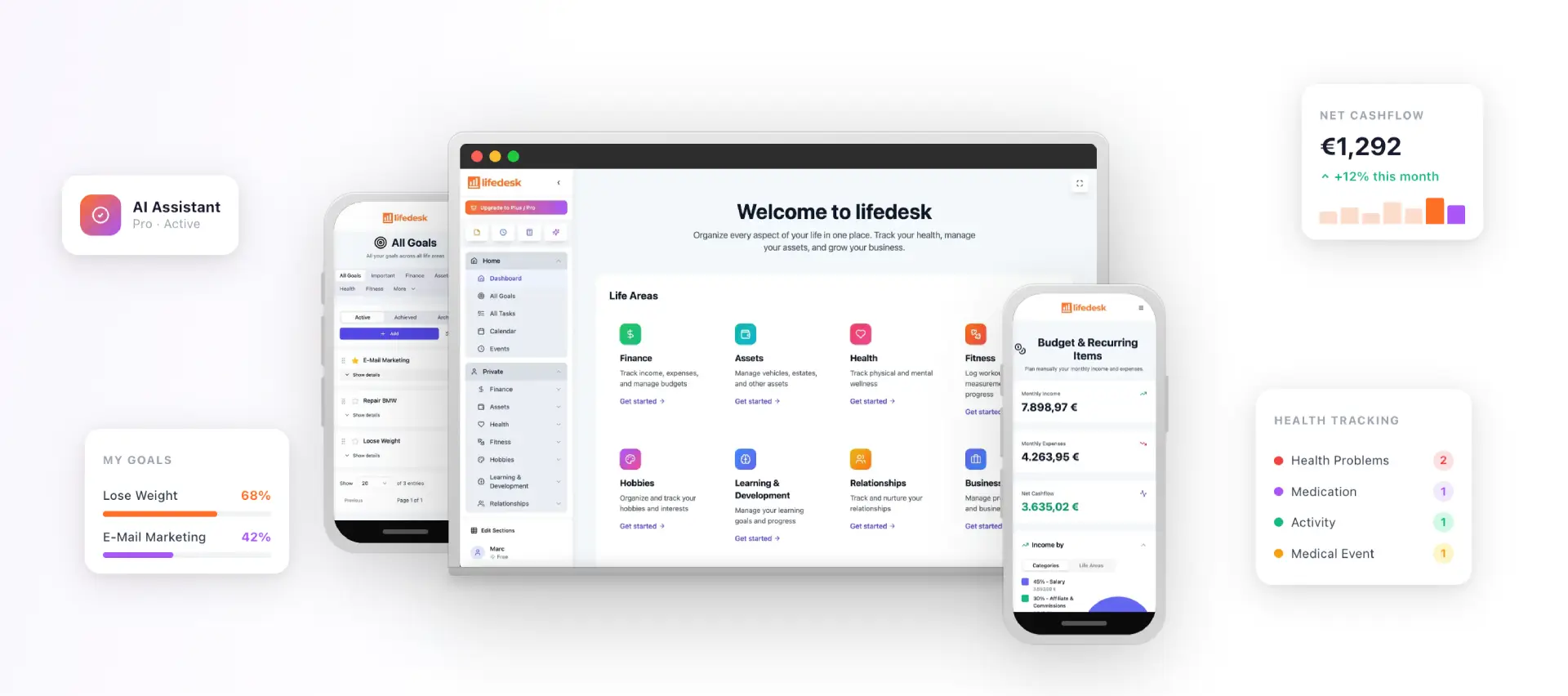
LifeDesk brings tasks, goals, calendars, health, fitness, and business organisation together for a clearer view of competing responsibilities.
What founders should track first: the foundational trio
Most habit advice treats sleep, exercise, and planning as separate from the business. For founders, they are the business. Cognitive capacity is the actual constraint on a startup’s output, and three categories protect it directly: deep work, personal well-being, and a weekly review.
Deep work is the uninterrupted stretch where real building happens: product decisions, writing, coding, strategy. Personal well-being covers the physical inputs that determine whether that deep work is even possible: sleep duration, movement, and recovery. The weekly review is the feedback loop that catches drift before it becomes a crisis, forcing a founder to look at the week’s actual numbers instead of the week’s felt busyness.
Each element works best when tracked with a specific, low-ambiguity metric rather than a vague intention:
Deep work: hours logged in a single uninterrupted block, not total hours at a desk.
Sleep: hours per night, tracked against a fixed target rather than a vague “enough.”
Movement: minutes of intentional activity, separate from incidental walking.
Weekly review: a binary, done or not done, with no partial credit.
The payoff shows up when these personal metrics get correlated with business outcomes. A founder who logs four hours of deep work on a given day often closes more customer calls that week; one who sleeps under six hours tends to push fewer decisions through without a redo. Treating these as linked data points, not isolated virtue metrics, is what turns habit tracking into an operational tool instead of a journaling hobby.
How to choose and prioritize habits: pick 1 to 3 and build sequentially
The single biggest predictor of habit failure for founders is simply tracking too many things at once. Limiting active habits to one to three is not a motivational platitude. It is a bandwidth constraint: every additional habit competes for the same morning attention and the same willpower that a startup already consumes in large, unpredictable chunks.
A simple heuristic helps decide which one to three habits earn a slot: impact times feasibility times context stability. A habit with high business impact but low feasibility during a fundraising sprint will fail regardless of intent, while a low-impact habit anchored to a rock-stable context (like brushing teeth) can run almost unattended.
Score each candidate habit on impact (does it move a business metric), feasibility (can it survive a bad week), and context stability (is the trigger reliable).
Pick the top one to three by combined score, not by what feels most virtuous.
Define a crisis version of each habit before you need it: a 10-minute deep work block instead of 90 minutes, a 5-minute walk instead of a gym session.
Protect the crisis version as the real minimum; missing the ideal version is not a broken streak if the crisis version happened.
Pacing also depends on the type of habit. Machine learning research on habit formation found that simple, high-frequency behaviors like handwashing can become automatic within weeks, while more complex, lower-frequency behaviors like a gym routine typically took several months to reach an automatic plateau. Set expectations accordingly: a daily journaling habit should feel easier within a month, but a complex weekly founder ritual may take a full quarter to stick.
Pro Tip:Define the crisis version of a habit on a good day, not a bad one. Decisions made under pressure tend to default to zero rather than to the minimum.
Designing a low-friction tracking system founders will use
A tracking system only works if it survives a bad week, and that means the logging itself has to take less time than making coffee. The structure that holds up under founder schedules has three parts: a morning check-in, a logging method matched to the habit type, and a weekly audit.
The morning check-in is a five to fifteen minute block, ideally done before email, where you set the day’s intention for each active habit and note anything that might derail it. The actual logging that follows, confirming a habit happened, should take 60 seconds or less. Anything longer gets skipped on the exact days it matters most.
Automate what you can measure passively: sleep, steps, and screen time sync from a device without you touching anything.
Log manually what requires judgment: whether a work block counted as “deep” work is a call only you can make in one tap.
Run the weekly audit on a fixed slot, ideally 15 to 30 minutes on Sunday, reviewing the week’s logs against the business outcomes you care about.
Block the audit on your calendar the same way you block a client call, so it does not quietly disappear during a busy week.
Automated tracking changes whether people stick with it at all. In an analysis of a workplace health program, participants who used automated, device-linked tracking stayed engaged for substantially longer than those logging manually, nearly double the duration. The gap is not about laziness. It is about friction compounding over time until it exceeds the habit’s perceived value.
A practical setup for founders looks like this: a one-tap mobile log for subjective habits, a calendar block for the habit itself and for the weekly audit, and a simple dashboard that shows the last four weeks side by side. Reviewing workflow and reminder design can also help here; see this breakdown of workflow automation for small business for ideas on reducing manual steps in daily operations.
Habit stacking and context cues: anchor routines to stable triggers
Habits stick fastest when they attach to something that already happens reliably, whether that is a time, a place, or a preceding action. This is called context stability, and it matters more than motivation for whether a habit survives past the first month.
A study on context and habit automaticity found that consistent context cues, meaning a stable time, place, and sequence of prior actions, significantly increased how automatic a behavior became and how often it led to actual goal attainment, compared to environments where the context kept shifting. For founders, whose days rarely look identical, this means choosing cues that survive chaos rather than ones that depend on a calm schedule.
Practical stacks that hold up:
After opening the calendar app, do a 15-minute daily plan. The calendar open is a trigger that happens every single day regardless of what else is going on.
After the first coffee, take a 20-minute walk or workout. Coffee is one of the few rituals that survives travel, back-to-back meetings, and crisis weeks.
After the last client call of the day, log the weekly review notes. Tying it to an event rather than a clock time means it still happens even when the schedule shifts by hours.
When context changes, such as travel or a new office, the old cue breaks and the habit often breaks with it. The fix is to consciously re-cue: pick a new trigger that exists in the new environment on day one, rather than waiting to “get back to normal.” A recent APA interview with habit researcher Wendy Wood makes the case that redesigning the environment to make a behavior easier, rather than relying on willpower to push through a disrupted context, is the more reliable lever for sustaining change.
Accountability systems that work for entrepreneurs
Founders lose habits for a specific, structural reason: every other obligation on a given day (a client emergency, an investor call, a hiring decision) is also legitimate, and there is no external enforcement forcing the habit to win that competition. This is the accountability split, and solving it means adding real consequences, not more willpower.
Three approaches tend to work well for founders specifically:
A small peer group of two to four other founders who report in weekly creates light social pressure without the overhead of a formal program.
Lightweight public reporting, such as posting a weekly habit summary somewhere visible, raises the cost of silently dropping the habit.
Financial commitment contracts, where money is forfeited on a missed target, work well for founders who respond more to loss aversion than to encouragement.
Pick based on personality and schedule: a founder who already has a tight peer network should use it before paying for a formal contract; a founder who travels constantly may find public reporting easier to sustain than a fixed weekly call. Whichever method you pick, pair it with the automated logging from your tracking system so the accountability check pulls real data instead of a self-reported summary. Progress-monitoring research found that increasing monitoring frequency and physical recording meaningfully boosts goal attainment, and public or peer accountability is one of the simplest ways to raise that frequency without adding daily effort.
Measuring impact: completion, energy, and one business KPI
Tracking whether a habit happened is only half the system. The other half is knowing whether it is actually doing anything, and that requires a second and third layer of measurement beyond a simple checkmark.
Completion: a binary yes or no, logged daily, with no partial credit for an attempt.
Subjective energy or focus rating: a 1 to 10 score logged once a day, capturing how the habit felt rather than just whether it happened.
One correlated business KPI: a single metric the habit is supposed to influence, tracked on the same timeline.
The KPI should be specific to the habit, not a generic business number. Deep work hours might correlate with completed product tasks or billable output; morning movement might correlate with the number of sales calls completed without a midday slump; a weekly review habit might correlate with how often a planned priority actually gets finished by Friday. Logging deep work specifically as a measurable output, the way freelancers track billable hours, gives founders a cleaner signal than a vague sense of “being productive.”
Run this for three to five weeks before drawing conclusions. A single bad week is noise; a pattern across a month is signal. If a habit shows no correlation with its target KPI after five weeks, it may be the wrong habit, the wrong metric, or in need of a different version entirely, and the weekly audit is where that call gets made rather than abandoned mid-week on a gut feeling.
How an integrated platform simplifies founder habit tracking
The hardest part of habit tracking is not the habit. It is the number of different places a founder has to check to see the full picture: a fitness app, a separate notes app, a calendar, and a spreadsheet for business metrics. Every switch between them is a small tax on the 60-second logging window this whole system depends on.
An all-in-one platform collapses that switching cost by keeping tasks, goals, calendar, health data, and business projects in one place. Within LifeDesk, a founder can run the morning check-in described above directly against the day’s calendar, log a workout or sleep hours in the same session as reviewing a client task list, and use the built-in AI assistant to handle reminders so the habit trigger does not depend on memory alone.
Morning check-ins map to time-blocked planning directly inside the calendar view.
Health and fitness logging happens in the same app as business task tracking, so the “deep work versus sleep” correlation described earlier takes one screen instead of three.
Weekly dashboards pull completion data and business goals together for the Sunday audit without manual exporting.
The AI assistant can handle the recurring reminder and reduce the setup time for new habit stacks.
This matters less as a feature list and more as a removal of friction: the fewer apps a founder has to open to log a habit and check its business impact, the more likely the habit survives a bad week.
Why entrepreneur habits fail under competing obligations
Most founders do not abandon a habit because they stop believing in it. They abandon it because something else on the same day was also legitimate: a customer emergency, an investor update, a hire that needed finishing. Unlike a scheduled gym class with a cancellation fee, a personal habit rarely has any real cost attached to skipping it, so it loses the competition for attention almost every time a genuine conflict shows up.
This is the accountability split described earlier, and it explains why habit advice built for a stable 9-to-5 life often fails for founders specifically. A salaried employee’s calendar has fewer true emergencies competing for the same slot; a founder’s calendar generates new emergencies constantly, and each one feels more urgent than a sleep target or a planning review.
The fix is not more discipline. It is removing the habit from pure willpower by giving it either a stable trigger that survives chaos, as covered in the context cues section, or a real external consequence, as covered in the accountability section. A habit that depends entirely on a founder remembering and wanting to do it on a hard day will lose to the next fire almost every time, which is exactly why the crisis-minimum version matters: it gives the habit a version small enough to survive even the worst weeks.
Common pitfalls in entrepreneur habit tracking and how to avoid them
The most common mistake is starting with too many habits at once, usually five or more, which guarantees that at least one gets dropped within the first two weeks and often drags the others down with it. The fix is the one-to-three rule covered earlier: fewer habits tracked consistently beat more habits tracked sporadically.
A second pitfall is logging that takes too long. A tracking system that requires three minutes of typing per habit will get skipped on exactly the days it is needed most, which are the busy ones. Keep logging at 60 seconds or under, and automate anything that can sync from a device instead of requiring manual entry.
A third pitfall is treating a missed day as a failed system rather than expected variance. Founders often quit entirely after breaking a streak, when the better response is checking whether the crisis-minimum version was used. If it was not defined in advance, that is the gap to fix, not the habit itself.
A fourth pitfall is tracking without ever reviewing. Data collected but never looked at in a weekly audit provides no decision value. The habit log only earns its keep once it gets compared against the business KPI it was meant to influence, on a fixed weekly schedule rather than whenever time happens to allow it.
Incorporating mental health and stress management into habit tracking
Stress and mental load are not separate from the habit system. They are often the reason a habit gets dropped in the first place, which means they deserve their own line in the tracking routine rather than being left implicit. A simple subjective energy or stress rating, logged alongside habit completion, catches a pattern that pure completion tracking misses entirely: a founder can complete every habit on the list while running on fumes, and the tracker would show a perfect week.
Adding a 1 to 10 stress or energy score to the daily log, the same rating described in the measurement section, gives a founder an early warning signal before burnout forces a complete stop. A string of low scores alongside completed habits is a sign the habits themselves may need a crisis version even without an external emergency forcing it.
Mental health tracking also benefits from the same low-friction principles as any other habit: a single daily number takes less time to log than a journal entry, and it is more likely to be logged consistently as a result. For founders who want a more structured view, pairing stress ratings with a dedicated health tracking setup keeps the data in the same place as sleep and movement, making it easier to see when physical and mental signals are moving together.
Examples of successful entrepreneur habit tracking routines
A simple routine that holds up across busy founder weeks looks like this: a 10-minute morning check-in that sets the day’s single deep-work block, a one-tap log for sleep hours synced automatically from a wearable, and a 20-minute Sunday review comparing the week’s completed deep-work hours against client output.
Another version anchors around movement instead of deep work: a 20-minute walk immediately after the first coffee, logged with a single tap, paired with a weekly peer check-in where the founder reports completion to two other founders in a shared message thread. The habit itself is simple, but the peer reporting is what keeps it from quietly disappearing during a launch week.
A third version is built around the weekly review as the anchor habit rather than a daily one: a fixed Sunday block that covers both the personal habit log and a quarterly goal check, structured similarly to a one-page quarterly plan with three to five goals. This version suits founders who find daily logging too rigid but still want a consistent weekly discipline tying personal habits to business direction.
What these routines share is not the specific habit but the structure: a stable trigger, a sub-60-second log, and a review cadence that is actually scheduled rather than left to chance.
Reviewing and adapting habit tracking goals over time
A habit tracking system built in week one should not look the same by month three. What starts as a deep-work and sleep tracker often needs to shift once the initial habits become automatic and stop requiring active attention, freeing up bandwidth for a new target.
The weekly audit is where small adjustments happen: dropping a metric that shows no correlation with a business outcome, or tightening a target that has become too easy. The quarterly review is where bigger changes belong, such as swapping an entire habit category once a founder’s business phase shifts, for example moving from a product-building phase focused on deep work to a growth phase where client calls and outreach habits matter more.
Goals that were set under one set of pressures, such as a pre-launch sprint, rarely fit the next phase without adjustment. Revisiting the impact times feasibility times context stability heuristic from earlier at each quarterly review keeps the habit list matched to what the business actually needs right now, rather than what it needed when the tracker was first set up. A habit that has become fully automatic and no longer needs active logging can graduate off the list entirely, making room for the next priority.
Using habit tracking data to drive strategic business decisions
Once a few weeks of habit and KPI data have accumulated, the data itself becomes a decision tool, not just a personal record. A founder who notices that weeks with four or more hours of logged deep work consistently produce more completed product milestones has a reason to protect those hours more aggressively, even if it means pushing back a meeting.
The same logic applies in the other direction. If energy scores are consistently low on weeks following a skipped movement habit, that is a business-relevant signal, not just a personal one: it suggests decision quality on those weeks may be compromised, which is a real operational risk for a founder making calls that affect the whole company.
This is where the earlier KPI correlation work pays off directly. Instead of guessing whether a personal routine matters, a founder with three to five weeks of consistent logs can look at the actual relationship between a habit and an output metric like completed tasks, closed calls, or billable hours, similar to the comparison described in guides to billable hour tracking for freelancers. That turns a wellness habit into a defensible business input, worth protecting the same way a founder protects a key client relationship or a product deadline.
How to handle disruptions: travel, office changes, and crisis modes
Every founder hits weeks where the normal routine is impossible: a fundraising sprint, a product launch, a week of travel, or a move to a new office. The instinct is often to drop tracking entirely during these periods, which is exactly backward, since these are the weeks where the crisis-minimum versions defined earlier matter most.
When travel disrupts the usual context cues, the fastest fix is deliberate re-cueing rather than waiting for the trip to end: pick a new trigger that exists in the travel environment, such as hotel coffee replacing the usual home coffee cue for a movement habit. The same applies to an office change. The old anchor (a specific desk, a specific coworking space) is gone, so the habit needs a new one on day one in the new location, not after a few weeks of drift.
During true crisis periods, such as closing a funding round, the goal shifts from maintaining the ideal habit to protecting the crisis-minimum version only. A 90-minute deep-work block becomes 20 minutes; a 45-minute workout becomes a 5-minute walk. The point of defining these minimums in advance, as covered in the prioritization section, is that the decision does not have to be made under pressure. The habit survives in a smaller form, and the streak, and the identity behind it, survives with it.
Try LifeDesk for founder habit tracking: a 7-day experiment
We built an all-in-one platform to cut the number of apps a founder needs open just to run the system described in this guide. Instead of a separate fitness tracker, a separate notes app, and a separate project tool, we keep tasks, goals, calendar, health, finances, and an AI assistant in one place, so the morning check-in and the weekly audit both happen without switching screens.
A short experiment is the easiest way to see whether this structure fits your week:
Day 1: pick one to three habits using the impact, feasibility, and context stability heuristic.
Day 1: set a morning check-in block on the calendar and define each habit’s crisis-minimum version.
Day 2: connect health and fitness syncing so sleep and movement log automatically.
Day 7: run the first weekly review and compare completion against one business KPI.
Day
Action
1
Choose habits, set check-in block, define crisis versions
2
Enable health sync for automatic logging
3 to 5
Log daily in under 60 seconds
7
Run the weekly review and check KPI correlation
We offer a Free plan, a Plus plan, and a Pro plan, each unlocking more of the tracking, finance, and AI features used above. Start the seven-day version with our current pricing plans and see whether a week of consistent, low-friction logging changes what your Sunday review actually shows.
FAQ
What is the 3-3-3 rule for habits?
The 3-3-3 rule is a popular shorthand for spending three minutes on a small task, dedicating three hours to a priority, and reviewing three key goals, though definitions vary across sources. For founders, the useful version is the article’s own one-to-three habit limit: track a small number of things well rather than a long list poorly.
What are the 7 habits of successful entrepreneurs?
There is no single, universally agreed list of seven founder habits, and different sources name different traits. The habits with the strongest support in this guide are protecting deep work time, tracking personal well-being basics like sleep and movement, running a consistent weekly review, and building real accountability rather than relying on willpower alone.
What are the 5 C’s of an entrepreneur?
The “5 C’s” framework also varies by source, with no single authoritative definition in the research used for this article. Rather than relying on an unverified acronym, founders are better served focusing on the concrete, measurable habits covered here: deep work, well-being, and weekly review, each tied to a real business metric.
What is the 21-90 habit rule?
The popular claim that a habit forms in 21 days and becomes permanent after 90 is contradicted by research analyzing millions of real-world habit observations which found formation speed varies widely by behavior, with simple habits forming in weeks and complex habits like exercise often taking months. Founders should expect timelines to differ by habit type rather than relying on a fixed number of days.
How do I track habits effectively as a founder?
Track a maximum of one to three habits at a time, log completion in under 60 seconds each morning, and pair that with a weekly review comparing habit completion against one business KPI. Progress-monitoring research supports combining frequent, low-effort monitoring with some form of accountability to sustain the habit past the first few weeks.