Project and client management work best as two linked systems, not one blurred job. Delivery lives on scope, schedule, and resourcing; the relationship lives on trust, expectations, and retention. Agencies that connect them, with a shared client record and a fixed...
Calendar task integration turns your to-do list into scheduled, time-bound calendar blocks so work actually gets done instead of piling up unseen. The fastest path is either a native tasks layer inside your calendar app or an OAuth-based connector syncing a separate...
Most people don’t need one framework. They need three, stacked by time horizon: a long-range direction setter like a BHAG or OGSM, a quarterly execution engine like OKRs, and SMART criteria to keep the resulting key results honest and measurable. Skip the strategic...
The PARA method sorts every file, note, and task you own into four folders (Projects, Areas, Resources, Archives) based on how soon you need to act on it. The main payoff is speed: you stop hunting through nested folders and start finding what you need in seconds,...
The best prioritization frameworks for anyone juggling client work, personal goals, and everything in between are the Eisenhower Matrix, the Pareto principle (80/20), the 1-3-5 Rule, time blocking, and a weekly review. Pick one today: schedule a 90-minute protected...
The fastest way to turn emails into tasks is to use your inbox’s built-in conversion feature (Outlook’s drag-to-Tasks or Gmail’s Tasks panel) for one-off items, and automation rules for anything that repeats. Manual capture works fine at low volume; once the same type...
A hobby project planner is a tool, template, or notebook system that helps you capture ideas and, more importantly, always know your single next physical action. Right now, pick one tool, however basic, and write down the very next step for your current project....
AI agents reclaim your schedule by auto-scheduling tasks, defending focus blocks, and resolving conflicts before you even notice them, but only when you keep human-in-the-loop controls turned on. The strongest results come from task-first tools that unify your to-do...
AI goal planning converts a single sentence of intent, like “I want to get fit” or “I want a promotion,” into a measurable SMART goal with milestones, weekly tasks, and deadlines already attached. Within minutes, you get a concrete plan for the next seven days plus...
Calendar finance integration works best when you match the method to the job: native iCal feeds or a calendar-first finance app for visibility, middleware like Zapier or IFTTT for quick pilots, and API plus webhooks for anything running in production. Most finance...
Quarterly Planning for Busy Teams: One Page 90 Day Plan with 3–5 Goals
Quarterly planning means running your business goals on a 90-day cycle instead of a single annual push, reviewing progress and adjusting course every quarter. The practical version that works best: pick a few measurable priorities, assign a clear owner to each, set leading KPIs you can check weekly, and run a short review every week, a deeper one every month, and a full retrospective at quarter close. The rest of this guide covers the exact templates, meeting agendas, and cadence you need to run it yourself.
TL;DR:
Keeping the list of priorities to three to five ensures teams focus on the most impactful objectives, avoiding diluted efforts and prioritization conflicts.
Clear ownership with one accountable individual per goal and explicit success definitions help prevent goals from becoming vague or unmanageable.
Tracking both leading indicators, which predict outcomes, and lagging indicators, which measure results, enhances the ability to adapt tactics early and measure true success.
Regular review cadences, including weekly updates and a quarter-end retrospective, are essential to maintain momentum and adjust strategies before drift occurs.
Using a single, integrated planning tool that consolidates goals, KPIs, ownership, and calendar events reduces clutter and increases the likelihood of maintaining discipline in execution.
LifeDesk
Bring Quarterly Priorities Into One Place
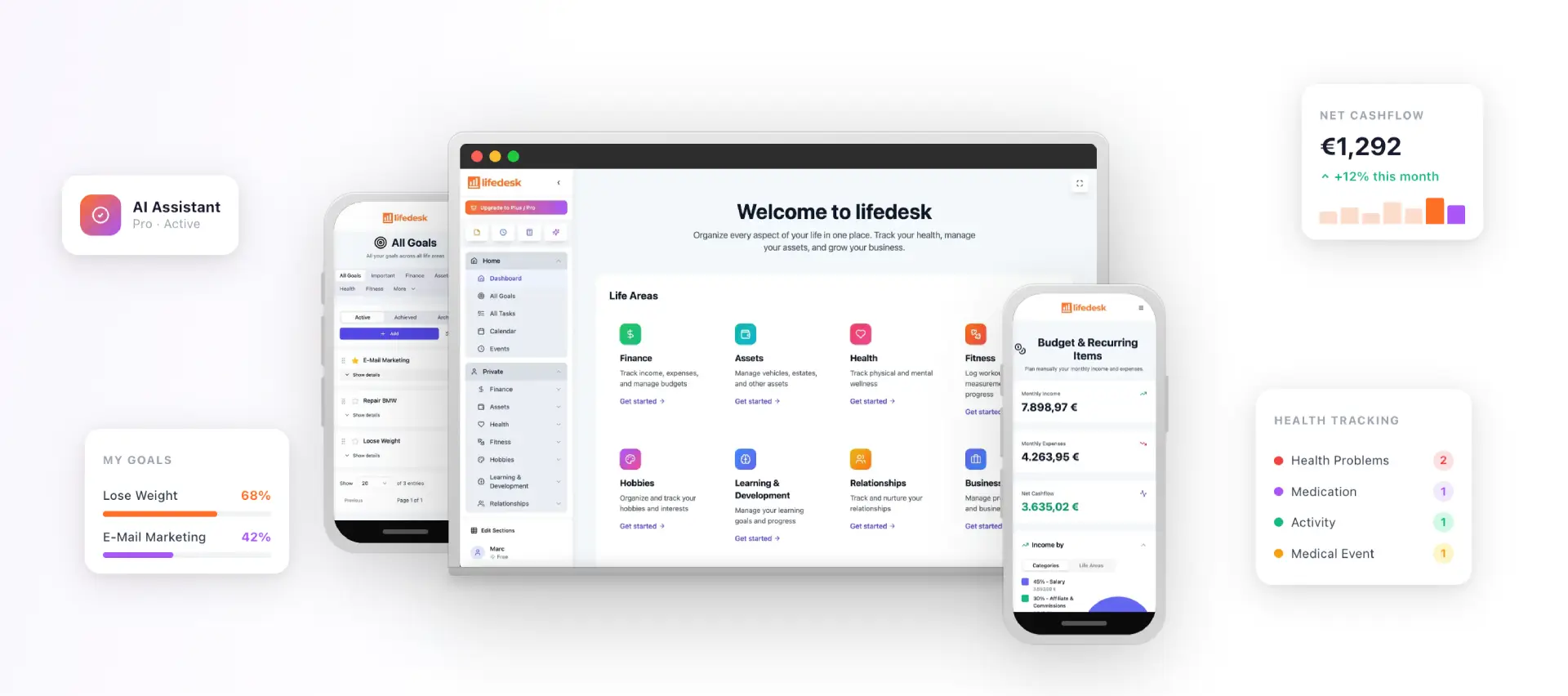
LifeDesk brings goals, tasks, calendars, and business organisation together, helping busy professionals structure priorities and track progress centrally.
What Is Quarterly Planning and Why It Beats Annual-Only Goals
Quarterly planning is a management rhythm where a team sets goals for a 90-day window, executes against them, and formally revisits both the goals and the plan at the end of that window. Think of it as a checkpoint system built into the calendar rather than a once-a-year guess about what matters.
Annual plans go stale fast. A goal set in January can look irrelevant by June once budgets shift, a competitor moves, or a big client churns. Quarterly cycles force a reset every 90 days, so the plan stays tied to what’s actually happening rather than what someone predicted a year earlier.
The real advantages show up in three places:
Faster feedback loops. You find out in weeks, not months, whether a priority is working.
Sharper focus. A 90-day window is short enough that “everything is a priority” stops being an option.
Better resource allocation. You reassign people and budget every quarter instead of locking them in for twelve months.
This isn’t the only rhythm available. The 12 week year model compresses execution into 12 weeks and treats each cycle like a mini year, which some teams prefer for its urgency. Quarterly planning covers roughly the same ground but aligns more naturally with fiscal reporting, which is why most businesses default to it.
What Belongs in Every Quarterly Plan
A quarterly plan is only as good as the fields it forces you to fill in. Skip one of these and you get a wish list, not a plan.
Goals, not activities. Write 3 to 5 outcome statements (“grow trial signups by 20%,” not “run more ads”), then map each one to the specific initiatives that will move it, using expert advice on how to measure hiring efficiency enterprise metrics.
Timelines and milestones. Break the 90 days into monthly checkpoints with rough dates, and flag any dependency that could stall a milestone before it happens.
Ownership fields. Every goal needs one accountable owner and a list of supporters. Shared ownership with no single name attached is how goals quietly die.
Effort estimates. Attach a rough time or story-point estimate to each initiative and check it against actual team capacity. If the math doesn’t work, cut scope now, not in week 6.
Definition of success. Write the acceptance criteria in plain language before the quarter starts, so nobody argues about whether a goal was “kind of” hit.
Fields like this are exactly what turns a vague ambition into something a team can execute against. Slack’s quarterly planning template centralizes goals, timelines, ownership, and success criteria in one document for this reason, and Atlassian’s framework adds explicit fields for effort estimates and dependencies so teams commit to something realistic instead of aspirational.
Pro Tip:Write the “definition of success” line before you write the initiatives. If you can’t describe what winning looks like in one sentence, the goal is still too vague to plan around.
How to Run a Quarterly Planning Session
A planning session is where the one-page plan actually gets built, and the prep matters more than the meeting itself.
Before anyone sits down, gather:
Last quarter’s KPI data and a short list of wins and misses
Current team capacity (who’s out, who’s overloaded, who’s free)
Any known dependencies on other teams or vendors
Invite the people who will own the work, not just leadership. That usually means the function heads who’ll be accountable for each priority, one or two individual contributors who’ll catch unrealistic scope early, and whoever owns the budget. Skip this and you end up with a plan the team never bought into.
Timing depends on team size:
Small teams (under 10 people): a half-day session covers review, prioritization, and drafting the one-page plan.
Larger or cross-functional orgs: block a full day, or split it into two half-days a week apart so teams can align internally between sessions.
Schedule the session in the last two weeks of the current quarter, so the new plan is live on day one of the next. Add a 30-minute mid-quarter check-in at the six-week mark to catch drift early. The session should end with a finalized one-page plan, every goal assigned an owner, and a shared document everyone can access, not a set of notes someone promises to write up later.
How to Pick the Right 3 to 5 Priorities and Metrics
More priorities usually means none of them get real attention. Keep the list small to ensure focus.
The fastest way to narrow the list is the bottleneck rule: find the single constraint limiting growth right now, and rank priorities by how directly they remove it. A sales team bottlenecked on lead volume shouldn’t spend a quarter polishing onboarding, no matter how good that project looks on paper.
Once priorities are set, split metrics into two types:
Leading indicators predict outcomes and move weekly, like outbound calls made or demos booked.
Lagging indicators confirm results after the fact, like closed revenue or churn rate.
Track both, but review leading indicators more often since they give you time to react. It also helps to attach a quality metric alongside a volume metric for each KPI, so a team isn’t rewarded for hitting a number with weak results. Catalyst’s 90-day planning framework recommends pairing conversion or effectiveness metrics with raw output for exactly this reason.
From there, cascade each priority into 3 to 5 monthly milestones, then break those into weekly actions your team can actually check off. A prioritization framework can help if the team keeps disagreeing on what makes the cut.
Pro Tip:If two priorities are tied for the fifth slot, ask which one your team could execute even with half the resources. That’s usually the real answer.
Running the Weekly, Monthly, and Quarter-Close Review Loop
A quarterly plan without a review cadence is just a document nobody looks at again. The fix is a three-loop rhythm, each with a different job and a different length.
Cadence
Length
Core question
Weekly
15 to 30 minutes
Are we on track or off track this week?
Monthly
45 to 60 minutes
Are KPI trends moving in the right direction, and do we need a tactical pivot?
Quarter-close
2 to 3 hours
What worked, what didn’t, and what are next quarter’s priorities?
Weekly reviews should score each priority with a simple on-track or off-track flag rather than a long status report. Monthly checks are where you look at KPI trends and decide whether a tactic needs to change, not the goal itself. Quarter-close is the only meeting long enough to document real learnings and set up the next 90-day cycle properly, a structure Catalyst’s guide lays out as the backbone of a working 90-day plan.
Put all three on a shared calendar as recurring blocks, and keep a one-page dashboard that anyone can scan in under a minute. A 20-minute weekly planning ritual is usually enough to keep the weekly loop from becoming another meeting nobody wants to attend.
Templates and Tools for Running a Quarterly Plan
A one-page quarter plan should fit on a single screen: 3 to 5 goals, the owner for each, the key initiatives, monthly milestones, leading and lagging KPIs, and the definition of success. If a plan needs a second page, it usually has too many priorities.
Different teams need slightly different versions. A small team might combine everything into one shared page. Product teams often add a dependency column for engineering handoffs. Cross-functional plans need an extra field for which department owns which milestone, since that’s where handoffs typically break down.
Whichever version you use, a good tool checklist covers three things:
One single source of truth everyone checks, instead of a plan buried in someone’s inbox
Calendar integration so weekly and monthly reviews show up automatically
A place to log check-ins without opening a separate app every time
Reforge’s planning examples show that short, readable documents speed up decisions and cut down on wasted meetings compared to sprawling roadmap decks. LifeDesk’s tasks and goals app is built around that same idea: goals, projects, and calendar live in one place, so a one-page plan doesn’t have to compete with five other tools for attention.
Common Quarterly Planning Mistakes and How to Fix Them
Most quarterly plans fail in the same handful of ways, and each one has a fast fix.
Too many priorities. If the list is past five, cut it. Enforce the 3 to 5 rule even when everything feels urgent.
Listing activities instead of outcomes. “Launch a new landing page” isn’t a goal. Reframe it as the outcome it’s supposed to produce, like a signup increase.
Weak or shared ownership. Assign one name per goal and make it visible to the whole team, not just the owner.
No capacity check. Run a quick effort estimate against actual team hours before locking the plan, and trim scope if the math doesn’t fit.
Skipped reviews. A missed weekly check-in almost always leads to a missed quarter. Put reviews on a recurring calendar block instead of relying on memory.
How LifeDesk Helps You Run Quarterly Planning
A suitable app can give you one place to build the one-page plan, assign owners, and actually run the weekly rhythm instead of scattering it across a spreadsheet, a calendar app, and a separate notes tool.
The core problem with most quarterly planning falls apart in week three, when the plan lives in one app, the calendar lives in another, and nobody remembers to check either. LifeDesk combines goals and business tasks, project tracking, and your calendar in one workspace, so a priority you set in January shows up automatically in your weekly review in February without extra setup. You can attach an owner to each goal, track leading KPIs alongside the initiatives feeding them, and run the weekly check-in as a built-in routine instead of a recurring meeting invite everyone dreads.
If you’re setting up your next 90-day cycle, start by building your one-page plan inside the LifeDesk life management system and see how goals, projects, and your weekly schedule stay connected in one screen instead of three.
Templates and Guides Worth Bookmarking
For deeper reading beyond this guide: Atlassian’s quarterly planning guide covers templates in detail, Reforge’s planning examples show real documents from operators, Slack’s quarterly template is ready to copy, and Catalyst’s 90-day plan guide breaks down the review cadence step by step.
A quarter is always 3 months. A calendar year has four quarters of 3 months each, which is why quarterly planning runs on a 90-day cycle.
What are some good quarterly goals?
Good quarterly goals are outcome-focused and measurable, like increasing qualified leads by a set percentage, launching a specific feature, or cutting customer churn by a defined amount, rather than vague activity lists.
How do you make a quarterly plan?
Pick 3 to 5 priorities using the bottleneck rule, assign an owner and a leading KPI to each, break them into monthly milestones and weekly actions, and document everything in a one-page plan like the templates from Slack or Atlassian.
How do you divide the year into quarters?
Most businesses split the calendar year into Q1 (January through March), Q2 (April through June), Q3 (July through September), and Q4 (October through December), though some companies use a fiscal year that starts in a different month.
How often should you review a quarterly plan?
Run a short 15 to 30 minute review every week, a deeper 45 to 60 minute check monthly, and a full 2 to 3 hour retrospective at quarter close to set up the next cycle.